


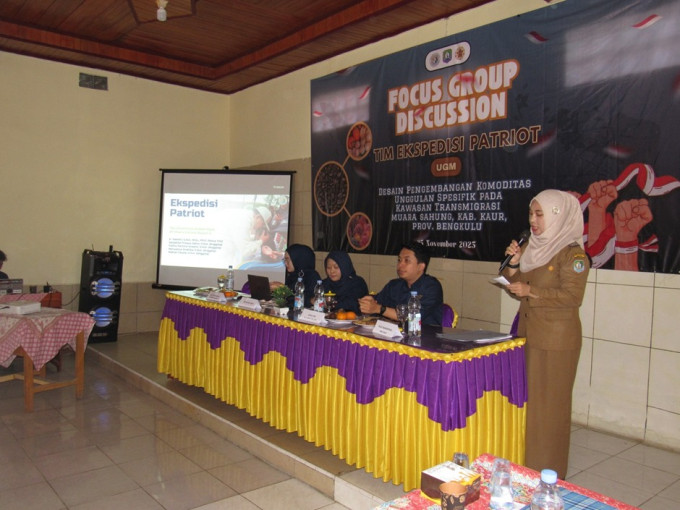
The Universitas Gadjah Mada Patriot Expedition Team (TEP UGM) conducted a study on the potential of plantation commodities and local food sources for development in the Muara Sahung Transmigration Area, Kaur Regency, Bengkulu. The study, the result of a collaboration between UGM and the Ministry of Transmigration of the Republic of Indonesia, identified several agricultural and livestock commodities whose productivity can be enhanced to improve the economic income of transmigrant communities.
The findings were presented by the TEP UGM team led by Dr. Sawitri, with team members Marsetya Andhika, Fadila Rachma Susanti, Raihan Fauzie, and Salsabila Firdaus Zahro.
Dr. Sawitri explained that the team had just completed an initial assessment and field data collection, including interviews with local communities and stakeholders and field surveys at various locations.
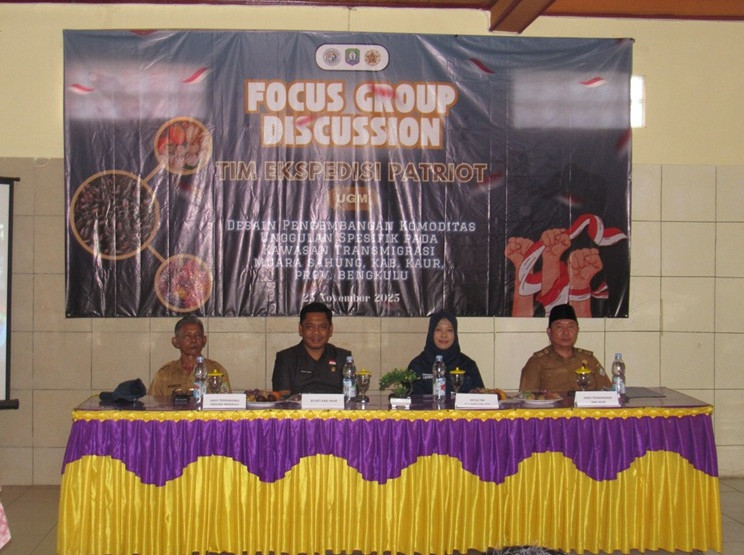
To validate the analytical results on existing conditions and the potential of leading commodities, the team held a Focus Group Discussion (FGD) on November 25 in Kaur City.
The event was attended by stakeholders, including regional government organizations from the Bengkulu Provincial Government and Kaur Regency, district heads and village heads in Muara Sahung, farmer groups, and local media.
In his opening remarks, the Assistant for Government and Public Welfare Affairs of Kaur Regency, Dr. Nasrur Rahman, emphasized the importance of active participation from all FGD participants to provide objective and constructive input on the analysis conducted by TEP UGM.
The Chair of TEP UGM, Daris Fahmaa Sutata, presented the potential of proposed innovations in agricultural and livestock land management (agroforestry) through the Strategic Improvement Framework (Strategi Jangka Benah/SJB).
According to him, this approach is highly relevant for Muara Sahung, particularly in strengthening farmer institutions.
“At the same time, it integrates coffee, areca nut, and oil palm into a more productive and sustainable landscape design,” Sutata added in a statement released on Tuesday (Dec. 9).
In addition, Dr. Dwi Laraswati highlighted the dynamics and shifts in global market orientation toward land-based commodities, stressing that opportunities for developing plantation commodities are strongly influenced by sustainability standards.
Therefore, strategies in this area need to be adjusted to remain competitive in regional and international markets.
During the FGD, Dr. Sawitri noted that participants provided various inputs and proposals to strengthen farmers’ capacity, as well as infrastructure, facilities, and post-harvest processing.
Discussions also covered the potential development of integrated land management combining trees, grasslands, and livestock (silvopasture).
In addition, participants raised the issue of coffee commodities often being marketed under the names of other regions, resulting in lost product value for Kaur Regency.
“Overall, this activity aligns analytical findings with field experience. TEP UGM hopes that this forum will strengthen the integration of data, policy, and community needs, so that area development can proceed in a more targeted, inclusive, and sustainable manner,” she concluded.
Author: Hanifah
Editor: Gusti Grehenson
Post-editor: Rajendra Arya
Photographs: TEP UGM