


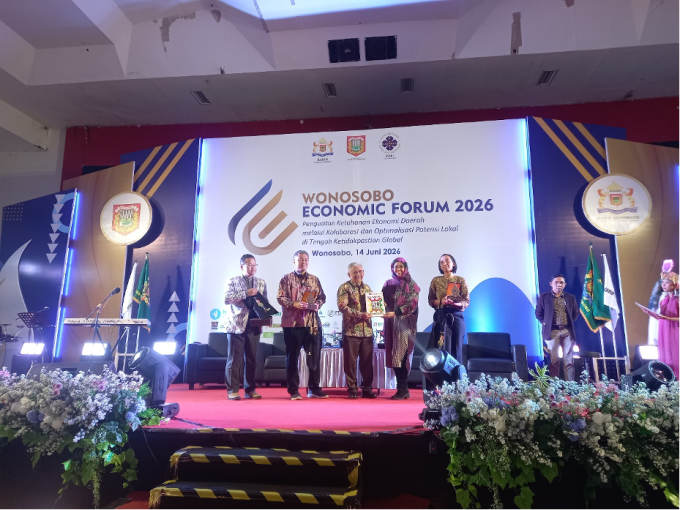
Universitas Gadjah Mada (UGM) is promoting stronger regional economic resilience by developing the Global Gotong Royong (G2R) Tetrapreneur, introduced at the Wonosobo Economic Forum 2026 on June 14. The forum brought together representatives from government, academia, businesses, professional organizations, and micro, small, and medium enterprises (MSMEs) to formulate development strategies based on local potential.
Through this initiative, UGM offered a collaborative approach that connects stakeholders within a single community empowerment ecosystem. Various strategic issues were discussed, ranging from strengthening MSMEs and enhancing the competitiveness of local products to advancing sustainable economic development. The forum is expected to generate recommendations that support more inclusive and sustainable regional economic growth.
Representing the Regent of Wonosobo, Regional Secretary of Wonosobo Regency, One Andang Wardoyo, stated that regional economic development requires close collaboration among government, businesses, academics, and communities. According to him, Wonosobo has significant potential in agriculture, tourism, and MSMEs that must be further strengthened through innovation and capacity building.
He emphasized that forums such as this are important for bringing together ideas and experiences from various stakeholders. Beyond serving as a discussion platform, the forum is also expected to produce recommendations that can be implemented in practice.
“We hope this forum will generate concrete measures that can strengthen regional economic resilience while improving community welfare,” he said.
One of the forum’s keynote speakers was Dr. Rika Fatimah P.L., S.T., M.Sc., Ph.D., a lecturer at UGM’s Faculty of Economics and Business (FEB UGM) and the originator of the G2R Tetrapreneur concept. In her presentation, she explained that strengthening regional economies should focus not only on increasing production but also on reinforcing the ecosystem that supports sustainable business growth.
According to her, many MSMEs produce high-quality products yet still face challenges in business management and market development. Therefore, an approach is needed that connects various development actors within a mutually reinforcing ecosystem.
“What needs to be encouraged is not merely helping MSMEs move up the ladder, but enabling them to grow gradually and sustainably according to their capacities,” she said.
Rika further explained that G2R Tetrapreneur was developed as an empowerment model integrating four key elements: business chains, supply chains, human resource quality, and institutional support. This approach positions communities as the primary drivers of economic development by utilizing the unique potential of their respective regions.
Through this model, MSMEs do not operate independently but receive support from multiple stakeholders with distinct yet interconnected roles. She emphasized that successful economic development cannot be achieved through interventions from a single sector alone.
“When all elements within the ecosystem move together, economic resilience becomes stronger, and its benefits can be felt more broadly by society,” she explained.
During the forum, Rika also presented the Indonesian National Standard (SNI) for G2R Tetrapreneur as an instrument for strengthening community-based business development. The standard was designed to help entrepreneurs more systematically identify their business position and development needs.
Its implementation is expected to serve as a guide for local governments and MSME facilitators in designing more targeted development programs. In addition to improving business quality, this approach supports strengthening local economies rooted in mutual cooperation.
“The SNI G2R Tetrapreneur provides a clearer framework for carrying out MSME development systematically and sustainably,” she said.
Rika also highlighted opportunities to strengthen regional economies through strategic government programs involving local products. According to her, growing demand for food, services, and processed products presents opportunities for MSMEs to expand their markets.
However, these opportunities can only be fully utilized if business actors possess adequate production capacity, product quality, and governance systems. Therefore, improving entrepreneurial competencies must go hand in hand with expanding market access.
“Local economic potential will grow more rapidly when communities are able to seize opportunities and are supported by a healthy ecosystem,” she said.
Chair of the Wonosobo Chamber of Commerce and Industry (KADIN), Dwi Sukatman, stated that cross-sector collaboration is key to strengthening regional competitiveness. According to him, the business sector requires policy certainty and an ecosystem that encourages investment growth and business development.
He noted that forums such as the Wonosobo Economic Forum are important for bringing diverse interests together in a constructive dialogue. Synergy among government, academia, businesses, and communities is expected to accelerate the emergence of economic innovations.
“Regional economic progress can only be achieved when all stakeholders move together and strengthen one another according to their respective roles,” he said.
Meanwhile, Asri Sarawati, representing MSME Agradaya, shared her experience in developing spice-based products and community-processed goods to reach broader markets. She explained that the main challenges still faced by MSMEs include maintaining consistent product quality, meeting market standards, and expanding marketing access.
According to her, continuous mentoring is essential to help entrepreneurs adapt to evolving market demands. She also noted that collaboration with universities and government institutions has provided significant benefits for community business development.
“What we need most is continuous assistance so that MSMEs can continue to grow and develop stronger competitiveness,” she said.
The discussion session was highly interactive, featuring questions from young entrepreneurs, professional organizations, academics, and MSME representatives. Participants highlighted issues related to business development strategies, human resource capacity building, and market expansion opportunities for local MSMEs. Discussions also addressed the challenges of scaling businesses sustainably without losing their local identity and strengths.
Various insights generated during the forum served as valuable reflections in formulating more inclusive regional economic development strategies. Through the forum, stakeholders expressed hope for stronger collaboration to promote economic resilience and improve the welfare of the people of Wonosobo.
Author: Triya Andriyani
Post-Editor: Zabrina Kumara