


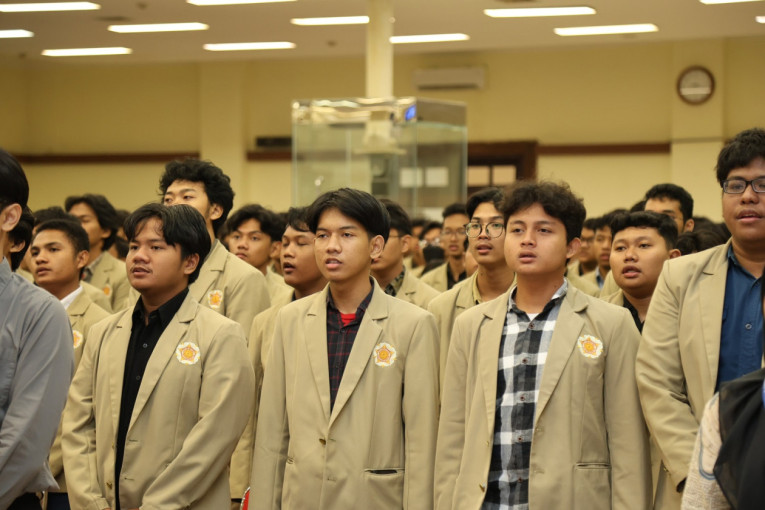
Universitas Gadjah Mada (UGM) has provided internal scholarship assistance to students from the 2025 cohort who come from underprivileged families and are experiencing difficulties in meeting tuition costs.
The assistance is also targeted at 503 new students from the 2025 intake who are classified as non-eligible KIP Kuliah recipients and have not received funding under the 2025 KIP Kuliah scheme due to quota limitations, and who require additional support to continue their studies effectively.
Through this policy, UGM reaffirms its commitment to safeguarding the continuity of students’ education by ensuring that economic constraints do not hinder those with strong academic potential and high learning motivation.
The Vice Rector for Student Affairs, Community Service, and Alumni, Dr. Arie Sujito, stated that as a manifestation of institutional responsibility and commitment to the principles of social justice, inclusivity, and educational sustainability, UGM has prepared a range of mitigation measures for non-eligible KIP Kuliah students who face difficulties paying tuition due to quota limitations.
These measures include using Rp1.5 billion in returns from UGM Endowment Fund investments to support the continuity of education for affected students, as well as allocating Rp1.1 billion from the 2025 IPI budget.
He explained that the implementation and technical arrangements for distributing this assistance are coordinated by the Directorate of Finance in collaboration with the Directorate of Student Affairs.
Nevertheless, he emphasized that UGM applies a careful, data-driven mitigation approach through internal university mechanisms.
“UGM seeks to ensure that students’ learning processes are not disrupted by financial constraints by providing assistance, temporary financial support, or addressing in advance the impacts of policies such as quota limitations or delays in KIP Kuliah disbursement,” he said at UGM on Friday (Jan. 23).
In addition to using the Endowment Fund, UGM will optimize other internal assistance schemes, including adjustments to the Single Tuition Fee (UKT), internal scholarships, and other forms of support tailored to students’ conditions.
Accordingly, funding mitigation efforts does not rely on a single source but is designed to be comprehensive and sustainable.
From the perspective of financial governance, UGM ensures that the utilization of the Endowment Fund is carried out in an accountable manner, in accordance with applicable mechanisms, and coordinated across units, as part of the university’s social responsibility.
UGM emphasizes that not all students who have yet to receive KIP Kuliah automatically receive the same replacement funding.
“Each student is handled individually based on data mapping and verification that includes socio-economic conditions, UKT status, financial capacity, as well as academic records and progress,” he explained.
Dr. Sujito noted that the 503 students facing economic constraints have essentially met the eligibility criteria as non-eligible KIP Kuliah recipients. However, due to limited quotas, they urgently require financial assistance to ensure the continuity of their studies.
“Therefore, UGM is responsible for ensuring that students can study comfortably by protecting them from policy burdens that have the potential to disrupt the learning process,” he stated.
He further reaffirmed that UGM continues to implement selection and verification mechanisms to ensure that assistance is well-targeted and equitable.
The evaluation process is conducted on an ongoing basis and coordinated with various stakeholders, including the government, to ensure that students’ rights are appropriately protected.
Through these measures, UGM is determined that no student will be left to face the risk of dropping out alone, and remains committed to sustaining education in line with the values of social justice and inclusivity.
Author: Agung Nugroho
Post-editor: Rajendra Arya