


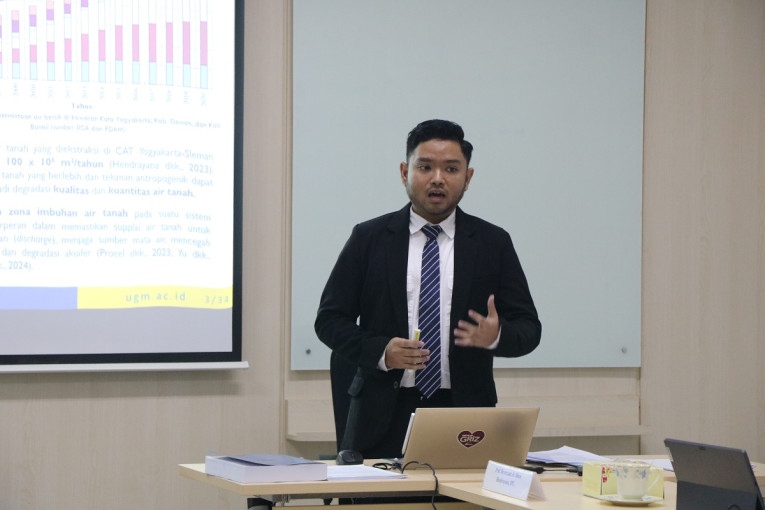
Groundwater in the Yogyakarta-Sleman Basin plays a crucial role in sustaining local communities. This resource not only serves household needs but also supports agriculture, tourism, and industrial activities. However, excessive extraction and rapid land-use changes have led to a significant increase in groundwater demand, resulting in a continuous decline in both its quantity and quality.
Research conducted by Muhammad Haikal Razi, a doctoral student in the Geological Engineering program at Universitas Gadjah Mada (UGM), revealed that massive development, land conversion, and climate change have significantly impacted groundwater quality.
The ongoing degradation poses a threat to water security for approximately 2.5 million people across Sleman Regency, Yogyakarta City, and Bantul Regency.
In his dissertation titled “Determining Groundwater Recharge Zones Based on Isotope and Hydrogeochemical Analysis in the Yogyakarta-Sleman Groundwater Basin, Indonesia,” Razi mapped groundwater recharge zones by integrating stable isotope analysis, hydrogeochemical methods, and subsurface geological interpretation.
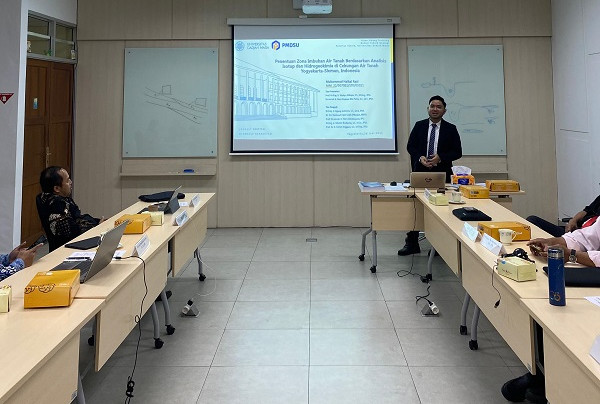
Razi explained that recharge zones are crucial areas where rainwater infiltrates the ground and replenishes underground aquifers.
His study found that the most effective recharge zones are located in the basin’s northern part, at elevations between 453 and 1,473 meters above sea level.
“In the Special Region of Yogyakarta, these include parts of Pakem, Turi, and Cangkringan subdistricts in Sleman Regency. These areas are dominated by porous young volcanic rocks and natural land cover, such as forests and open land,” he explained during his doctoral defense at the Department of Geological Engineering, Faculty of Engineering UGM (FT UGM), on Thursday, Jun. 26, 2025.
He emphasized that accurately identifying groundwater recharge zones is essential to determining which areas must be protected and where development should be restricted.
“Without this understanding, conservation efforts will be less effective and potentially in vain,” he said before the examination committee.
Based on his findings, Razi stressed that protecting groundwater recharge zones is an urgent necessity to prevent a clean water crisis.
In his view, groundwater conservation must be based on scientific data and integrated into spatial planning.
He asserted that protecting recharge zones is not only an environmental issue but also a critical investment in ensuring public access to clean water.
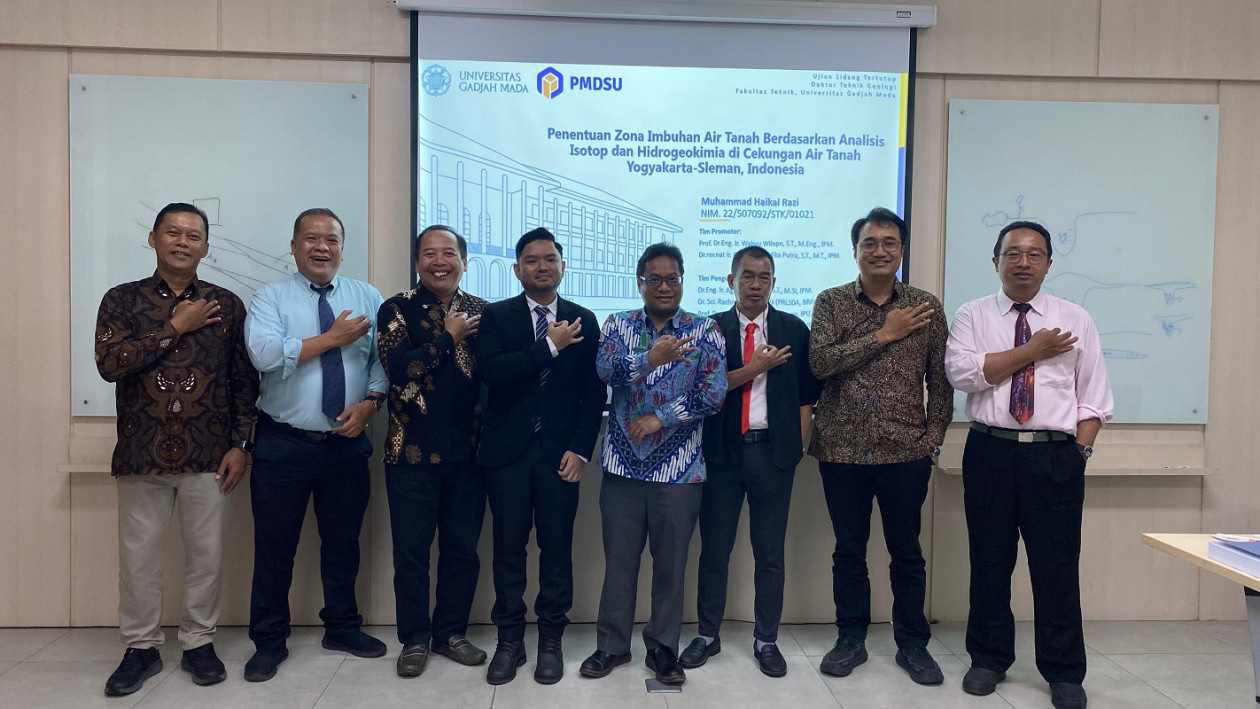
He expressed hope that his research could serve as a foundation for policymaking and planning to ensure future water security.
“Recharge zones must be strictly protected as designated conservation areas with regulated spatial plans to prevent land conversion and ensure continuous rainwater infiltration. Land use planning must also align with hydrological and geological conditions to maintain a balance between groundwater recharge and usage,” he asserted.
Razi’s academic journey has been remarkable.
He survived the devastating Aceh tsunami at the age of five, which claimed the lives of his parents and siblings.
Yet, his spirit for learning never waned.
After graduating from high school, he pursued scholarships and earned the PMDSU scholarship.
Completing his doctoral program was one of his dreams, and he is now grateful to have achieved it at the Department of Geological Engineering, FT UGM.
His dissertation has led to four scientific articles published in reputable international journals.
Author: Agung Nugroho
Post-editor: Lintang Andwyna