


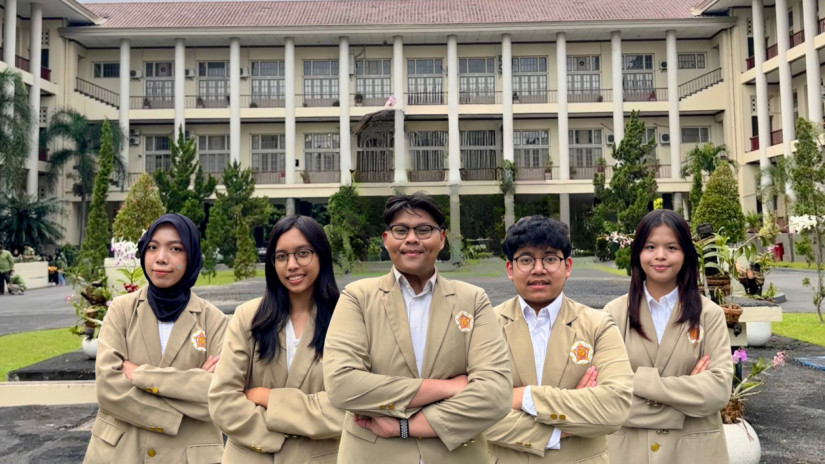
Universitas Gadjah Mada (UGM) has once again earned the top rating in the 2025 Student Affairs Performance and Governance Information System (SIMKATMAWA) assessment. The award was conferred by the Directorate of Learning and Student Affairs of the Ministry of Higher Education, Science, and Technology following the verification and evaluation of student affairs documentation for 2024.
The assessment covered student affairs, institutional structure, independent activities such as achievements and non-competition recognition, and the implementation of programs initiated by the Directorate. This achievement reaffirms UGM’s position as a university with strong and consistent student affairs governance.
UGM Director of Student Affairs, Dr. Hempri Suyatna, stated that this accomplishment reflects concrete performance in developing a healthy student affairs ecosystem. He noted that the success stemmed from strengthened processes and outputs, as seen in various student achievements. Cross-unit collaboration within UGM also contributed to securing the highest rating this year.
According to Dr. Suyatna, UGM continues to refine its development system to better organize student activities.
“I believe this serves as evidence of the concrete work carried out by our Student Affairs colleagues in building a supportive ecosystem for student development,” he said on Thursday (Nov. 27).
Dr. Suyatna added that this result was made possible through the support of the faculty and the active participation of students. He emphasized that alignment between the development process and outcomes forms the foundation for strengthening student affairs services at UGM.
He explained that students’ achievements reflect improvements in the quality of the learning ecosystem. The synergy between student affairs units and university leadership also helps sustain these positive outcomes.
Dr. Suyatna believes that this top rating further motivates UGM to strengthen its student development and mentoring efforts. He noted that swift responses to evolving student needs must complement improvements in governance.
Enhancing development programs, he added, is essential for achieving more robust results. UGM also continues to update its documentation system to ensure more accurate reporting and evaluation.
“We hope this becomes a driving factor for our continued improvement and development,” he said.
In addition, UGM aims to cultivate a student affairs ecosystem capable of generating sustainable achievements. According to Dr. Suyatna, consistent development efforts will determine the quality of student accomplishments in future periods.
Strengthening entrepreneurship, leadership, and creativity programs remains a priority to provide students with adequate avenues for self-actualization.
He emphasized that achievements are not merely the outcome of competitions but the product of a long, systematic process.
“We hope to see a variety of strong achievements emerge, which we will later advance into concrete forms of downstream impact,” he explained.
Dr. Suyatna stressed that the SIMKATMAWA assessment is conducted annually, which poses a primary challenge of maintaining consistency. He noted that governance updates are essential for retaining the top rating in the years ahead.
UGM, he said, benefits from a strong academic culture that supports the development of student potential. Strengthening the capacity of student affairs personnel also remains an important agenda to sustain positive outcomes.
He added that UGM is now mapping strategies to maintain strong student affairs performance in future assessments. Priorities include strengthening service systems and expanding opportunities for student achievement.
Dr. Suyatna highlighted that program innovation is crucial to help students adapt to advances in knowledge and shifts in the job market. He also stressed the importance of building a resilient student affairs ecosystem capable of navigating resource limitations.
“We remain committed to maintaining student achievement stability amid global challenges and changing higher education policies. Strengthening competencies, particularly in leadership, creativity, and entrepreneurship, continues to be a core focus of our development efforts,” he said.
The directorate currently oversees around 26 communities and 51 student activity units (UKM), all of which are continually encouraged to maintain and enhance their achievements.
Various forms of appreciation are also provided, ranging from incentives for outstanding students and funding support for student organizations to scholarships for student leaders.
In addition, the directorate recognizes both achievements and extracurricular activities and ensures that student involvement is recorded in the Diploma Supplement (SKPI).
Author: Triya Andriyani
Post-editor: Rajendra Arya
Photographs: UGM Students