


The Industry 4.0 era, marked by incredibly rapid technological development, includes advancements in manufacturing technology.
However, to achieve similar progress to that of developed countries, Indonesia needs to formulate a more focused long-term strategy for manufacturing industry development.
Mastery of this technology is expected to drive technological independence and national transformation in the future.
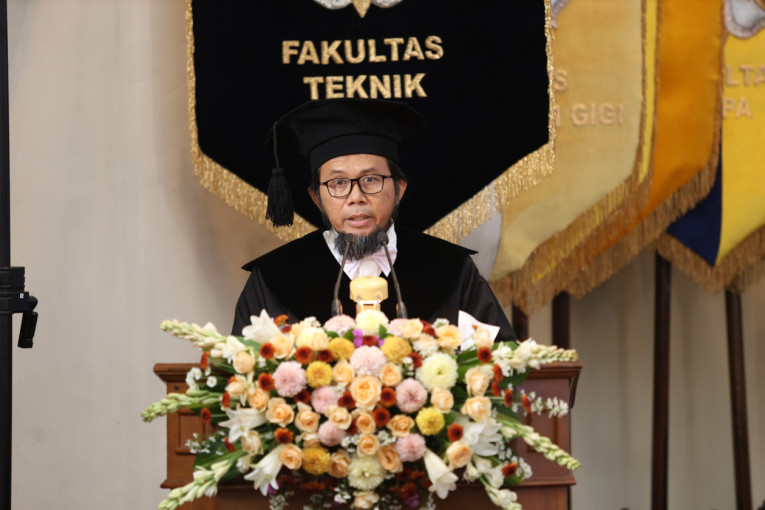
New professor at the Department of Mechanical and Industrial Engineering, Faculty of Engineering, Universitas Gadjah Mada (FT UGM), Herianto, stated that additive manufacturing system technology is one of the pillars of the Industrial Revolution 4.0.
It begins with the creation of digital designs using Computer-Aided Design (CAD), which are then converted into machine instructions in G-code.
These instructions are sent to 3D printing machines that automatically perform the manufacturing process.

In his inaugural speech as a professor in additive manufacturing systems, Professor Herianto said that Universitas Gadjah Mada began using 3D printing or additive manufacturing technology when it was still relatively new and not widely adopted in Indonesia.
Although it has been utilized since then, Professor Herianto noted that research at the time focused more on introducing technology.
Intensive in-depth research began in 2017.
“UGM has an advantage because it started research activities focusing on additive manufacturing earlier, which has even been widely used by lecturers, researchers, and students,” Professor Herianto explained on Tuesday (Jun. 24), at the UGM Senate Hall.
Additive manufacturing technology has been used extensively since 2014 in the Department of Mechanical and Industrial Engineering at FT UGM.
One application is for the development of post-stroke rehabilitation robots.
Then, in 2016, the research team built a local 3D printing machine, which later gave birth to the HALTech machine.
There has even been research on soft pneumatic actuators, as well as on the development of 3D printing technology in Indonesia.
“This year, we are focusing on the strategic direction of additive manufacturing technology development domestically,” Professor Herianto said.
Seeing the rapid development of this technology, Professor Herianto mentioned that future research will focus on cross-disciplinary application development.
According to Professor Herianto, collaboration with the Faculty of Medicine, Public Health, and Nursing (FK-KMK UGM) supports product development for cardiac and anatomical specialists.
Collaboration with the Faculty of Dentistry (FKG UGM) aims to develop dental phantoms and 3D printing applications in dentistry.
Professor Herianto emphasized that this technology is a strategic solution for improving and developing the national industry.
Therefore, he invites all elements of society to participate in this transformation.
“Through this initiative, I hope that additive manufacturing can contribute broadly across various sectors and advance Indonesia,” Professor Herianto hoped.
Author: Lintang Andwyna
Editor: Gusti Grehenson
Post-editor: Afifudin Baliya
Photographer: Donnie