


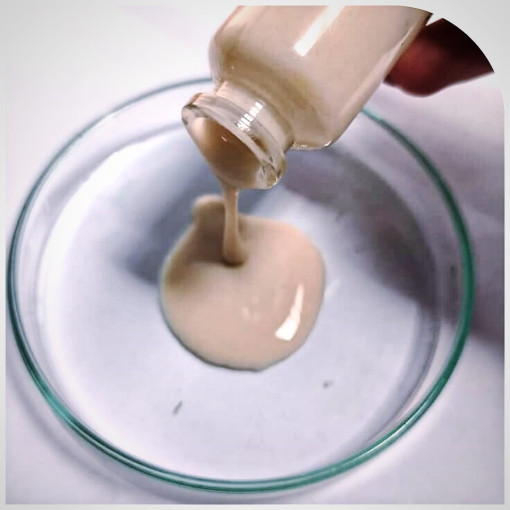
UGM students from the Pevillia Dent Team join the Student Creativity Program for Exact Sciences Research (PKM-RE) 2025 and have successfully developed an innovative remineralization biocomposite gel using locally sourced natural materials. The innovation utilizes green mussel shells (Perna viridis), which are rich in calcium for the synthesis of nano-hydroxyapatite, and green tea leaves (Camellia sinensis), which contain fluoride and polyphenols as natural antibacterial agents.
The resulting product is a nano-hydroxyapatite-green tea leaf biocomposite gel with a nanoparticle structure capable of penetrating, adhering to, and strengthening teeth biomimetically.
Hardness testing was conducted at the Materials and Production Laboratory of UGM Vocational College (SV UGM) using bovine teeth. The results showed increased enamel hardness and reduced surface porosity after 4 days of gel application, followed by immersion in artificial saliva.
“Meanwhile, antibacterial testing at the Integrated Research Laboratory, UGM Faculty of Dentistry (FKG UGM), also demonstrated inhibition zones against Streptococcus mutans, indicating effective antimicrobial activity,” said Hasan Rabbani, Chair of the Pevillia Dent Team, at UGM on Thursday (Nov. 6).
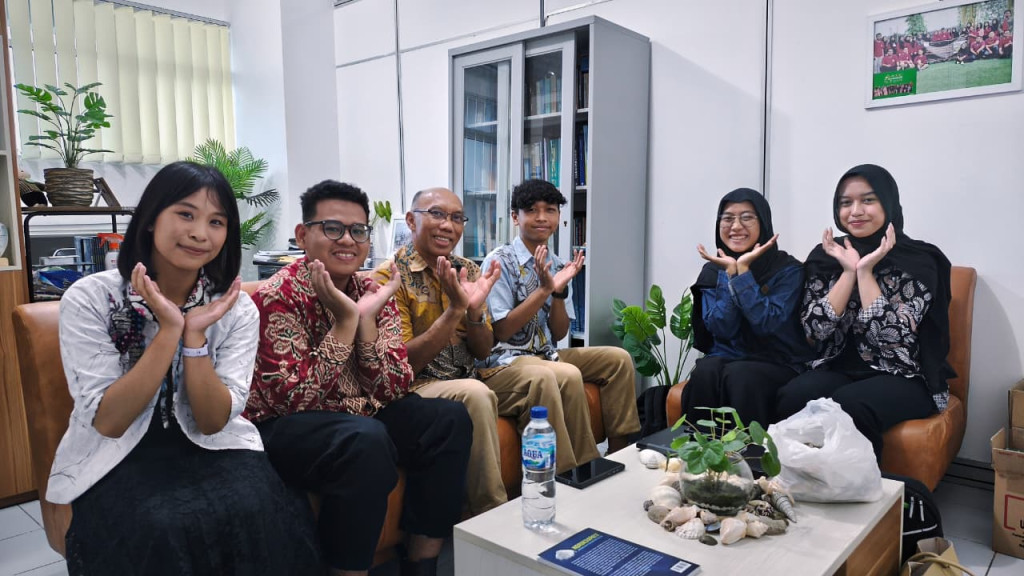
In addition to Hasan Rabbani (UGM Faculty of Mathematics and Natural Sciences/FMIPA UGM), the team consists of Achmad Musa Nurhadi (FKG UGM), Irya Dira and Jovanka Sandy (FMIPA UGM), and Ifah Nuur Rakhimah (Faculty of Biology/Biology UGM).
The team is supervised by Professor Yusril Yusuf, a materials physics expert from FMIPA UGM.
Hasan Rabbani explained that, through a study titled “Potential of a Nano-Hydroxyapatite Biocomposite Gel from Green Mussel Shells (Perna viridis) and Green Tea Leaf Extract (Camellia sinensis) for Tooth Remineralization,” the team explored tooth remineralization as a method to prevent the progression of dental caries.
They selected green mussel shells from Baron Beach, Gunungkidul, which contain 95.69 percent calcium carbonate, an ideal material for synthesizing nano-hydroxyapatite, the primary mineral in tooth enamel.
“The synthesis process used a sintering method with a furnace at 1000°C to produce nanosized particles. Meanwhile, tea leaves from the Nglinggo tea plantation in Kulon Progo were processed through 96 percent ethanol extraction to obtain natural fluoride and polyphenols as antibacterial agents against Streptococcus mutans,” Rabbani explained.
He further noted that the research idea emerged from observing the persistently high rates of dental caries in Indonesia. Referring to Ministry of Health data (2023), he noted that dental caries prevalence reached 82.8 percent.
“We wanted to provide a solution from local materials that is not only effective but also safe and sustainable. Our work took us from the coastal areas of Baron Beach to the mountainous slopes of the Nglinggo tea plantations, culminating in the development of this local-resource-based remineralization gel,” he said.
Achmad Musa Nurhadi added that the gel developed by the Pevillia Dent Team can penetrate the tooth enamel layer. Unlike topical fluoride, which only works on the surface, this product strengthens the outer layer while penetrating deeper to restore the mineral structure from within.
“Importantly, our formulation is free from cow’s milk protein allergens often found in imported products such as CPP-ACP,” Nurhadi noted.
He explained that the gel is easy to apply with a clean fingertip or a small silicone spatula, and should be spread evenly on the tooth surface twice daily after brushing. This application method supports a more optimal and natural remineralization process. Nurhadi also confirmed that the particle size and crystal structure met biomaterial standards, as determined by XRD, FTIR, and SEM analyses.
“The main challenge of this research was maintaining gel stability to ensure consistent form and viscosity, which we successfully achieved by adjusting the pH,” he added.
For antibacterial testing, Jovanka Sandy explained that the team used Streptococcus mutans cultures to evaluate antibacterial effectiveness.
The research process was not without obstacles; among them were difficulties in finding a furnace capable of reaching 1000°C during synthesis and in ensuring safe gel sterilization for antibacterial testing. These hurdles, Sandy noted, delayed formulation optimization beyond the initial plan.
“Thanks to intensive supervision and cross-laboratory collaboration among FMIPA UGM, Biology UGM, and FKG UGM, we ultimately completed all testing stages and finalized the formulation,” Sandy said.
The Pevillia Dent Team is grateful that their product offers several advantages, including enamel penetration, cow’s milk protein allergen-free composition, natural enamel-mimicking structure, antibacterial properties, and the use of local resources.
According to Sandy, the gel has strong potential for further development, including patenting the formulation, conducting organoleptic tests (taste, aroma, smell, color), conducting clinical trials in humans, and scaling up to industrial production.
“The Pevillia Dent Team is now preparing to compete at the 2025 National Student Scientific Week (PIMNAS) at Universitas Hasanudin. We continue to carry the spirit of cross-disciplinary collaboration and innovation based on Indonesia’s natural resources to support sustainable, healthy smiles,” she concluded.
Professor Yusril Yusuf also expressed appreciation, noting that the Pevillia Dent Team’s research reflects UGM’s multidisciplinary synergy.
He stated that the team not only harnessed natural potential but also successfully integrated materials physics, analytical chemistry, biology, and dentistry into one biomimetic product grounded in sustainability.
Author: Agung Nugroho
Post-editor: Rajendra Arya