


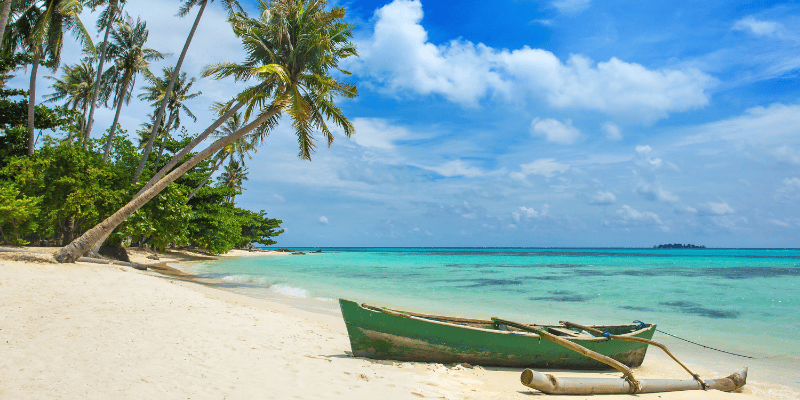
As many as 80 students from the 2022 cohort of the Regional Development Study Program, Department of Development Geography, Faculty of Geography, Universitas Gadjah Mada (UGM), chose the Karimunjawa Islands as the location for their compulsory Field Work Lecture (KKL) study.
They delved into the dilemmas of development in island and coastal areas.
Some of the findings from these student studies were then presented at the UGM Faculty of Geography’s 112th SDGs Seminar Series.
This was for audience re-evaluation, with the theme “Archipelago Development: The Dilemma of Tourism Development, Conservation, and Community Welfare in Karimunjawa.”
This activity was conducted online via Zoom and YouTube Live Streaming on Monday (Jun. 16).
Freya Alif Maretha, one of the KKL III student participants, explained that island regions like Karimunjawa have great potential.
However, they also face complex and uneven development challenges, both economically and ecologically.
“When conducting this five-day study, we found a gap between tourism business actors and the traditional sector community, such as fishermen,” she revealed.
She added, “Furthermore, increasing tourism activity has exacerbated environmental degradation, such as coral reef damage.”
Muhammad Ahsan Alhuda, another student, explained in detail the focus of the 8 study topics conducted by the Faculty of Geography students.
He explained that the ecotourism study focused on the potential of coastal ecotourism and the evaluation of Global Sustainable Tourism Council (GSTC) criteria.
Then, the livelihood topic highlighted the impact of tourism hegemony on the local economy.
The marine economy study discussed blue economy development strategies, while environmental preservation examined the impact of human activities on Karimunjawa’s natural sustainability.
Next is the study of Regional Governance and Local Partnerships. In this study, the students focused on mapping and on alternative strategies to address land-use discrepancies.
The Infrastructure Development study focused on the development of tourism and tourism-supporting infrastructure in Karimunjawa.
“For the Disaster Management study, students examined the reduction of high waves, abrasion, and drought threats in supporting sustainable tourism. Even for logistics and food security, we studied the mapping of rice supply chain flows and obstacle analysis on Karimunjawa Island,” Alhuda explained.
Havid Widiyanto, a representative from the Jepara Regency Environmental Agency (DLH), Central Java, also shared his response regarding the study presentation from UGM students.
He stated that this study should be explored in more detail.
“Because this student study could actually be an opportunity for us policymakers to determine future development programs for Karimunjawa Island,” he said.
Through the studies conducted by these Faculty of Geography students, a deeper understanding is expected to develop regarding the relationships among regional development, environmental conservation, and improved community welfare in Indonesian archipelagic areas, especially in Karimunjawa.
Dr. Alia Fajarwati, as the Field Supervising Lecturer, said that these student studies are part of a compulsory course that students of the Regional Development Study Program must take.
Through KKL III, students are expected to compile comprehensive regional analyses based on field data.
Author: Lintang Andwyna
Editor: Gusti Grehenson
Post-editor: Afifudin Baliya
Illustration: Joglosemar