


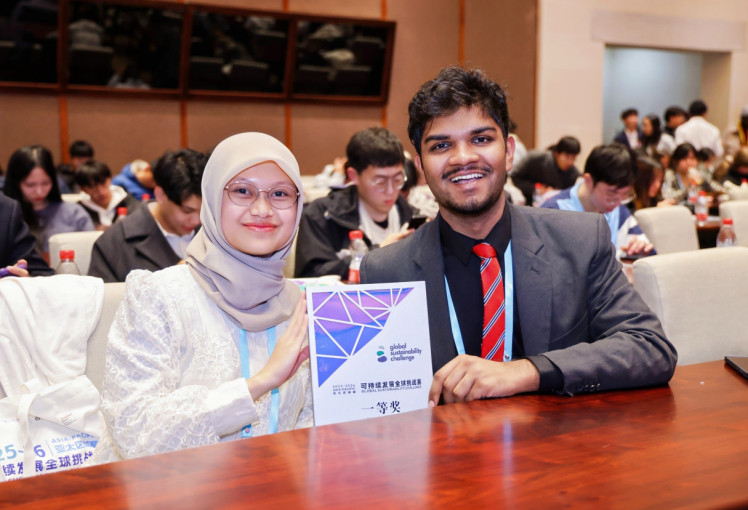
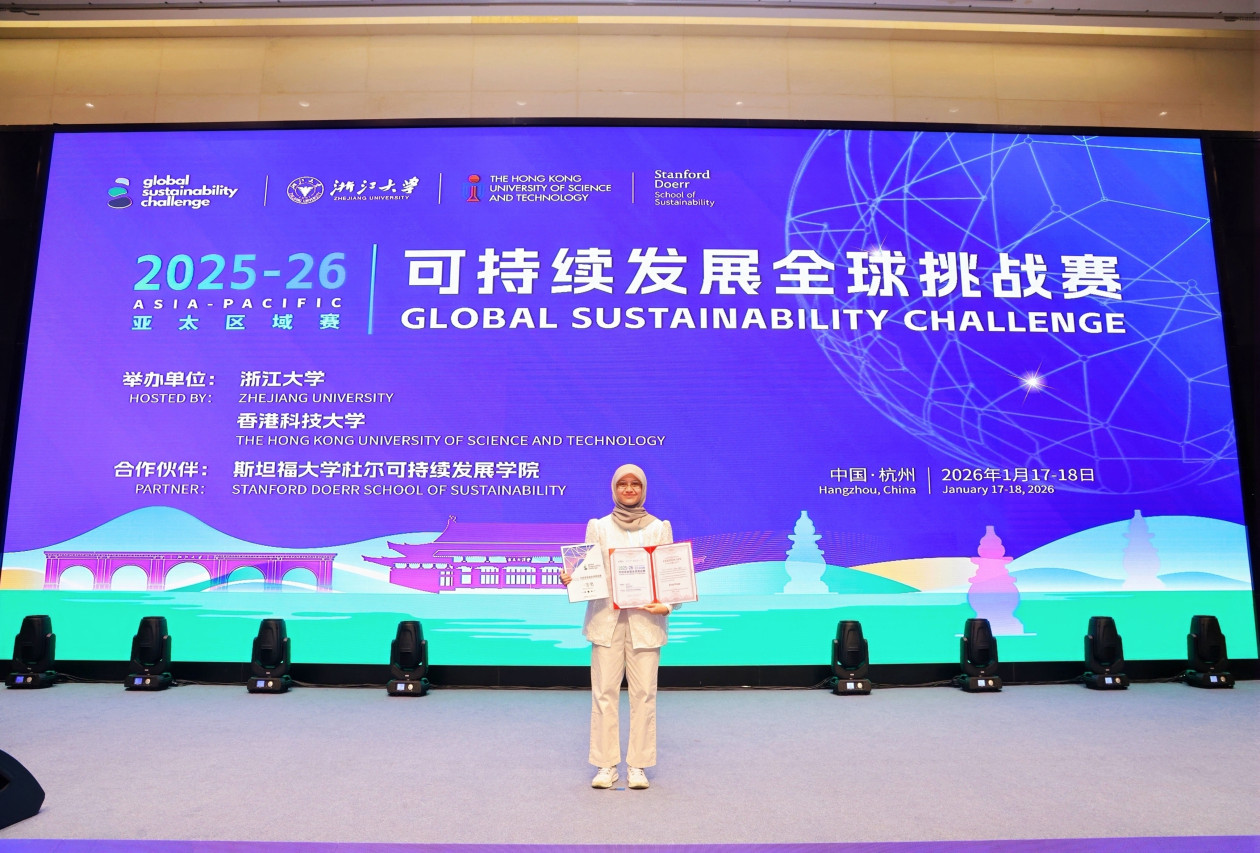
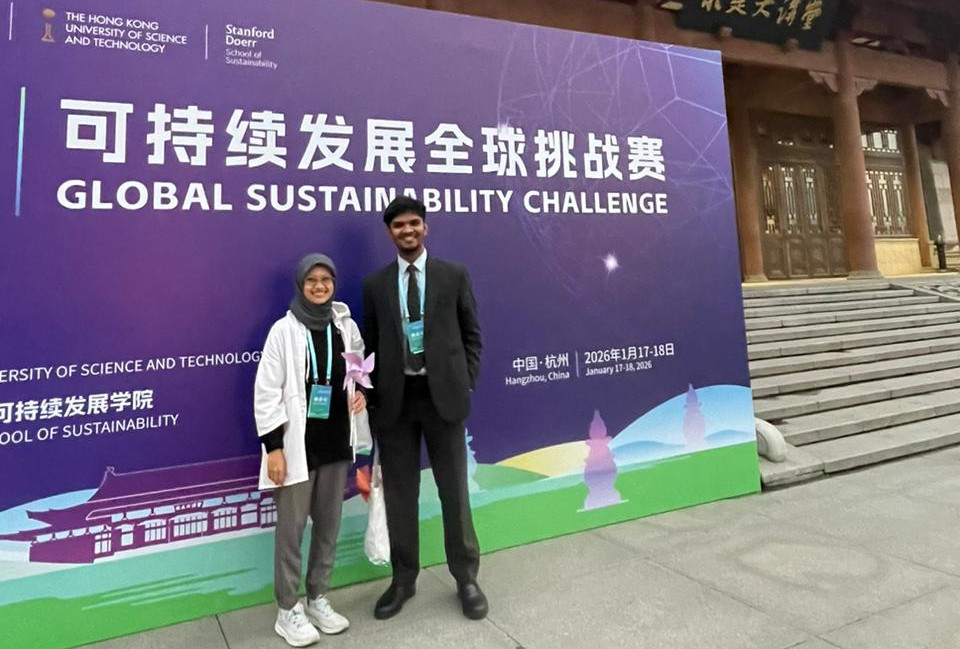
Indonesian students have recorded another proud achievement on the international stage. Satwika Nino Wandhana, a student of the Computer Science Program, Faculty of Mathematics and Natural Sciences, Universitas Gadjah Mada (FMIPA UGM), won First Prize at the Regional Final of the Global Sustainability Challenge, held on Jan. 17, 2026, at Zhejiang University, Hangzhou, Zhejiang, China.
The competition lasted approximately three months and brought together multidisciplinary teams from various countries.
The regional final was organized by the Global Sustainability Challenge and conducted in collaboration with Zhejiang University, the Hong Kong University of Science and Technology (HKUST), and the Stanford Doerr School of Sustainability.
In the competition, Wandhana collaborated with several other UGM students and two students from international universities: Pranavi Kuntrapakam (Computer Engineering + AI, HKUST), Anuk Ranaweera (Mechanical Engineering, HKUST), Najwa W. Ayu (Business Management, UGM Faculty of Economics and Business), Nikita Dinda Azizah (Business Management, UGM Faculty of Economics and Business), and Gustav Susanto (Business Management, UGM Faculty of Economics and Business).
The diversity of academic backgrounds and institutions posed a unique challenge for Team Tycoon in preparing for the competition. This was further complicated by the fact that two team members were international students with different schedules and commitments.
“We all have our own activities. For instance, I am currently interning, and Niki is as well. Najwa has other programs she is involved in, and our friends from India and Sri Lanka also have their own commitments. Because we are a cross-country team, we had to adjust our meeting times, which also had to be quite short,” said Wandhana on Tuesday (Jan. 27).
In the competition, Team Tycoon presented Resilient360, an integrated disaster management platform designed to enhance preparedness and emergency response through digital technology.
Resilient360 combines early warning systems, a community-based mobile application, and AI-powered logistics drones into a unified ecosystem.
“When a natural disaster occurs, there is usually extensive damage. That is why we developed an application that can be useful for people who need assistance. The drones can scout disaster-affected areas and help deliver essential supplies such as food, drinks, first aid, and other necessities, along with other application features,” Wandhana explained.
This solution addresses key challenges in disaster management, including fragmented coordination, limited access to information, and slow aid distribution.
Through real-time geospatial mapping, drone tracking, and a centralized command system, Resilient360 can accelerate aid delivery, improve the accuracy of identifying high-risk areas, and build community capacity before disasters occur.
Based on simulations and initial testing, the platform has the potential to significantly increase response speed.
Winning First Prize did not make Team Tycoon complacent or stop at the competition stage. Looking ahead, they hope the prototype innovation can be realized and implemented, particularly in Indonesia.
They believe the idea is highly relevant to the country’s urgent disaster risk context.
“In my opinion, this idea could be implemented in Indonesia, which has regions with higher disaster risk. If we can receive sufficient support, I believe we can bring this idea to life,” said Gustav Susanto.
In addition, the team also hopes to receive broader support from the university. Based on their experience, support thus far has only come from the faculty.
“We hope that for future delegations like ours, the support will not only come from the faculty, but also from the university,” said Najwa W. Ayu.
Author: Fatihah Salwa Rasyid
Editor: Gusti Grehenson
Post-editor: Rajendra Arya
Photographs: UGM Students