


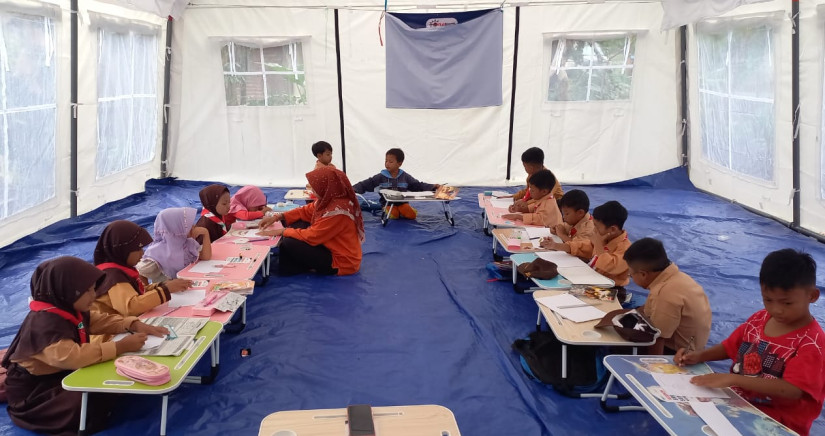
Universitas Gadjah Mada (UGM) has once again mobilized its experts to support response efforts following the major floods that struck Sumatra in late 2025. One of the initiatives is an online training session for student volunteers from Universitas Syiah Kuala (USK) who are involved in restoring educational activities for child survivors. The training, led by disaster psychology expert Dr. Diana Setiyawati, was held on Sunday (Dec. 7) and equipped volunteers before their deployment to the field.
According to Dr. Setiyawati, online training is a crucial measure to support volunteer teams, who have been under immense pressure since the disaster.
“When a disaster strikes, everyone experiences overwhelm and difficulty making decisions. Our colleagues at USK also received an overload of information, with calls coming from many directions, making it hard to stay focused. Because we are not directly affected, we offered assistance by providing the psychosocial materials the volunteers need,” she explained on Wednesday (Dec. 10).
Regarding essential skills for volunteers, Dr. Setiyawati emphasized the importance of interacting sensitively with child survivors.
“Volunteers must show compassion, treat the children with sensitivity, uplift their spirits, and provide activities that help them feel safe and joyful again. The aim is to create a child-friendly safe space, rather than immediately pursuing academic targets,” she said.
However, revitalizing emergency schools on the ground presents significant challenges. In addition to limited access due to damaged bridges, efforts to clean school buildings require heavy machinery that is difficult to deploy.
“Schools are tough to clean. Heavy equipment is needed, but access is cut off because many bridges have collapsed. Parents also do not yet feel safe letting their children play or study on their own,” Dr. Setiyawati noted, describing conditions that remain far from recovery.
To address these challenges, UGM is collaborating with USK and local volunteer networks. The USK team has deployed around 25 volunteers to four affected districts to provide psychosocial support, facilitate child recovery activities, and help restart learning in temporary spaces.
“We are partnering with USK because they have volunteers on the ground, while our team provides training and psychosocial support,” she said.
Dr. Setiyawati expressed hope that the volunteers’ contributions would bring meaningful improvements to children’s well-being in the disaster-affected areas.
“The priority is to provide basic support for children and their families so their well-being is protected, preventing prolonged distress and helping them recover more quickly,” she concluded.
Author: Kezia Dwina Nathania
Editor: Gusti Grehenson
Post-editor: Salma
Photograph: Ministry of Primary and Secondary Education