


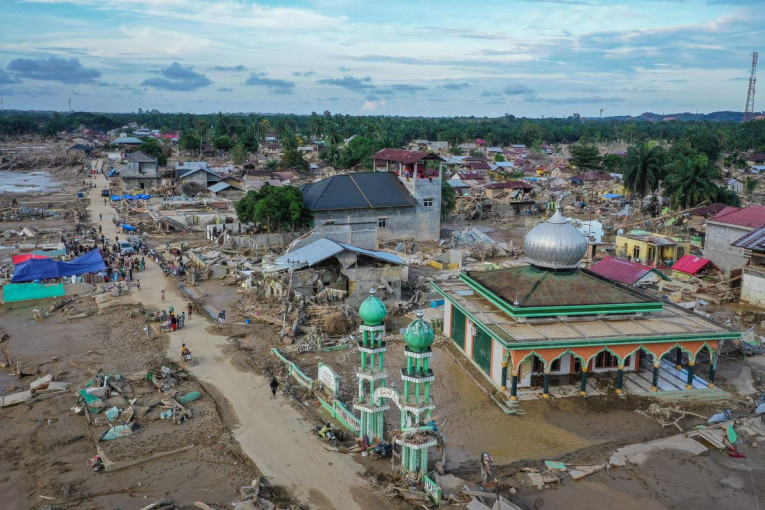
The floods and landslides that struck several areas of Aceh last November have prompted Universitas Gadjah Mada (UGM) to mobilize a psychosocial support program as part of its emergency response. A cross-faculty team is currently developing a needs map and data-driven intervention plan to ensure survivors receive services aligned with on-the-ground conditions. These efforts include consolidating damage information, identifying vulnerable groups, and designing rapid assessment routes. The initiative serves as the foundation for strengthening emotional protection for affected communities.
Prior to field deployment, UGM began its response by aligning plans and data needs through cross-unit coordination. An initial coordination meeting with the UGM Strategic Management Bureau (BMS) was held on Monday (Dec. 8) to harmonize data requirements and the work plan of the psychology team.
Head of BMS, Dr. Wirastuti Widyatmanti, emphasized the importance of mapping public facilities and affected populations to determine field visit priorities. Information such as the number of school-aged children, affected families, and the locations of public facilities serves as a key reference for the needs-mapping team.
“Information on the number of schoolchildren, affected families, and the locations of public facilities is crucial in determining priority areas,” she said in opening the discussion.
The outcomes of this technical discussion were then translated by the mapping team into more detailed operational steps. The team developed a data synchronization mechanism to ensure spatial information remains accessible despite limited field connectivity. Data on shelters, health facilities, and accessibility were collected from various networks already operating in Aceh.
Coordination was also carried out with the National Disaster Management Agency (BNPB) and local governments, as updates on regional conditions, survivor needs, and basic service readiness continue to evolve.
“We are currently collecting and synchronizing data so that the UGM Faculty of Psychology team can move more precisely and swiftly,” Dr. Widyatmanti explained.
In parallel with the development of this data foundation, the Faculty of Psychology has also prepared capacity-building efforts for volunteers and local partners to strengthen intervention readiness.
Dr. Diana Setiyawati stated that up-to-date field conditions are essential to prevent assessments and assistance from becoming unfocused. Mapping psychosocial needs must be integrated with spatial data to more accurately identify areas with a high burden of impact.
“We strongly hope to receive updated data so that we can develop synergistic short-term and long-term responses,” said Dr. Setiyawati on Wednesday (Dec. 10).
This training forms part of efforts to ensure that volunteers understand the principles of psychosocial support before deployment. The Faculty of Psychology subsequently organized an online training session for volunteers from Universitas Syiah Kuala.
The materials covered mental health literacy in disaster contexts and Psychological First Aid skills. The training was designed to help volunteers provide a sense of safety and emotional comfort to survivors.
“At the very least, volunteers should be able to help without adding psychological burden through inappropriate words or actions,” Dr. Setiyawati emphasized.
The training is particularly important given that early field responses often involve activities that do not fully adhere to psychosocial support guidelines. Dr. Setiyawati highlighted the frequent misuse of the term trauma in media coverage and assistance activities.
She explained that current emotional reactions among residents remain within normal post-disaster responses, and therefore, interventions must be adjusted to the appropriate recovery phase.
“A major challenge lies in coordination and media misconceptions surrounding the term trauma, as residents are not yet in a phase of long-term psychological disorders,” she noted.
With this preparation, the psychology team then outlined plans for a rapid assessment to be conducted directly in affected areas. The UGM Psychology Team is scheduled to be deployed to Aceh from 10 to 20 December to conduct rapid assessments in four locations: Bireuen, Pidie Jaya, Lhokseumawe, and North Aceh.
The assessment will include mapping psychosocial support needs, shelter conditions, and levels of vulnerability among affected groups. Initial data from partner volunteers are being used to design assessment routes and determine assistance priorities based on each area’s conditions.
“The rapid assessment is scheduled for 15 December so that we can immediately map psychological burdens and urgent needs in the field,” Dr. Setiyawati explained.
The assessment results will serve as the basis for subsequent interventions to strengthen sustainable community recovery. In this coordination process, the team is also considering access challenges, shelter readiness, and resource gaps.
Some areas, such as Aceh Tamiang, remain in the phase of meeting basic needs, meaning psychosocial assistance will be implemented once conditions stabilize. The involvement of partner universities in Aceh is expected to strengthen the continuity of support beyond the emergency response phase.
“We hope Universitas Syiah Kuala can take on a leadership role with us in long-term assistance,” Dr. Setiyawati said.
This integrated effort lays the groundwork for the recovery of affected communities, particularly vulnerable groups such as children and families living in shelters.
By combining data mapping, volunteer training, and field assessments, UGM seeks to ensure that psychosocial interventions are systematic and responsive to actual needs. The team stressed the importance of sustaining psychosocial support to enable optimal recovery.
“We hope that interventions can be continuous so that communities truly recover and regain optimal functioning,” Dr. Setiyawati concluded.
Author: Triya Andriyani
Post-editor: Salma
Photograph: Kompas