


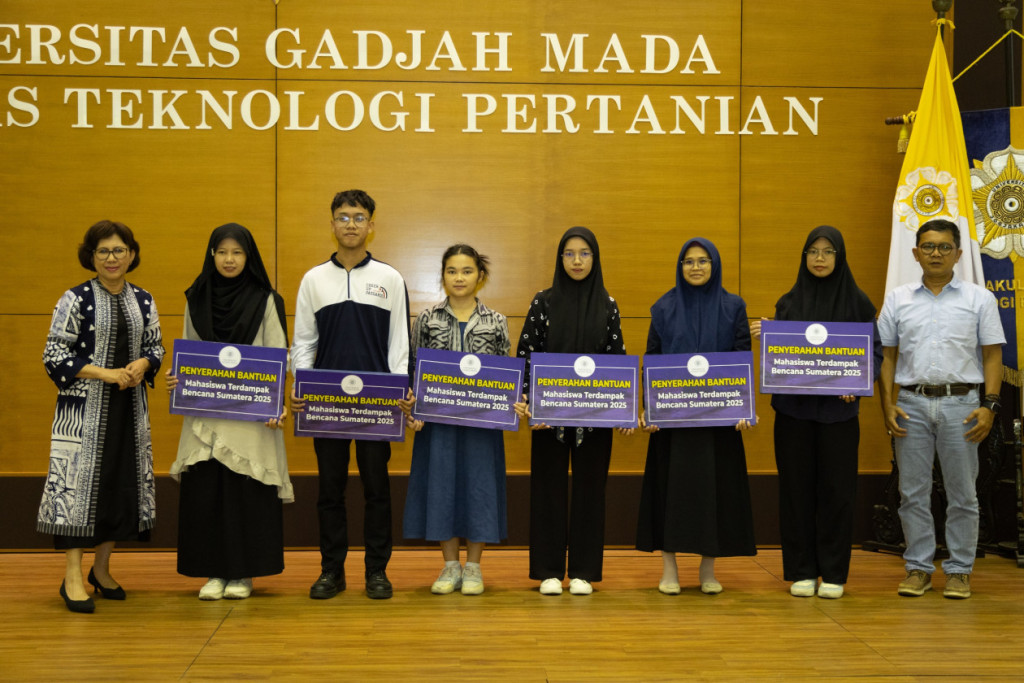
Universitas Gadjah Mada (UGM) has reaffirmed its commitment by providing various forms of assistance to 162 students whose families were affected by recent disasters in Aceh, North Sumatra, and West Sumatra. This swift response reflects UGM’s concern for members of its academic community facing hardship and ensures that students’ educational continuity remains protected. The university emphasized that support is provided comprehensively, covering academic, psychological, and financial aspects, through a verification process involving multiple units.
UGM Rector Professor Ova Emilia expressed her deepest condolences and sympathy to all students and families affected by the disaster. She noted that UGM continues to work to deliver aid as quickly as possible to ease the burden on students and their families.
“I appreciate everyone who acted swiftly in preparing support mechanisms for affected students. We also encourage students to remain resilient and committed to their studies, and UGM ensures that no student will be forced to discontinue their education due to financial constraints,” said Professor Emilia on Tuesday (Dec. 10) at the Auditorium of the Faculty of Agricultural Technology (FTP UGM).
Academic support is provided because disasters can significantly impact students’ learning performance. In addition, Professor Emilia stated that UGM offers psychological services, including counseling and trauma healing, through existing service units.
From a financial standpoint, UGM provides several forms of relief, ranging from tuition fee adjustments for the coming semester to urgent living support for affected students.
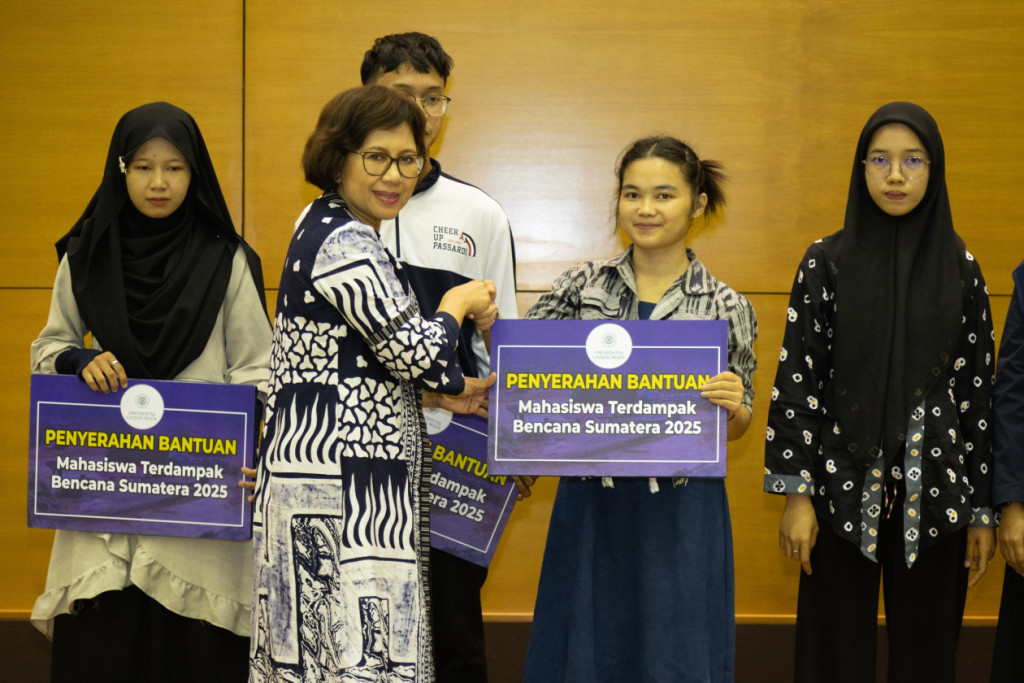
UGM Vice-Rector for Student Affairs, Community Service, and Alumni, Dr. Arie Sujito, said that UGM has moved swiftly to distribute assistance in collaboration with universities in Aceh and Sumatra.
“KAGAMA members have also shown strong support for these efforts. We want to ensure that our assistance does not stop at meeting short-term needs. In the long term, students’ safety and educational continuity must remain guaranteed,” said Dr. Sujito.
Meanwhile, according to Dr. Hempri Suyatna, UGM Director of Student Affairs, the UGM Disaster Response Unit (DERU) continues to collect data on students affected by the disaster, with support from various student organizations.
“The identification process is supported by units such as FORKOM, UGM Student Executive Board (BEM UGM), the Graduate Student Forum, and Gelanggang Emergency Response (GEr) to ensure accurate data collection. So far, 162 students have registered through the system,” said Dr. Suyatna.
UGM has also distributed aid in the form of meal vouchers and essential living support, and is preparing a student volunteer program to be deployed to affected regions in Sumatra after the end of the semester. These humanitarian activities will be coordinated by the Directorate of Community Service together with GEr.
“We hope that with this support, students can remain motivated and continue their studies. Our prayers are always with them,” added Dr. Suyatna.
One of the affected students, Eva Rosdiana from the Faculty of Agriculture (Agriculture UGM), comes from Aceh Tamiang, one of the hardest-hit areas. For several days, Rosdiana waited for news of her family from anyone who managed to leave the isolated area, as communication had been cut off.
“For four days, my parents stayed in a local resident’s home that was turned into a shelter, without food or water. There was no clean water, they had to drink floodwater, the signal was down, and relief was uneven,” she said.
Rosdiana added that most assistance reaching her village came from passing vehicles rather than official posts, as access to the village remained difficult. As a result, aid distribution was uneven and insufficient for community needs.
“That is why I am very grateful to UGM for coming and providing direct assistance. UGM’s presence really addressed our urgent needs as survivors. I hope this support can reach all affected areas. Thank you very much,” she said.
Assistance distribution is carried out through synergistic collaboration among the university, faculties, departments, and study programs within UGM. The university ensures that all support is delivered appropriately and continues to monitor its implementation.
In addition, UGM remains committed to monitoring disaster developments nationwide and taking swift, concrete action to support affected students.
In a separate statement, Vice Dean for Academic and Student Affairs of the Faculty of Economy and Business (FEB UGM), Dr. Bayu Sutikno, stated that the faculty leadership has introduced flexible tuition payment policies for affected students. This measure ensures that students can continue their academic work smoothly despite the difficult circumstances their families face.
“To date, 18 FEB UGM students from various undergraduate and graduate programs have been affected,” he said.
Additionally, FEB UGM has adopted further policies, including providing free lunch facilities for affected students across all levels of study. This initiative aligns with UGM’s commitment to ensuring that no enrolled student experiences obstacles in completing their studies, particularly those from disaster-affected regions in Sumatra.
Authors: Lintang and Ika (FEB UGM)
Editor: Gusti Grehenson
Post-editor: Salma
Photographer: Firsto Adi