


Universitas Gadjah Mada (UGM) began constructing temporary shelters (Hunian Sementara/Huntara) for flood-affected residents in Geudumbak Village, Langkahan District, North Aceh Regency, on Saturday (Jan. 3). This activity marks the start of the housing recovery phase following the hydrometeorological disaster that struck the area.
UGM is present, with support from the Bulaksumur Peduli Foundation, Kagama Care, Rumah Zakat, and the local government, to ensure that residents can soon have safe and decent housing.
This momentum also signifies UGM’s long-term commitment to accompanying disaster-affected communities throughout the recovery process.
In her remarks, UGM Rector Professor Ova Emilia emphasized UGM’s commitment to being involved from the emergency response phase through early recovery.
UGM has consolidated academic, medical, social, and technical resources through cross-faculty and inter-unit collaboration. This approach is designed to ensure that disaster response efforts are data-driven and aligned with community needs.
“UGM has formed a hydrometeorological disaster response team with seven interdisciplinary working groups to ensure that all interventions are well coordinated and relevant to conditions on the ground,” she said.
The rector also stressed that the construction of the temporary shelters adopts a community-based approach. Residents are positioned as the main subjects of recovery, supported by UGM’s academic expertise and technical assistance.
This model is expected to strengthen community capacity during the post-disaster transition phase.
“These temporary shelters, or Rumah Geunira, are designed to make residents feel safe and comfortable, while also providing space for them to actively participate in the recovery process,” she explained.
From a technical perspective, the construction of the shelters is designed to be easily implemented on-site and carried out together with residents.
The Head of the Tangguh Team from the Faculty of Engineering (FT UGM), Dr. Ashar Saputra, explained that the house design has been adapted to the availability of materials and the capabilities of the local community.
This approach was chosen to accelerate the construction process without compromising safety.
“We designed houses that can be built using basic tools so that residents and their families can be directly involved in the construction process,” he said.
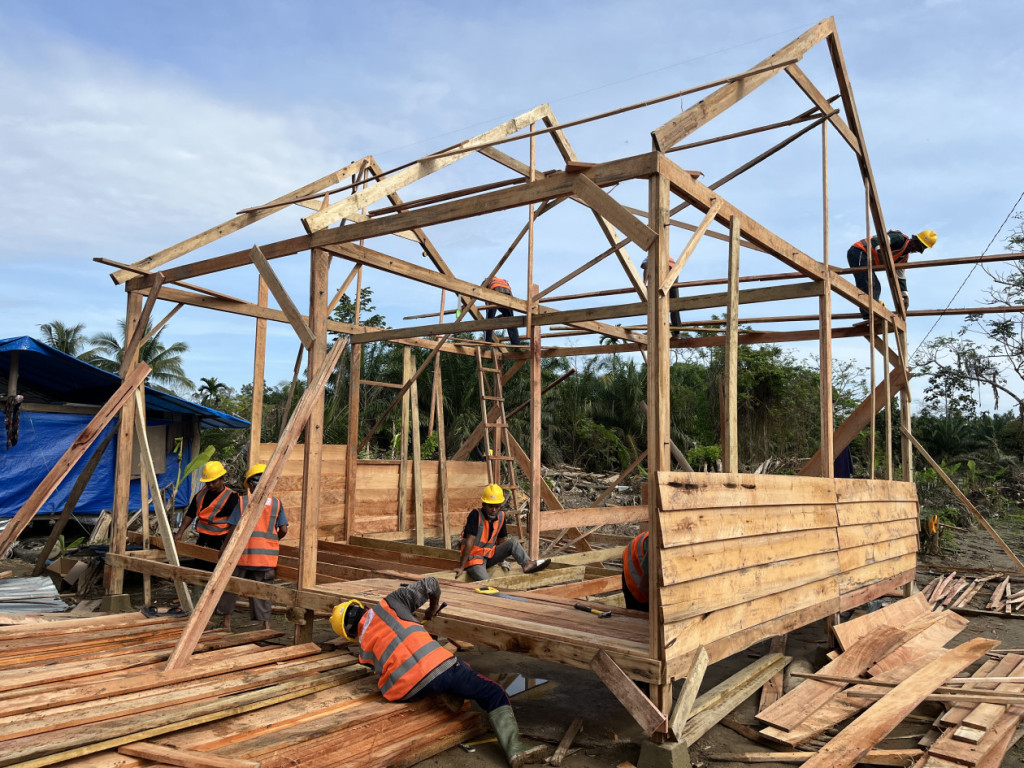
Furthermore, community involvement is a key element in the empowerment-based recovery strategy.
Through construction skills training, residents are actively engaged in building the temporary shelters. The 6 x 6 meter shelters are designed to support family life during the transition period.
“Each house has two bedrooms, a multifunctional space, and a terrace to support family activities and social interaction among residents,” Dr. Saputra explained.
The ceremonial event was also marked by spiritual reflection and a call to rise together in the wake of the disaster.
The Head of the Religious Affairs Office of North Aceh Regency, H. Fadli, emphasized the importance of viewing disasters as both a test and a pathway toward recovery. He expressed appreciation for UGM’s presence in accompanying residents during difficult times.
“Today we see that behind hardship, God provides ease through the hands of those who care for the community,” he said.
Support also came from the local government, which witnessed firsthand the conditions of flood-affected residents. The North Aceh Regency Government views the presence of temporary shelters as an essential step in restoring community life, especially in severely affected areas.
Cross-sector collaboration is expected to continue through the long-term recovery phase.
“On behalf of the Regent of North Aceh, we extend our gratitude to UGM for bringing new hope to our community,” said Zulkifli, representing the local government.
For disaster survivors, the presence of the temporary shelters has brought significant change after a prolonged period of displacement.
According to Martunis, one of the residents, the shelters provide his family with a sense of safety and certainty. Residents directly feel the tangible impact of the collaboration.
“For us, these temporary shelters are like a palace because they arrived at a time when we desperately needed decent housing,” he said.
A similar sentiment was expressed by Suryani, who has benefited from the shelter and assistance during the emergency period. The support received has helped her family resume life with greater peace and dignity. The aid has been a source of strength amid the difficult post-disaster situation.
“We are grateful to have been provided with decent housing and assistance during these hard times. May this kindness be rewarded with blessings,” Suryani said emotionally.
Author: Triya Andriyani
Post-editor: Rajendra Arya
Photographs: UGM Team and Rumah Zakat