


International Women’s Day is observed annually on March 8. This year’s theme, “Give to Gain,” reflects a commitment to providing time, knowledge, access, opportunities, and support for women to help build the foundation of social justice. In today’s postmodern era, women’s equality is not measured solely by the number of women in decision-making roles in government or legislative bodies, but also by the space given for them to express their views.
Andy Yentriyani, Chairperson of the National Commission on Violence Against Women (Komnas Perempuan) for the 2020–2025 period, stated that women’s participation in decision-making cannot be measured solely by the numerical presence of their voices. It must also include spaces that consistently support women in expressing their perspectives, at any time and in any place, regardless of their identity. Nevertheless, efforts to achieve social equality can be realized when the number of women leaders increases.
“A survey in 159 countries shows that legislation produced through women’s participation contributes to social progress and equality, and this has been proven by data,” said Andy during a Ramadan Dialogue held in commemoration of International Women’s Day at Mardliyyah Islamic Center (MIC) on Wednesday (Mar. 4).
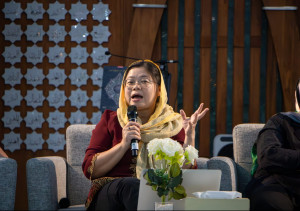
Beyond simply improving the democracy index, Andy explained that women’s participation allows them to develop strategies, negotiate, compromise, or even take positions of conflict with careful consideration, including resisting unequal power relations. At times when their groups face crises of power, such vulnerability is often exploited by those with greater authority.
“From various studies and hundreds of peace negotiation processes I have examined, when women are involved in decision-making, the promotion of democracy and politics becomes far more stable. This is because women have strong negotiation skills to build mutual understanding, enabling them to resolve conflicts without violence,” she explained.
A Professor in Literature and Gender Studies at the Faculty of Cultural Sciences, Universitas Gadjah Mada (FIB UGM), Professor Wening Udasmoro, said that current gender inequality is shaped by practical experiences in society, where the phenomenon of flexing, the public display of wealth or status, is often considered normal.
“Contemporary society is structured by consumption, leading people to seek as many resources as possible to demonstrate authority in public and gain affirmation and validation,” she said.
According to Professor Wening, the phenomenon of flexing is not limited to Indonesia but occurs in many parts of the world. She explained that flexing is a concrete example of how inequality is perpetuated by an ecosystem that disregards others and lacks empathy.
“We have entered a postmodern era in which people emphasize performance rather than substance. This ecosystem sustains inequality,” she said.
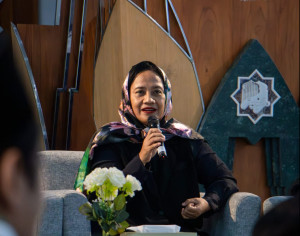
A lecturer at IAIN Syekh Nurjati Cirebon, Faqihuddin Abdul Kodir, stated that Islam clearly affirms equality between men and women beyond reproductive roles. Specifically, he noted that both men and women share the role of leaders (auliya) who support one another in upholding the core principles of Islam (amar ma’ruf nahi munkar), such as promoting good deeds, paying zakat, performing prayers, and obeying Allah and His Messenger.
“There are more than 25 verses in the Qur’an that emphasize that men and women are essentially equally involved. However, in everyday public discourse, this understanding is often overshadowed by incomplete interpretations of verses on polygamy or narratives portraying men as leaders while women are merely followers, even though the origins of these interpretations are often unclear,” he said.
For Faqihuddin, equality is a mandate of civilization that is absolute in nature, not a gift granted by those with greater power to those with less.
Author: Ika Agustine
Editor: Gusti Grehenson
Post-editor: Zabrina Kumara
Photo: Documentation of Mardliyyah Islamic Center