


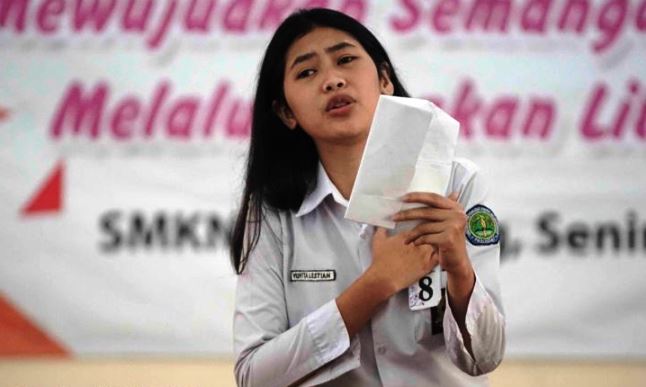
Amid today’s overwhelming flow of digital information, poetry emerges as a “pause” that soothes the soul. The tradition of poetry in Indonesia has long served as a medium for preserving cultural wisdom. The commemoration of World Poetry Day on March 21 became a moment to celebrate poets’ works while nurturing the social sensitivity and imagination of the younger generation.
“Poetry must continue to be kept alive through reading, writing, and various platforms of appreciation in schools, universities, communities, and digital media. In doing so, poetry can remain a ‘small light’ of words that fosters empathy, expands imagination, and strengthens humanity,” said the Head of the Indonesian Language and Literature Study Program at the Faculty of Cultural Sciences, Universitas Gadjah Mada (FIB UGM), Dr. Novi Siti Kussuji Indrastuti, on Monday (Apr. 6).
Novi believes that the essence of poetry goes far beyond mere aesthetics. The commemoration of World Poetry Day serves as a momentum to celebrate the importance of words as a space for human reflection amid the onslaught of digital information.
“World Poetry Day continues to endure as a reflective moment, serving as a medium to contemplate life, nature, hope, and local wisdom,” she explained.
Novi acknowledged that challenges remain regarding the low level of interest in reading poetry among the younger generation, particularly amid fast-paced, visually oriented patterns of information consumption. According to data from Statistics Indonesia (BPS) in 2023, the national Reading Interest Index stands at 72, while results from the Program for International Student Assessment (PISA) survey indicate that students’ reading literacy in Indonesia still needs improvement, including in reading literary works such as poetry.
Nevertheless, Novi observes positive developments in recent years. Poetry has begun to find new spaces on digital platforms such as Instagram, blogs, and online literacy forums, helping revive appreciation for poetry.
“Interest in poetry has not declined; rather, it is undergoing a transformation in its medium and modes of appreciation,” she noted.
To promote a culture of reading poetry, it is also important to address the perception that poetry is difficult to understand. Overly theoretical teaching approaches in schools are considered to contribute to this perception.
She encourages more creative approaches to teaching poetry, such as literacy communities, festivals, poetry performances, and digital media, making poetry more accessible and relevant to younger audiences.
“There needs to be continuous mentoring, discussion, and spaces for appreciation so that literary activities can build a literacy system that encourages young people to read, write, and appreciate poetry as part of their cultural and intellectual expression,” she added.
As inspiration, Novi mentioned several prominent figures in Indonesian poetry, including Joko Pinurbo, Sapardi Djoko Damono, and Aan Mansyur, who exemplify the genre’s continued vitality. Their works, which often use everyday language, are considered more accessible and relatable to younger readers.
“These figures carry forward the legacy of great poets such as Chairil Anwar, W.S. Rendra, and Taufik Ismail. This shows that Indonesia’s poetic tradition continues to thrive,” she explained.
With the commemoration of World Poetry Day 2026, Novi hopes that poetry will continue to be sustained through reading, writing, and spaces of appreciation across various sectors, including schools, universities, communities, and digital media.
“Poetry must remain a ‘small light’ of words that fosters empathy, expands imagination, and strengthens humanity,” she concluded.
Author: Diyana Khairunnisa
Editor: Gusti Grehenson
Post-editor: Jasmine Ferdian
Photo: Jabarekspres