


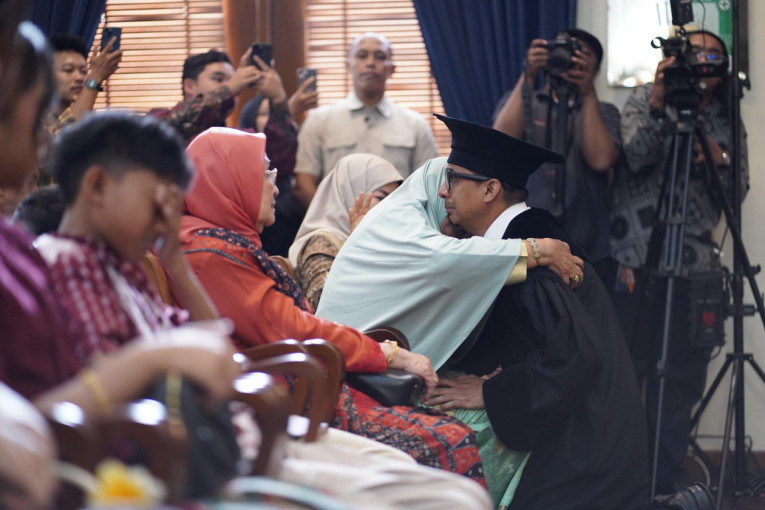
An atmosphere of deep emotion marked the inauguration ceremony of Zainal Arifin Mochtar as a full professor at the Senate Hall of Universitas Gadjah Mada (UGM) on Thursday (Jan. 15). The packed hall, filled with guests, suddenly fell silent and paused momentarily as Professor Mochtar delivered the closing remarks of his inaugural address. Known affectionately as Uceng, he wiped his tears away, recalling a message from his late father. He felt sadness and profound emotion, as the man who had always encouraged him was unable to witness his son attaining the title of professor at UGM.
Professor Uceng reflected on the long journey of dedication and the promise he had made to his parents upon becoming a professor. He admitted that 2017 was the saddest period of his life, marked by the passing of his father.
He recalled two promises he had once made. First, to take care of and preserve the thousands of books left behind by his father, a promise he has now fulfilled. Second, to complete his academic journey and attain the rank of professor, which has finally come to fruition.
After stepping down from the podium, Professor Uceng broke into tears in his beloved mother’s embrace, Zaitun Abbas, adding to the ceremony’s poignant atmosphere. He reflected on his life journey, filled with rises and falls, disappointments and joys, all of which he regarded as part of a long process he had endured.
For him, this achievement was not “a stone suddenly falling from the sky,” borrowing a phrase from Pramoedya Ananta Toer.
“I dedicate my gratitude to the many parties who have contributed, directly or indirectly, to my steps and journey up to this day,” he said.

Born in Makassar, Professor Uceng acknowledged that igniting his contribution to the field of law was not an easy path. His roles continued to shift and evolve as a son, sibling, student, university student, lecturer, and eventually a leading thinker in academia, national discourse, and the digital public sphere.
He recalled his upbringing in a modest house in Makassar, not far from Mattoangin Stadium. Under the galvanized roof of that home, he and his family shared stories, joys, and sorrows bound by blood ties.
His organizational experiences also shaped his character, from serving as President of the Student Council at SMANSA Makassar and Chair of the Student Senate of the UGM Faculty of Law (FH UGM) to active involvement in various communities and institutions.
He was involved with the Center for Anti-Corruption Studies (Pukat Korupsi), Pandheka FH UGM, Cakshana Institute, and Kemitraan, and served on a mosque supervisory board in his neighborhood, among others.
Professor Uceng’s intellectual journey began early. He frequently “traveled” through various forums, such as seminars, workshops, discussions, focus groups, talk shows, and television broadcasts, even nearly two decades ago.
“It was there that I met figures, thinkers, and intelligent people who helped accumulate information and knowledge within me,” he recalled.
His higher education journey began in 2003 when he completed his Bachelor of Laws at UGM. He later earned a Master of Laws (LL.M.) degree from the Faculty of Law, Northwestern University, Chicago, United States, in 2006, and completed his doctoral studies at FH UGM in 2012.
Professor Uceng previously served as Head of the Department of Constitutional Law at FH UGM (2021-2025).
In addition, he has been active in various national strategic positions, including as Vice Chair of the Tax Supervisory Committee at the Indonesian Ministry of Finance (2023–2025), a member of the Non-Judicial Team for the Settlement of Gross Human Rights Violations of the Past (2022-2025), and previously as part of the Task Force for Eradicating Illegal Levies (2020), among others.
Over the past five years, he has been involved in dozens of research projects, authored journal articles and numerous publications, compiled three edited volumes, written five single-author books, and received seven awards.
His name has also become widely known through the documentary film “Dirty Vote: Designing Electoral Fraud in the 2024 Election,” which presents a critical analysis of the electoral process and reinforces his position as an intellectual who speaks out based on data and facts.
Professor Uceng emphasized that, for him, becoming a professor is primarily an administrative matter, while attitude, intellectual responsibility, and alignment with the public interest carry far greater weight.
He expressed hope that professors can become organic intellectuals, not necessarily always appearing directly in the public sphere, but capable of empowering and strengthening public knowledge, especially amid increasingly systematic conditions of misinformation and neglect.
“Our responsibility will one day be called to account. From there, it will be determined what Indonesia will become in the future. For to Him we ask, and to Him we all surrender,” he said in closing his address.
One of his discussion partners, Ganjar Pranowo, also shared his happiness over Professor Uceng’s inauguration. He appreciated Professor Uceng’s freedom of movement as both a professor and an activist who voices truth based on scholarly data and facts.
“Hopefully, this mandate will continue to be carried forward as an organic intellectual attitude,” he remarked.
Jusuf Kalla likewise welcomed the occasion, expressing hope that Professor Uceng’s ideas would benefit the nation’s progress toward a more principled democratic path.
“Yes, this is a democratic country. Society, through its representatives, is certainly expected to offer criticism when needed,” he explained.
Eddy O. S. Hiariej, whom Professor Uceng has described as a brother, friend, and debate rival, also conveyed his congratulations on the new title.
“Today I am delighted and proud. I am confident that the professorship held by Professor Uceng will bring blessings for the advancement of legal knowledge and for the development of our national legal system,” he said.
Author: Hanifah
Editor: Gusti Grehenson
Post-editor: Rajendra Arya
Photographer: Firsto Adi