


The Bena Transmigration Area in South Central Timor Regency holds significant potential in dryland agriculture, horticulture, and plantation crops. To fully harness this potential, however, the area requires innovation, value chain strengthening, and a more measurable, data-driven development approach. Through the Patriot Expedition Team (TEP) Program, the Ministry of Transmigration has partnered with Universitas Gadjah Mada (UGM) to conduct field studies and formulate research-based development recommendations.
By involving academics from multiple disciplines, the program is expected to enhance the region’s potential and improve the welfare of communities in the Bena Transmigration Area, South Central Timor Regency.
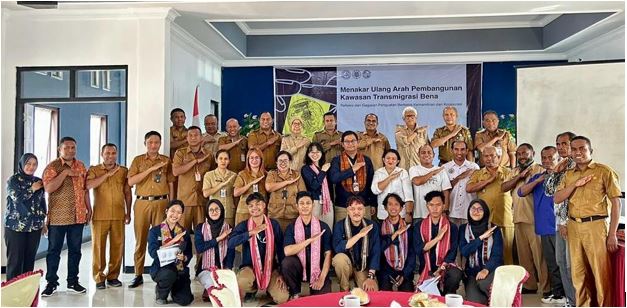
As part of the Output 2 research series, the TEP UGM and the South Central Timor Regency Government recently held a Focus Group Discussion (FGD) titled Reassessing the Development Direction of the Bena Transmigration Area: Reflections and Ideas for Strengthening Self-Reliance and Collaboration.
The Regional Secretary, Seperius E. Sipa, emphasized during the FGD opening the importance of combining data with on-the-ground realities.
He noted that the development of the Bena area requires a blend of scientific data and the local context of the four districts serving as transmigration loci, Kolbano, Kualin, Kuanfatu, and South Amanuban.
“The suboptimal agricultural productivity here remains a key challenge. There are also issues of fluctuating commodity prices and limited post-harvest facilities, all of which require more integrated and collaborative policies,” said Seperius E. Sipa.
Acting Head of the South Central Timor Regency Office for Food Crops, Horticulture, and Plantations, Jakob E. P. Benu, highlighted the need to revitalize local farming practices while introducing simple technologies to increase productivity.
He explained that dryland areas such as Kualin and Kolbano Districts could serve as promising horticulture hubs and help support the area’s economic base.
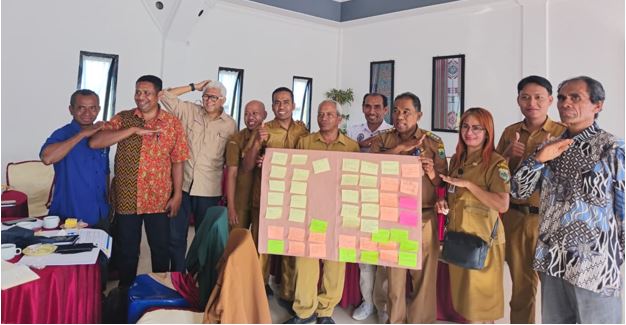
Jakob E. P. Benu added that the South Central Timor Regency Government recently collaborated with the NGO ICRAF Southeast Asia to map new potential commodities suited to the land characteristics and topography of the Bena Transmigration Area, such as robusta coffee in South Amanuban District and arabica coffee in Kuanfatu District.
“Through this FGD, we hope to generate feedback for plans to develop the agriculture and plantation subsectors, given this area’s important contribution to food needs and the regional economy,” he explained.
Chair of the Bena Output 2 Patriot Expedition Team, Deni Prasetio Nugroho, presented several studies on leading commodities and infrastructure challenges.
He stated that key commodities in the Bena Transmigration Area (such as maize, candlenut, coconut, tamarind, and horticultural crops like shallots and chilies) have strong prospects, particularly when supported by robust institutions, marketing systems, and infrastructure.
“What we found is substantial commodity potential without a solid value chain system. There is a need for collection points, market partnerships, and strengthening of village-owned enterprises (BUMDes) as aggregators,” said Nugroho on Thursday (Nov. 13).
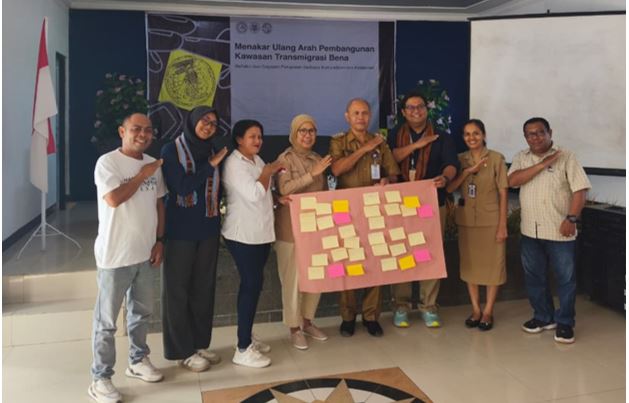
For Nugroho, the Patriot Transmigration Program is part of a national strategy to develop inclusive, productive, and sustainable transmigration areas.
Through collaboration between local governments, academics, and communities, the study aims to produce concrete policy recommendations, from determining priority commodities and strengthening the local economy to developing supporting infrastructure.
“This is the initial step toward designing an area development plan that is competitive and equitable,” he added.
From the latest field notes, Nugroho expressed his appreciation for the launch of the Nona Bena rice brand, produced through community initiatives in the South Amanuban District.
“We hope this initiative becomes the starting point for revitalizing community-based institutions and serves as a model for other regions and commodities,” he said.
Meanwhile, Dr. Dewanti, from the UGM Department of Civil and Environmental Engineering, drew attention to accessibility constraints that continue to hinder the movement of goods and people.
She explained that poor road conditions (such as damaged bridges and limited village transportation services) make it difficult for key commodities to reach regional markets such as Soe and Kupang.
“There are three key steps that can be taken to develop existing commodities and achieve community welfare: concrete action, collaboration, and downstream development. I believe that people-centered economic growth will not occur without efforts in commodity development, processing, and technological application. With the spirit of solidarity as a social asset, coordination across sectors and regions will become more structured,” she said.
Author: Agung Nugroho
Post-editor: Rajendra Arya