


The Turi area in Sleman is known as Indonesia’s main production center for salak pondoh. Its strong production potential even reaches international markets, including China, Cambodia, Vietnam, Hong Kong, and the Middle East. However, high export demand is often hindered by fruit fly infestations, which degrade harvest quality and disrupt the standardization of export products.
Chair of the Salak Farmers Group in Turi Subdistrict, Suroto, explained that fruit fly attacks are a recurring challenge, especially during the harvest season.
“At certain times, pest populations can increase by up to 40-60 percent,” he said on Wednesday (Nov. 12).
He added that his farmer group has been using methyl eugenol (ME) attractants to control the pest, but their effectiveness remains limited, particularly ahead of the peak harvest season when infestations surge sharply.
“This situation shows the need for more effective and sustainable control methods,” he said.
To address this issue, a team of lecturers from the Faculty of Agriculture (Agriculture UGM) and the Faculty of Mathematics and Natural Sciences (FMIPA UGM) collaborated to develop pest-control research using protein-based bait.
The team is led by Dr. Suputa (Agriculture UGM), with members Dr. Deni Pranowo (FMIPA UGM), Dr. Sri Wahyuni Buadiarti (National Research and Innovation Agency/BRIN), Professor Subejo (Agriculture UGM), and Dr. Panjisakti Basunanda (Agriculture UGM).
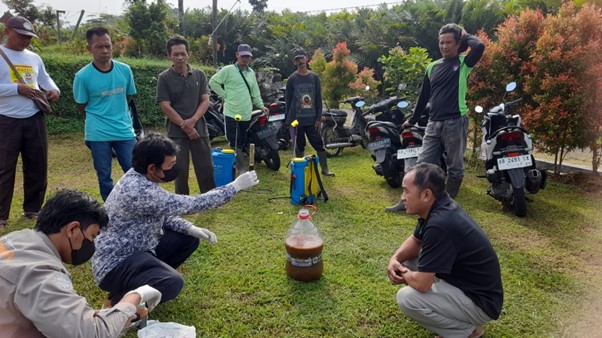
Since 2022, the team has conducted educational outreach for farmer groups on fruit fly life cycles, the mechanism of attractants, and the importance of area-based pest control.
This collaboration continued in 2024 through a partnership with the Directorate of Horticulture Protection to introduce the Area-Wide Management (AWM) method, a large-scale fruit fly control system that involves participation across multiple stakeholders.
The approach being developed consists of two main innovations: Augmentarium and Protein Bait. According to Dr. Pranowo, the Augmentarium increases populations of natural enemies of the fruit fly, such as parasitoids and predators. Meanwhile, the Protein Bait is designed to attract both male and female fruit flies.
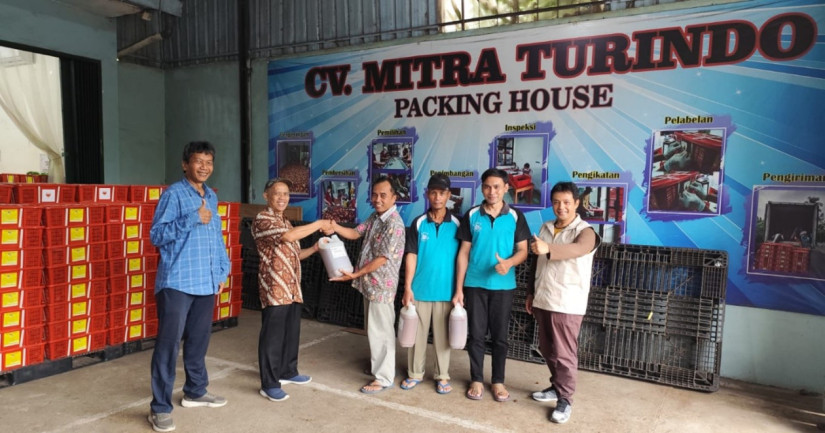
“Both innovations are being directly implemented by farmer partners in Turindo as part of our community service activities,” he explained.
The application of the AWM method has shown significant results. Fruit fly populations in the field trial area decreased by up to 96 percent after the integrated use of protein bait, wooden blocks, ME attractants, and rotting fruit sanitation.
Dr. Suputa explained that the protein bait’s effectiveness lies in its ability to target female fruit flies, which produce the next generation of pests.
“Farmers in Wonokerto reported that within just two weeks, infestation intensity dropped sharply and the number of damaged fruits decreased,” he said.
If applied sustainably, this innovation has strong potential to improve both the quality and quantity of salak production in Turi, while also expanding export opportunities and enhancing farmer welfare.
“We hope that this multi-stakeholder collaboration will create new synergies to strengthen and sustain salak pondoh production in Turi,” Dr. Suputa concluded.
Author/Documentation: Hanifah
Editor: Triya Andriyani
Post-editor: Rajendra Arya