


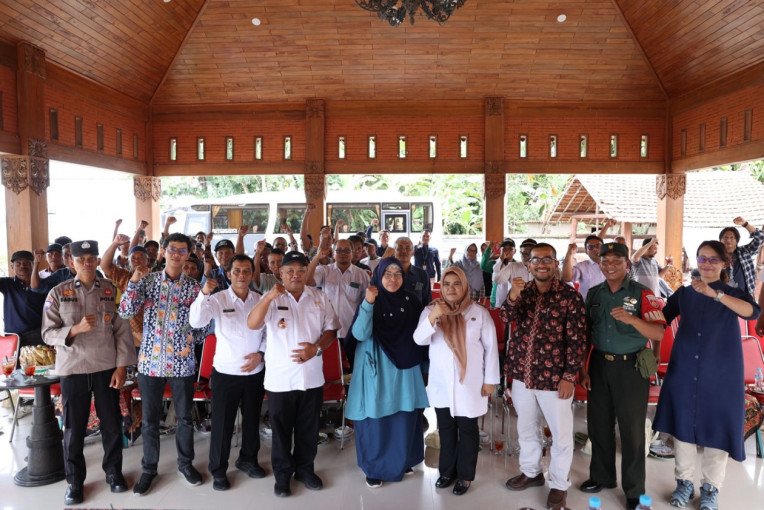
Food research conducted by researchers at Universitas Gadjah Mada (UGM) has been ongoing for decades, evolving in response to changing challenges and the real needs of society. Through the Resona Saintek Program: Empowering Research, Advancing Food Security, these innovations are being introduced to the public through dialogic, interdisciplinary activities closely connected to everyday life.
Running from September to December 2025, the program serves as a platform for UGM to present science in a more grounded manner, as part of its efforts to strengthen national food security.
At the upstream level, plant breeding research forms the foundation of several key innovations, including the development of Gamagora 7, a rice variety produced through years of selection and multi-location trials.
This innovation has become an entry point for Resona Saintek activities, bringing researchers together with farmers in various regions. The campaign has reintroduced the story behind the development of this superior variety to the public, in line with the aspirations of its researchers.
“Gamagora was developed to respond to farmers’ needs for productive and adaptive varieties,” said Professor Taryono of the Faculty of Agriculture, on Thursday (Dec. 11).
Research downstreaming also received significant attention throughout the program. From the harvest of Gamagora varieties, Presokazi, a premium rice product, was developed and produced under strict quality standards to support family nutrition in Indonesia.
During the Rerasan Pangan (food dialogue) in Caturtunggal Village, the community was introduced to the taste, nutritional value, and characteristics of Presokazi as a premium food product. The public response demonstrated the strong potential of downstreaming as a bridge between superior seed research and consumer needs.

On the other hand, soil fertility challenges have become a key focus of UGM’s interdisciplinary research. Gamahumat, a soil conditioner processed from low-calorie coal, was reintroduced through Rembug Sesarengan (community forum) activities in Klaten and a national webinar.
The product is designed to improve soil structure, enhance fertilization efficiency, and support the rehabilitation of marginal and post-mining land. Participants from various regions actively discussed the application on their respective agricultural lands.
“We aim to provide environmentally friendly technology that is also affordable for farmers,” said Professor Ferian Anggara during a national webinar titled “Synergy of Science and Institutions for Sustainable Agriculture” held last November.
Social studies on farmer institutions have also enriched the campaign’s journey. In the same national webinar, Dr. Hempri Suyatna highlighted the importance of strengthening farmer groups, village networks, and other supporting social structures to ensure the sustainable adoption of technological innovations.
This perspective highlights that food security is not merely a technological issue, but also depends on society’s capacity to manage change.
“Food security cannot stand without strong social capacity,” he said.
Meanwhile, anthropological research on food has offered another perspective on Indonesia’s food journey. Through the Resona Saintek podcast, Professor Bambang Hudayana discussed the role of porang in the history of food and community survival strategies across various regions.
He explained how porang has regained relevance amid the need for food diversification and changing consumption patterns. His discussion served as a reminder that food innovation also grows from cultural understanding and local knowledge.
“Porang holds an important place in food history and is once again relevant in the context of sustainability,” he emphasized.
The series of Resona Saintek activities illustrates UGM’s efforts to bridge research and society through inclusive approaches. In villages, farmers discussed superior crop varieties and soil conditioners.
On campus, students explored dialogues on the future of food security. In the digital sphere, the public had access to podcasts, webinars, and educational content produced throughout the program. All of these efforts reinforce UGM’s commitment to delivering relevant knowledge that provides tangible benefits to society.
The program is supported by the Ministry of Higher Education, Science, and Technology through the Resona Saintek Grant. At the conclusion of the program, UGM reaffirmed its commitment to expanding research dissemination and opening avenues for collaboration so that food innovations become more widely recognized and utilized by the public.
This long research journey demonstrates that food security is built through diligent scientific work, interdisciplinary collaboration, and active community participation.
Author: Triya Andriyani
Post-editor: Rajendra Arya
Photographer: Firsto Adi