


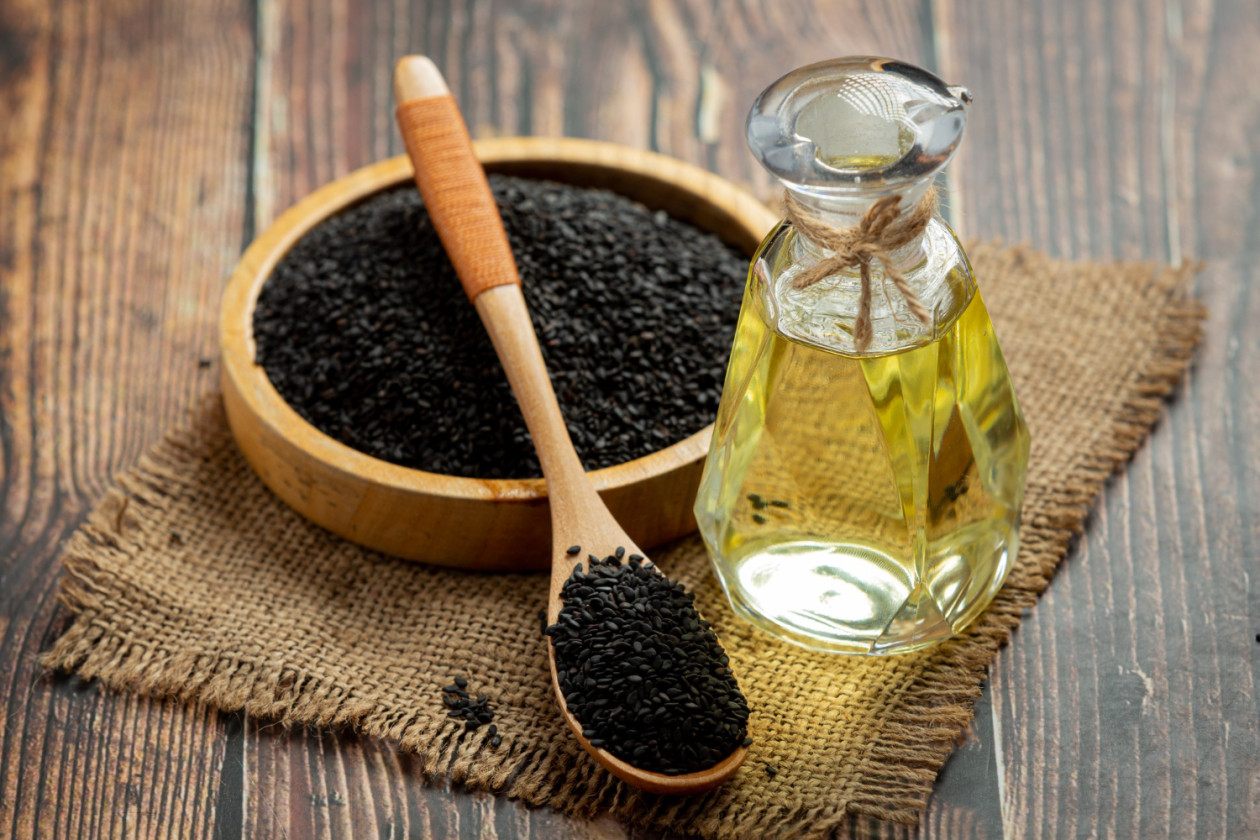
Black seed (Nigella sativa L.) has long been known in the community as a spice for dishes such as gulai and curry, while its oil is often consumed as a traditional remedy. Black seed oil contains high-value bioactive compounds, including thymoquinone, carotenoids, and tocopherols, which exhibit antioxidant and anti-inflammatory properties. However, these compounds are vulnerable to degradation when exposed to light, heat, and oxygen.
A lecturer from the Department of Food and Agricultural Product Technology (TPHP) at the UGM Faculty of Agricultural Technology (FTP-UGM), Dr. Aulia Ardhi, has successfully developed a lipid-based Nanostructured Lipid Carriers (NLC) system at the nanoscale that enhances the solubility, oxidative stability, and bioaccessibility of thymoquinone.
This NLC system uses a combination of solid and liquid lipids as the dispersed phase, with particle sizes below 100 nm. In his research, Ardhi combined glyceryl monostearate and black seed oil as the lipid phase, used Tween 80 as a nonionic surfactant, and optimized the formulation to produce an efficient and stable system.
As a result, the NLC slowed thymoquinone degradation by more than twice compared to conventional emulsions and maintained clarity and small particle size when applied to pure apple juice and carbonated apple juice for up to 28 days of storage.
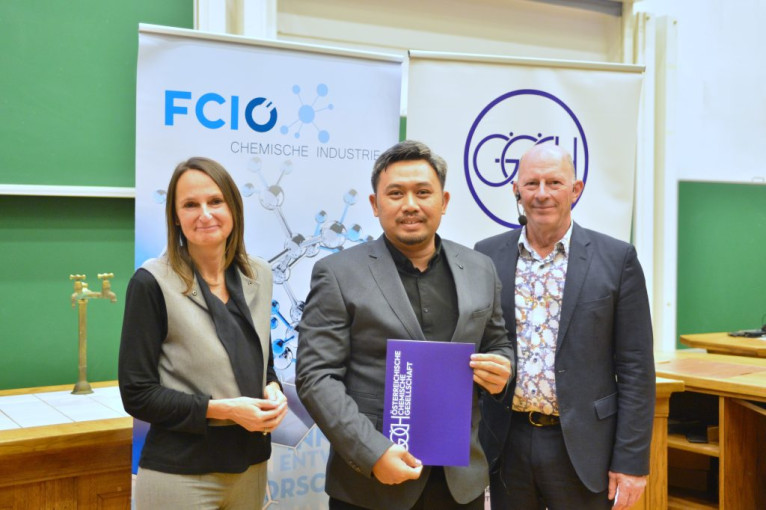
For this research, Ardhi received the Chemistry Promotion Award (Förderungspreis für Chemie) 2025 from Die Österreichische Chemische Gesellschaft (GÖCH), or The Austrian Chemical Society, in Vienna, Austria, on October 17, 2025. The award was presented directly by Peter Gärtner, President of GÖCH, to Ardhi, a young researcher recognized for significant contributions to the development of chemistry and its applications.
Ardhi expressed gratitude for the award from Austria. He noted that the achievement was also made possible by the guidance of Priv.-Doz. Dr. Matthias Schreiner (BOKU University) and Professor Sri Raharjo from FTP UGM, while completing his doctoral dissertation at the University of Natural Resources and Life Sciences, Vienna, titled “Nanostructured Lipid Carriers as a Delivery System for Black Seed Oil and Its Application in Beverage.”
He also explained that GÖCH considered the research to be an important contribution to food chemistry and nanotechnology, particularly in developing stable delivery systems for natural bioactive compounds applicable to food products.
“This innovation opens significant opportunities for developing food and nutraceutical products based on natural ingredients, especially from herbal sources widely used in Asia, including Indonesia,” he said on Thursday (Feb. 26).
The addition of beta-carotene was also shown to provide additional protection against photo-oxidative damage in the NLC system, making the technology promising for applications in the functional beverage and herbal supplement industries.
Beyond its scientific contribution, the research aligns with national priorities to strengthen food security, public health, and the utilization of local biodiversity to produce high-value innovative products. Despite receiving the award, Dr. Ardhi acknowledged facing significant challenges, particularly in maintaining thymoquinone stability within the nano system when applied to complex beverage matrices such as carbonated juices.
Through formulation optimization and a deep understanding of lipid oxidation mechanisms, he identified effective strategies to preserve the activity of these bioactive compounds.
“This technology bridges fundamental science and real-world application. With precise chemical and lipid technology approaches, natural bioactive ingredients can be delivered more stably and effectively without losing their natural characteristics,” Ardhi said.
For Ardhi, the international recognition underscores the growing presence of young Indonesian researchers on the global stage and strengthens scientific collaboration between UGM and BOKU University to advance innovation-driven research and enhance national research competitiveness.
Author: Ika Agustine
Editor: Gusti Grehenson
Post-editor: Rajendra Arya
Photo: Researcher Documentation and Freepik