


Over time, women have often been sidelined from avenues that lead to empowerment. As if deliberately hidden, history often seems unable to record the footprints of empowered women. Civilization appears reluctant and unprepared to read works born from women’s hands or to simply hear women’s resounding voices. This clearly affects the confidence of women born in more modern eras.
Writer and sociologist Okky Madasari explained that today, knowledge has become a right for all layers of society; yet some groups still struggle to achieve equality. This underlies her consistent choice to place women as the main characters in her books, because women are frequently marginalized or at least stereotyped for the choices they make for themselves.
“Indeed, not all portray women as protagonists, because I want to use literary works to depict injustice, inequality, and the lack of access to the ability to choose,” said the author of Entrok in the talk show Woman Inspiring Talk, part of the grand event Ramadan at UGM (RDK) at the Graduate Center Building UGM, Friday (Feb. 27).
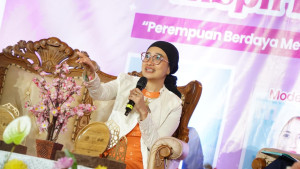
Okky noted that women often make choices under coercion. Therefore, efforts are needed so that women can choose, and that these choices do not stem from repression and compulsion.
In contrast to Okky, who comes from a sociological background, Sasti Gotama chose to weave words to voice the experiences of women in remote, frontier, and outermost regions (3T), including those of patients and their families, drawing on her service as a medical doctor.
“In areas with weak economies, I often see such inequalities. Many victims of domestic violence arrive with trauma, and most do not dare express their trauma due to pressure from their surroundings, preferring to hold it inside rather than tell their stories,” said the author of Ingatan Ikan-Ikan.
For Sasti, poverty often becomes the foundation that pushes parents to marry off their children early due to economic factors, “Better to finish someone else’s rice than to stay in their own home,” she added.
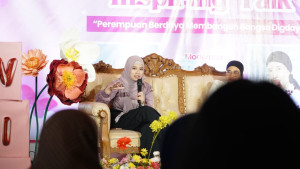
Addressing women’s right to choose is indeed closely linked to repression and pressure. Moreover, repression can come from anywhere—social media, those who claim high intellect and morality, even those closest to them. From this standpoint, Okky and Sasti agreed to use writing as a medium for women to express themselves and share their perspectives.
Throughout their careers in the literary world, when these experiences and perspectives are voiced through their works, many female readers have agreed and felt represented. Conversely, they noted that when women speak out directly, they often encounter pressure from norms and dogma, and even labeling, without a comprehensive investigation.
Women should not lose their identity. Writing is a skill every woman must possess. Writing is one way to help women find their identity, an art to determine choices according to the call of their hearts.
Furthermore, writing can open access to empowerment and a wide range of new experiences. It is time to uphold women’s right to choose and to enable them to create significant contributions through their knowledge and creativity.
Author: Ika Agustine
Editor: Gusti Grehenson
Post-editor: Zahra
Photo: Freepik and Courtesy of RDK UGM