


ASEAN is one of the world’s emerging economic regions, with a population of more than 687 million. Supported by digital integration, ASEAN has rapidly developed into a vital region for global trade and economic corridors. Amid recent global economic conditions driven by complex geopolitical tensions, ASEAN countries face significant challenges in sustaining regional economic stability and growth.
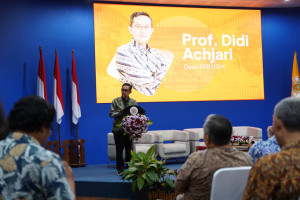
“We are facing an increasingly complex global environment marked by geopolitical tensions and persistent uncertainty. Policymakers need to be united to get a deeper understanding of ASEAN’s strategies for preserving momentum amid global uncertainty,” said Professor Didi Achjari, Dean of the Faculty of Economics and Business at Universitas Gadjah Mada (FEB UGM), during the “Seminar on ASEAN Regional Economic Outlook and Fiscal Policy” on Tuesday (May. 26) at the FEB UGM campus.
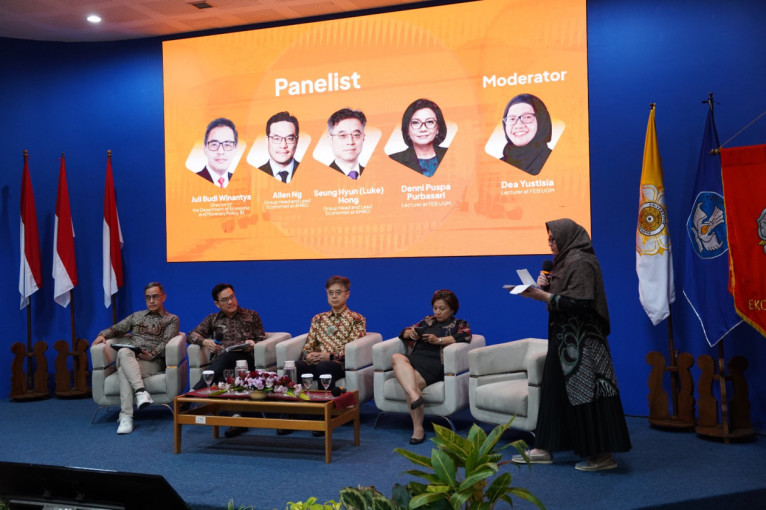
The seminar featured speakers and panelists from the ASEAN+3 Macroeconomic Research Office (AMRO), Bank Indonesia, and FEB UGM economists. In her presentation titled “Global Uncertainty and Regional Economic Integration”, AMRO Senior Economist Catharine Kho stated that the ASEAN+3 economy is projected to perform better in 2026 than in the previous year. This outlook is reflected in the region’s resilience despite pressures stemming from global tariff policies.
“ASEAN+3 economic growth continues to exceed expectations despite tariff shocks. This performance is supported by relatively low effective tariff rates and rising demand for AI-driven semiconductor exports,” she explained.
Ho added that strong domestic demand has also become a key pillar of regional economic stability. Household consumption remains resilient amid favorable labor market conditions and relatively low inflation. In addition, increasing foreign direct investment (FDI) flows continue to strengthen economic growth across ASEAN+3.
She also highlighted the growing trade and investment ties among countries within the ASEAN+3 region, which she believes provide an important buffer against global economic pressures.
“Stronger trade and investment relationships within ASEAN+3 serve as a critical cushion against various external challenges,” she said.
Despite these positive developments, Kho noted that the region’s economic outlook is increasingly tilted toward downside risks. Largely due to ongoing instability in the Middle East, where elevated energy prices continue to generate global repercussions. The conflict’s duration will determine the intensity of economic pressures and uncertainty.
“Based on current research, the global economy is expected to grow 4 percent slower, while inflationary trends are likely to increase,” she said.
Ho explained that economic relationships within ASEAN+3 are undergoing a major transformation. While the region was once known as the “world’s factory,” producing goods primarily for global markets, it is now evolving into a more interconnected network of regional production and trade.
Regional supply chains have become increasingly integrated. China serves as a manufacturing hub, Japan and South Korea specialize in high-tech components, while ASEAN countries are emerging as centers for mid-value manufacturing and digital services.
“Economic relationships in the region are no longer solely oriented toward global markets but are increasingly driven by regional strengths,” she said.
According to Kho, ASEAN+3 remains indispensable for Indonesia because it continues to be the country’s largest trading partner and a major source of demand for the national economy. While regional integration offers numerous benefits, including stronger resilience against global shocks and improved productivity, she cautioned that it also creates new challenges.
“The deeper the regional integration, the greater the risk that crises in one country may spread across borders,” she explained.

She emphasized that ASEAN countries need to strengthen regional cooperation, maintain flexible economic policies, and improve industrial capabilities and human capital to remain competitive amid global economic shifts. ASEAN should also increase intra-regional investment to support deeper and more sustainable economic integration.
“ASEAN needs to promote cross-border investment within the region to strengthen trade ties and support long-term economic growth,” she concluded.
Meanwhile, UGM economist Denni Puspa Purbasari argued that the economic transformation currently taking place in ASEAN is driven by challenges that differ significantly from those of a decade ago. According to her, the changes are not merely cyclical fluctuations in interest rates or commodity prices but represent more fundamental structural shifts.
“In the past, our economic model relied on globalization, innovation, low production costs, and relatively stable global demand. Today, the situation is different. We are facing fragmentation, strategic competition among countries, climate change, and technological developments,” she said.
Denni explained that ASEAN’s challenge today extends beyond sustaining economic growth and strengthening regional resilience. It also involves determining the most appropriate development model amid ongoing global uncertainty. She noted that changes in the global economic structure are affecting market demand patterns, including those in Indonesia.
According to her, market demand is increasingly concentrated in specific sectors, requiring more adaptive and inclusive development strategies.
“What we need now is not only inclusivity at the ASEAN regional level but also within Indonesia itself,” she said.
She added that Indonesia is facing not only global economic pressures but also domestic challenges that must be addressed seriously to ensure that economic growth is shared more evenly across society.
During the discussion session, Denni also emphasized the importance of ensuring that economic growth benefits the broader population. In her view, rising household consumption does not necessarily reflect a healthy economy. She pointed out that workers’ incomes increased by only 2.2 percent, while consumption grew by 5.5 percent, indicating an imbalance in the distribution of economic growth.
“We must ensure that economic growth is truly distributed throughout society. Consumption should not increase simply because people are relying on loans to maintain their purchasing power,” she said.
She warned that if this trend persists over the long term, it could become a dangerous trap for Indonesia’s economy. The government, she argued, needs to strengthen fiscal policy, particularly by improving the efficiency of budget allocations and safeguarding fiscal sustainability.
Denni also noted that rising government spending without corresponding increases in state revenue could pose significant risks to fiscal sustainability.
“If expenditures continue to increase without stronger revenue collection, it could become a major threat to Indonesia’s fiscal resilience,” she explained.
In addition, she highlighted the quality of foreign direct investment (FDI) in Indonesia. According to her, the country’s challenge is not merely attracting foreign investment but ensuring that it contributes to higher productivity and greater domestic industrial capacity.
“We have not yet been able to fully leverage incoming foreign investment to significantly improve national economic productivity,” she concluded.
Author: Zabrina Kumara
Editor: Gusti Grehenson
Post-editor: Jasmine Ferdian
Photo: Firsto