


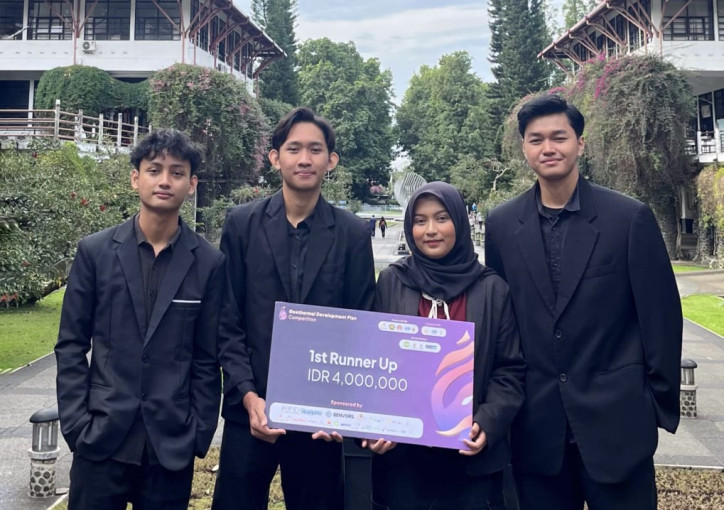
Students from Universitas Gadjah Mada who are members of the Selokan Mataram Team from the Faculty of Engineering (FT UGM) secured second place in the Geothermal Development Plan Competition (GDPC) held on February 20–22 at the Bandung Institute of Technology campus in Bandung. This international-scale competition was part of the Integrated Petroleum Festival ITB 2026 (IPFEST ITB) and was attended by students from various universities. Energy industry practitioners from companies such as Chevron, INPEX Geothermal, Geo Dipa Energi, and Pertamina Geothermal Energy served as judges in the final round, making the competition a platform for testing ideas closely connected to the industry ecosystem.
The Selokan Mataram Team consists of three students from the 2023 cohort: Muhammad Nabil Hafiz (Mechanical Engineering), Abdi Yuridan Arsya (Mechanical Engineering), and Jihan Fathin Salsabila (Geology), along with one student from the 2024 cohort, Lailum Lutvi Sahrudin (Geology). The team presented a paper titled “Feasibility Study: Patuha Geothermal Field Development,” which focuses on strategic planning for the development of the Patuha Geothermal Field by considering various technical and economic aspects. Collaboration between mechanical engineering and geology became the team’s main strength in producing a more comprehensive analysis.
Jihan explained that the project required the team to gain a comprehensive understanding of geothermal systems. The competition evaluated not only technical analysis skills but also the ability to formulate realistic development strategies.
“Geothermal development is not merely about calculating energy potential, but also about determining how risks can be managed so that practical strategies can be applied to real-world cases,” she said on Friday (Mar. 13).
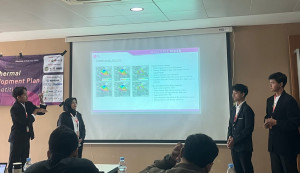
The Selokan Mataram Team began its analysis using the 3G approach by integrating geological, geophysical, and geochemical data. This approach was used to develop a conceptual reservoir model as a basis for understanding the geothermal system. The conceptual model then served as the foundation for further resource assessment.
The team believes this approach ensures every technical decision is supported by clear, structured scientific reasoning, keeping the project’s final outcomes consistent and accountable.
During the resource assessment stage, the team employed a probabilistic method using Monte Carlo simulations to calculate potential resources while mapping data uncertainty levels. This analysis helped measure both risks and opportunities, allowing the results to inform the most efficient development strategy.
“We aimed to ensure that the project design remains realistic, even though field conditions tend to be complex,” she said.
Regarding the project development strategy, the team proposed a phased approach to minimize investment risk. During the technical exploration stage, they recommended using slim-hole drilling methods. For power generation technology, the team proposed a Dry Steam Condensing system, which they considered most suitable for the characteristics of the Patuha reservoir.
In addition to technical and economic considerations, the team also incorporated principles of Occupational Safety, Health, Security, and Environment (K4L). Each development plan was reviewed to ensure that exploration and production activities prioritize worker protection and environmental sustainability.
For the team, renewable energy development is not only about energy production but also about social and ecological responsibility. The competition experience provided the students with deeper insight into the importance of academic and industry practices in supporting Indonesia’s energy transition.
Writer: Ika Agustine
Editor: Gusti Grehenson
Post-editor: Jasmine Ferdian
Photo: Courtesy of the Selokan Mataram Team