


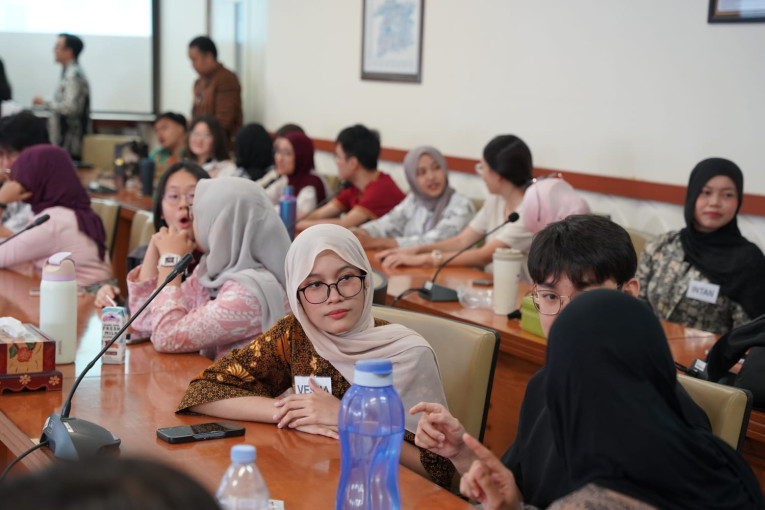
The Faculty of Agricultural Technology at Universitas Gadjah Mada (FTP UGM) and the National University of Singapore (NUS) collaborated in organizing the Southeast Asia Friendship Initiative, an international exposure program initiated by NUS through King Edward VII Hall.
The program, attended by 44 students and several lecturers from UGM and NUS, is being held on May 21 and 22, 2026, at FTP UGM. It features a series of activities themed around Zero Hunger, ranging from presentation sessions to various supporting activities designed to strengthen learning processes and collaboration among participants.
Dean of FTP UGM, Professor Eni Harmayani, stated that the program aims to broaden global perspectives and strengthen relationships between students from both institutions through academic activities and cultural exchange.

Professor Harmayani expressed appreciation for the initiative carried out by UGM and NUS, which highlights the theme of Zero Hunger. According to her, the theme is highly relevant, as Southeast Asia has faced a range of complex challenges in recent years, including climate change, food security, sustainable agriculture, public health, digital transformation, and corporate health.
“These challenges cannot be addressed by a single country or institution alone. They require regional solidarity, interdisciplinary collaboration, and the active involvement of universities as centers of knowledge and innovation,” she said on Thursday (May. 21) at FTP UGM.
Professor Harmayani emphasized UGM’s commitment to producing students who excel in research and can make a global impact. UGM also strives to encourage the emergence of a younger generation that is not only academically accomplished but also contributes to the development of a more resilient, inclusive, and sustainable Southeast Asia.
“We aspire to nurture students who excel and make meaningful contributions in research while supporting the development of Southeast Asia as a resilient, inclusive, and sustainable region,” she said.

She also expressed hope that the Southeast Asia Friendship Initiative would serve as a bridge connecting ideas, cultures, and future generations across Southeast Asia.
“We hope this initiative becomes a bridge that connects the ideas, cultures, and future generations of Southeast Asia,” she added.
Head of UGM’s Office of International Affairs, Tyas Ikhsan Hikmawan, stated that issues related to the Sustainable Development Goals (SDGs), particularly Zero Hunger, are important concerns for both national interests and university development.
According to Tyas, food challenges and sustainable development require the involvement of various stakeholders through cross-country and cross-institutional collaboration. Through the initiative, Hikmawan hopes participants will not only exchange knowledge and ideas but also develop mutual understanding and a shared sense of responsibility in creating relevant solutions to global challenges.
“Global solutions require global friendship,” he remarked.

NUS representative Giuseppe Timperio explained that the Southeast Asia Friendship Initiative was launched in 2023 as part of NUS’s efforts to raise awareness among future leaders about the importance of welfare and sustainability across institutions. He noted that in seeking partners for the program, NUS viewed Universitas Gadjah Mada as a strategic partner with a similar vision. According to him, UGM’s attention to food security and community welfare aligns with the values promoted by NUS.
“UGM is a strategic partner for NUS. I am very pleased to know that UGM, like NUS, also pays close attention to food welfare,” said Timperio.
Author/Photo: Zabrina Kumara
Editor: Gusti Grehenson
Post-editor: Rajendra Arya