


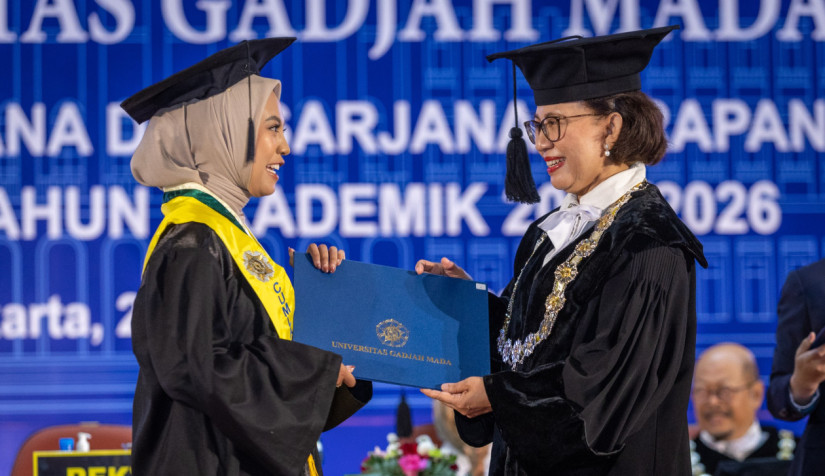
Universitas Gadjah Mada (UGM) held its 2026 Period III Undergraduate and Applied Undergraduate Graduation Ceremony at Grha Sabha Pramana on Wednesday (May 20). 1,762 graduates participated in the ceremony, comprising 1,644 undergraduate graduates and 118 applied undergraduate graduates, including 5 international graduates.
During this period, the average duration for undergraduate graduates was 3 years and 11 months, with an average GPA of 3.6. As many as 72 percent of graduates earned cum laude honors, while three graduates achieved a perfect GPA of 4.00. The ceremony also featured personal stories of perseverance that reflected a more inclusive and humane face of higher education.
UGM Rector, Professor Ova Emilia, noted that higher education is responsible for preparing adaptive human resources amid global change. Technological developments and social dynamics require cross-sector collaboration alongside stronger character development among students. UGM encourages competency development, collaborative networks, and the strengthening of inclusive educational paradigms so graduates are prepared to face increasingly complex social realities.
Professor Ova Emilia also addressed the discourse surrounding the elimination of study programs considered less relevant. The existence of academic programs should align with societal needs, including industrial demands, social life, sustainability, and the advancement of knowledge itself.
She explained that at UGM, across 28 disciplines ranked in the QS World University Rankings by Subject, three social sciences and humanities disciplines are among the world’s top 100. The Theology program ranks among the world’s top 45, placing it in a highly strategic position. In addition, Anthropology and Development Studies are both ranked within the world’s top 100.
“Strengthening these fields reflects UGM’s growing academic excellence, recognized globally, and demonstrates that academic development is being carried out in a focused and sustainable manner,” she said.
Professor Ova Emilia explained that academic development at UGM is conducted comprehensively, including through strengthening the social sciences and humanities disciplines that have gained global recognition.
“Education serves as a space for liberation that brings justice and progress to society, because human needs are not measured solely by industrial demands, but also by the needs of life itself,” she remarked.
In her speech, she also emphasized the importance of producing graduates who create a meaningful impact on society. An academic degree should not stop at administrative achievement or securing employment. The learning experience at the university is expected to shape integrity, critical thinking skills, and the courage to face future challenges.
Various collaborative learning experiences, research activities, Community Service Program (KKN-PPM UGM), and student activities have become spaces for character building among UGM students.
“Being a UGM graduate is not merely about earning a diploma, but about becoming an individual with strong moral character who can contribute meaningfully to society,” she stated.
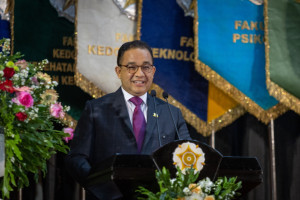
The Advisory Board of the Central Executive Board of KAGAMA, Anies Baswedan, encouraged graduates to view life after graduation realistically yet optimistically. He reminded graduates that they are entering the workforce amid a challenging economic and increasingly competitive job market.
However, those born during difficult times often become the strongest. He explained that challenges should not be feared, but rather viewed as opportunities for learning that build personal resilience.
“Generations graduating during difficult times often become the strongest because they learn to endure, understand circumstances, and grow amid limitations,” he said.
Anies also shared reflections on the meaning of a first job for young graduates. According to him, a first job may not always lead to an ideal position or a high salary, but it plays an important role in shaping character.
He believes that maintaining integrity, keeping promises, and completing simple tasks earnestly form the foundation of a long-term career journey. In professional life, individuals are shaped through small decisions made consistently every day.
“Do not wait for the perfect job to give your best, because the future is often built from small decisions carried out with full responsibility,” he noted.
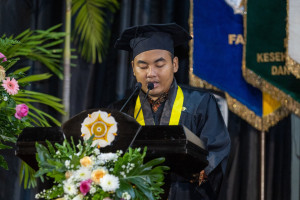
Meanwhile, a graduate representative from the Faculty of Animal Science (Animal Science UGM), Siham Hamda Zaula, shared his personal story as a student with autism. He admitted that since childhood, he often felt different because she had difficulty understanding social situations and easily felt overwhelmed in crowded environments.
These experiences made his academic journey challenging, especially when dealing with anxiety and environmental pressures. However, the campus environment gradually helped him understand that everyone grows and develops differently.
“Today, I learned that having a disability does not mean being incapable, because everyone has their own path and timing,” he said.
In his speech, Siham also expressed appreciation to lecturers, family members, and UGM’s Disability Services Unit for their support throughout his studies. According to Siham, support that may seem simple often becomes an important reason for students with disabilities to continue pursuing their dreams.
He encouraged graduates to help create a more inclusive environment that embraces differences. For him, diversity should not merely be accepted, but embraced as a shared strength in social life.
“I hope we can all build a future that provides a safe space for anyone who feels different, because differences are strengths,” he concluded.
Author: Triya Andriyani
Post-editor: Jasmine Ferdian
Photo: Donnie