


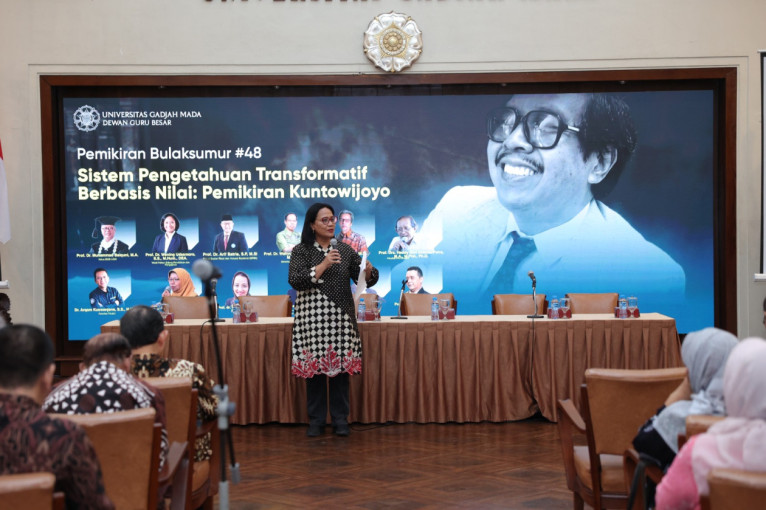
Over the past several decades, scientific knowledge has developed rapidly. However, these advancements have often not been accompanied by stronger commitments to humanity and social justice. Values such as humanity, integrity, sustainability, and social responsibility often appear only as normative slogans rather than being fully realized. According to Kuntowijoyo, knowledge is understood not merely as a tool for explaining reality but also as a means of transforming it.
These ideas were discussed during the 48th edition of the Bulaksumur Thought Discussion organized by the Professorial Board of Universitas Gadjah Mada (DGB UGM), titled “Sistem Pengetahuan Transformatif Berbasis Nilai: Pemikiran Kuntowijoyo” (Value-Based Transformative Knowledge Systems: The Thought of Kuntowijoyo), held at the Senate Hall of the UGM Central Office on Wednesday (May 20).
The discussion brought together interdisciplinary perspectives to build the foundation for a value-based model of social transformation. The forum explored topics ranging from epistemology to education and health.
As is well known, Kuntowijoyo was a Professor of History at Universitas Gadjah Mada and was recognized as one of Indonesia’s leading historians, cultural figures, and literary scholars. He was born in 1943 and passed away in 2005.
Dean of the UGM Faculty of Cultural Sciences (FIB UGM), Professor Setiadi, emphasized that Kuntowijoyo’s thought on Islam as knowledge serving as a path for social transformation remains highly relevant today. According to him, the essence of human life is rooted in profound individual characteristics, namely the values embedded within human beings.
“Whether we become complete Muslims or not can be seen through the outcomes reflected in our behavior,” he stated.
The lecturer from UGM Faculty of Philosophy (Philosophy UGM), Dr. Arqom Kuswanjono, highlighted Kuntowijoyo’s ideas on Islam as knowledge and epistemology, as well as transcendental structuralism. He responded to the concept of Islamization as an effort to Islamize Western sciences considered secular.
Dr. Kuswanjono further explained that Kuntowijoyo’s thought integrates empirical rationality, philosophy, Sufism, and religion. According to Kuntowijoyo, sacred texts, which are absolute in nature, are interpreted by humans situated within particular historical contexts.
“For example, interpretations of verses in the 1900s would differ from interpretations in the 2000s,” he explained.
This occurs because historical contexts and knowledge continue to evolve. Therefore, interpretations of the Quran must continuously be renewed in response to changing times. Without reinterpretation, such understandings risk being abandoned. He believes this partly explains why religion is increasingly neglected in contemporary society.
According to Dr. Kuswanjono, Kuntowijoyo’s thought suggests that it is not knowledge that needs to be Islamized, but rather Islam that should be studied scientifically. Islam must be transformed from merely a normative teaching into objective, empirical knowledge that can be applied in social life.
“Islam should not only function as a belief system, but also as a scientific paradigm capable of building civilization,” he explained.
Meanwhile, Professor Mora Claramita from the UGM Faculty of Medicine, Public Health, and Nursing (FK-KMK UGM), discussed Kuntowijoyo’s perspective on Islam as knowledge through the lens of family medicine. She referred to interpretations of Quranic verses containing medical insights.
Professor Mora cited Surah Al-Baqarah, verse 168, regarding halal and healthy food. According to her, the verse outlines what humans should and should not consume for health. She explained that when understood individually, these Quranic verses contain extraordinary knowledge for human life.
“Islam is knowledge is evident because it has been scientifically proven,” she concluded.
Kuntowijoyo’s wife, Susilaningsih, expressed appreciation to all parties who continue to discuss Kuntowijoyo’s ideas. She hopes that Kuntowijoyo’s books will inspire new ideas and broader benefits for society.
“On behalf of the family, we would like to thank everyone who continues to ensure that Mas Kunto’s books remain widely beneficial,” she remarked.
Author: Fatihah Salwa Rasyid
Editor: Gusti Grehenson
Post-editor: Rajendra Arya
Photo: Firsto