


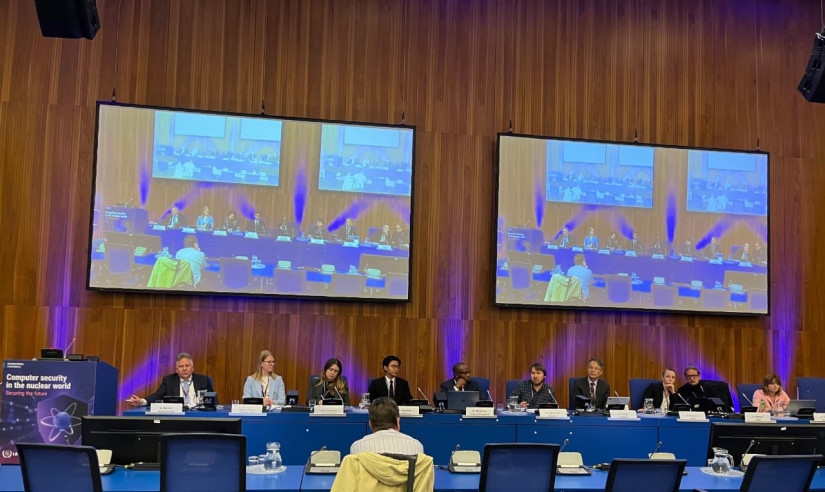
A student from the Nuclear Engineering Program at the UGM Faculty of Engineering (FT UGM), Marchelino Chrisrichy Cosmo Hutama, successfully represented Indonesia at the International Conference on Computer Security in the Nuclear World: Securing the Future 2026 (CyberCon26). The conference was organized by the International Atomic Energy Agency (IAEA) from May 11–15, 2026, in Vienna, Austria.
Marchelino was the youngest panelist, joining fellow panelists from the Netherlands, Ukraine, Canada, and the United Kingdom. He presented his research titled “Regulatory Frameworks Technical Session: Practical Use of International Standards and Guidance to Enhance Computer Security.”
According to Marchelino, the study was conducted to formulate strategic recommendations for strengthening computer security regulatory frameworks for Indonesia’s future nuclear power plants (NPPs).
“This research emphasizes standardization and conformity assessment principles through a qualitative comparative study using gap analysis of existing conditions, standards, technical regulations, and industry practices,” he explained on Tuesday (Jun. 2).
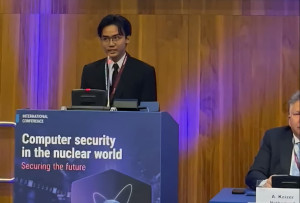
He noted that Indonesia has a long history of operating three nuclear research reactors and has committed to launching its first nuclear power plant by 2032. However, nuclear security regulations, particularly those concerning computer security, remain relatively underexplored and require further strengthening to protect critical NPP assets from cyber threats.
“I am grateful that both research projects resulting from collaboration with my colleagues were selected by the IAEA and presented at CyberCon26,” he said.
Jenna Decastro of Sandia National Laboratories in the United States, who chaired the session, praised Marchelino’s presentation. She described it as clear and highly engaging. Marchelino also received recognition and positive feedback from panelists and delegates from various countries.
“I truly appreciate Marchelino’s research presentation. It was energetic, clear, and compelling. I am confident that Marchelino will achieve great success,” said Natasha Edeh, a representative from Germany.
Similarly, Yannick Reboul, an IAEA Technical Officer, and Abraham Parbhunath, Senior Specialist in Nuclear Security at the Federal Authority for Nuclear Regulation (FANR) of the United Arab Emirates, who also attended the session, expressed their appreciation and support for Marchelino’s presentation.
“An excellent presentation. Collaboration with nuclear regulatory authorities and synergy with nuclear operators will undoubtedly be strategic steps toward strengthening regulations and the computer security ecosystem in the nuclear energy sector,” said Reboul.
According to Parbhunath, the research represents a promising starting point for developing nuclear security infrastructure, particularly for countries preparing to launch nuclear energy programs.
“What makes it even more encouraging is that this research was initiated by a member of the younger generation,” he remarked.
CyberCon26 marked the third IAEA international conference Marchelino has attended during his studies in Nuclear Engineering at UGM. Previously, he served as a speaker at the International Conference on Nuclear Security: Shaping the Future 2024 (ICONS 2024) and the International Conference on Advances in Radiation Oncology (ICARO-4) in 2025, both held at the IAEA headquarters in Vienna, Austria.
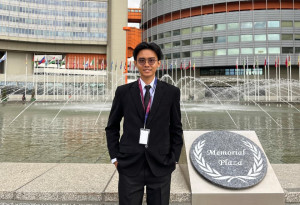
For Marchelino, serving as a panelist at CyberCon26 was both a valuable experience and a significant achievement, encouraging him to further develop his capabilities on the international stage. The conference was an honor and a source of pride, allowing him to represent Indonesia before delegates from United Nations member states.
In addition to presenting his research, Marchelino had the opportunity to receive career mentoring and build professional connections with experts and practitioners from various countries attending the IAEA event. He described the experience as particularly meaningful because it enabled him to collaborate across sectors and explore nuclear issues from regulatory and educational perspectives, ultimately contributing to internationally recognized research.
“I hope this experience can inspire fellow students, particularly those interested in advancing nuclear technology for Indonesia and the world,” Marchelino concluded.
As is widely recognized, CyberCon26 is an important global forum for strengthening computer security in the nuclear sector, addressing cyber threats, and promoting international cooperation among governments, experts, operators, and organizations involved in nuclear security and safety worldwide.
Author: Salwa
Editor: Gusti Grehenson
Post-editor: Zabrina Kumara Putri
Photo: Courtesy of Marchelino