


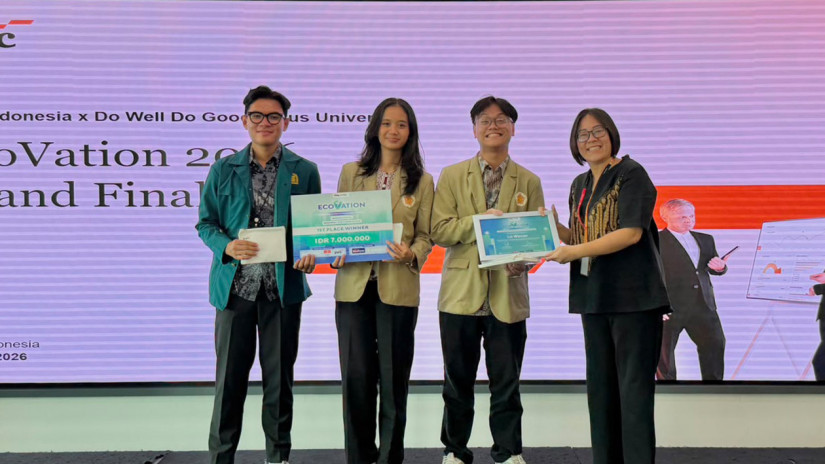
A proposal to strengthen environmental, social, and governance (ESG) standards in Indonesia’s nickel industry earned a team of students from Universitas Gadjah Mada (UGM) and Institut Teknologi Bandung (ITB) first place at EcoVation 2026, a national sustainability case competition. The final round was held at the PwC Office WTC 3 in South Jakarta on Friday (July 10).
The winning team comprised Fatika Permata Dewi and Derichson Qualimva, both Industrial Engineering students from UGM’s Department of Mechanical and Industrial Engineering (DTMI), together with Fadil Alfayat from ITB. In addition to securing first place, Qualimva received the Best Speaker Award. Zhejiang University finished second, followed by Binus University in third place.
The team tackled the international stigma surrounding Indonesia’s nickel industry through a proposal titled Dirty Nickel. Presented in a 15-slide pitch deck, the proposal drew on the concept of information asymmetry, commonly known as the “lemons problem,” to explain how international buyers often struggle to distinguish between nickel producers that meet Environmental, Social, and Governance (ESG) standards and those that do not because Indonesia lacks a credible national verification mechanism.

To address that challenge, the team introduced PROVE-N (Proof-based Responsible & Verified Nickel), a three-layer ESG governance and verification framework developed for PwC Indonesia.
Fatika Permata Dewi explained that PROVE-N integrates three complementary layers to strengthen responsible nickel production nationwide.
The Ground Layer establishes operational ESG standards covering areas such as tailings management and community relations. The Trace Layer strengthens implementation by integrating SIMBARA-ESG data with a PROVE Score linked to RKAB production quotas. Finally, the Proof Layer provides an official certification mechanism through the Indonesia Responsible Nickel Council (IRNC) that aligns with international standards, including IRMA, the Carbon Border Adjustment Mechanism (CBAM), and the Battery Passport, while supporting compliance with PSPK financial reporting requirements before the January 2027 deadline.
“Essentially, this system enables Indonesia’s nickel industry to demonstrate that its products are responsibly produced by building on existing systems rather than creating entirely new mechanisms,” Dewi said on Monday (July 20).
The team’s journey to the championship consisted of three competition stages, each featuring a different industry partner. Mad for Makeup collaborated on the preliminary round, Uniqlo sponsored the semifinal case, and PwC Indonesia hosted the final round.
During the final presentation, three PwC sustainability experts evaluated the proposal: Miranti Nastiti, Sustainability Manager; Vinsensius Hansen, Sustainability Manager; and Stella Farronikka, Senior Sustainability Manager.
Dewi said the changing case studies made the competition especially demanding because each stage required participants to develop an entirely new solution rather than refining ideas from previous rounds.
“Unlike competitions with a single case collaborator, where participants only need to develop ideas from previous rounds further, we had to start fresh at every stage,” she said.
Reflecting on the team’s achievement, Dewi said the competition taught them that developing sound problem-solving skills under pressure, strengthening teamwork, and remaining open to unfamiliar ideas were ultimately more valuable than winning itself.
“For us, the experience gained throughout the process was far more meaningful than the final result of the competition,” she concluded.
Author: Fatihah Salwa Rasyid
Editor: Gusti Grehenson
Post-Editor: Zabrina Kumara
Reportage: Gusti Purbo Darpitojati / Faculty of Engineering UGM