


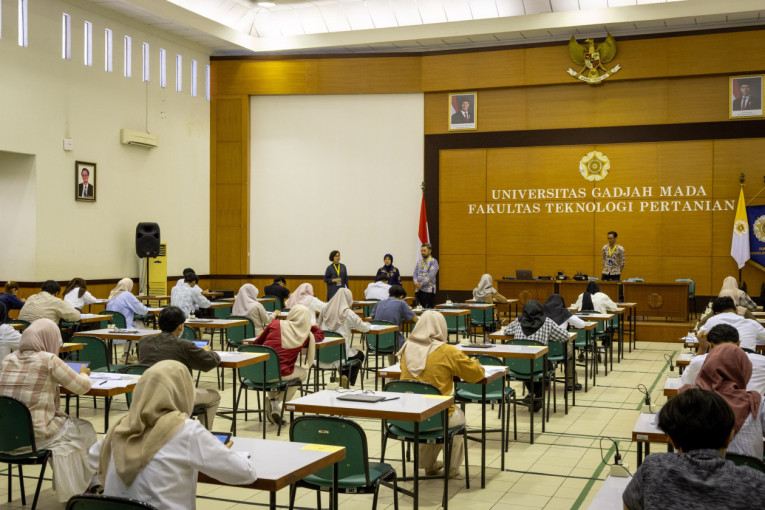
A total of 44,972 applicants participated in the 2026 Universitas Gadjah Mada Computer-Based Admission Test (UM UGM CBT), held from Jun 2 to 8. Most applicants chose Yogyakarta as their test location, with 40,190 participants, while another 4,782 took the examination in Jakarta.
The applicants are competing for 3,729 seats in undergraduate and applied bachelor’s degree programs still available through the university’s independent admission pathway. With nearly 45,000 applicants taking part, competition in this selection process is particularly intense. On average, more than 13 applicants are competing for each available seat at UGM.
UGM Rector, Professor Ova Emilia, stated that the implementation of the UM UGM CBT continues to improve from year to year. Evaluations from previous examinations have provided the basis for strengthening the university’s testing system. One of the university’s primary concerns is anticipating increasingly sophisticated forms of cheating that emerge alongside technological advancements. UGM has tightened various monitoring procedures, from screening participants before they enter examination rooms to regulating personal belongings during the test.
“With today’s technological developments, the potential for cheating can take many forms. Therefore, we continue to strengthen mitigation measures and supervision to ensure that the selection process remains fair and credible,” said Professor Ova Emilia during a monitoring and evaluation session of the UM UGM CBT on Thursday (Jun. 4).
Professor Ova Emilia added that this year’s increase in applicants has also become a key consideration in administering the UM UGM CBT. As a result, various aspects of the examination process continue to be evaluated and refined based on experiences from previous years.
According to her, improvements are being made not only in supervision but also in the overall support system for administering the examination. These measures are intended to ensure that the selection process runs smoothly while providing a positive experience for participants.
“Every year, we learn from previous implementations so that potential challenges can be anticipated earlier and the quality of administration continues to improve,” she said.
Director of Education and Teaching Professor Gandes Retno Rahayu explained that this year’s UM UGM CBT covers 93 undergraduate and applied bachelor’s degree programs. According to her, the large number of applicants does not affect the admission quota, which remains based on the university’s established capacity.
Of the applicants participating in the selection process, only about 3,729 will ultimately be admitted through the independent pathway. This situation has made competition in several study programs especially intense.
“There are 93 study programs, and of the 44,972 applicants, only around 3,729 will be admitted. In certain programs, the competition exceeds one seat for every thirteen applicants,” said Professor Rahayu.
Professor Rahayu further noted that Medicine, Management, and Law remain the most popular study programs among UM UGM CBT applicants this year. In addition, several programs have seen increased interest compared with the previous year, including Dentistry and Law.
According to her, this trend indicates that prospective students are increasingly considering both career prospects and academic interests when selecting their fields of study. Meanwhile, the examination content for this year’s UM UGM CBT remains unchanged from the previous year.
“The test subjects remain the same as last year, although the questions used are, of course, different for each admission cycle,” she explained.
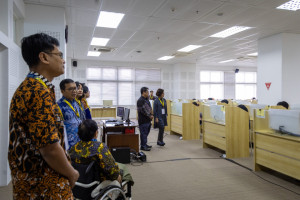
In addition to ensuring the quality of the selection process, UGM has also given special attention to applicants with disabilities participating in the 2026 UM UGM CBT. Head of the UGM Disability Services Unit, Dr. Wuri Handayani, explained that applicants with visual impairments were assigned to the UGM Faculty of Economics and Business (FEB UGM) to receive more optimal assistance during the examination.
UGM has prepared computers equipped with screen-reader applications to help participants access text-based questions. However, for questions that still contain images or visual illustrations, participants require assistance from companions to convey information that cannot be accessed through the application.
“Because some questions still contain images, each visually impaired participant is accompanied by an assistant who helps describe visual information that cannot be read by the screen reader,” explained Dr. Handayani.
Meanwhile, applicants with physical disabilities, hearing impairments, and psychosocial disabilities were assigned to other examination locations that had been adapted to their specific needs. According to Dr. Handayani, these arrangements were made to ensure that every participant receives appropriate support without reducing their independence in completing the examination.
Preparations for these services were carried out well before the selection process began, including installing screen-reader applications and preparing accessible examination rooms. These efforts are part of UGM’s commitment to providing an inclusive admission process for all prospective students.
“Our principle is to ensure that every participant has an equal opportunity to demonstrate their best abilities during the selection process,” she concluded.
Author: Triya Andriyani
Post-editor: Rajendra Arya
Photo: Donnie