


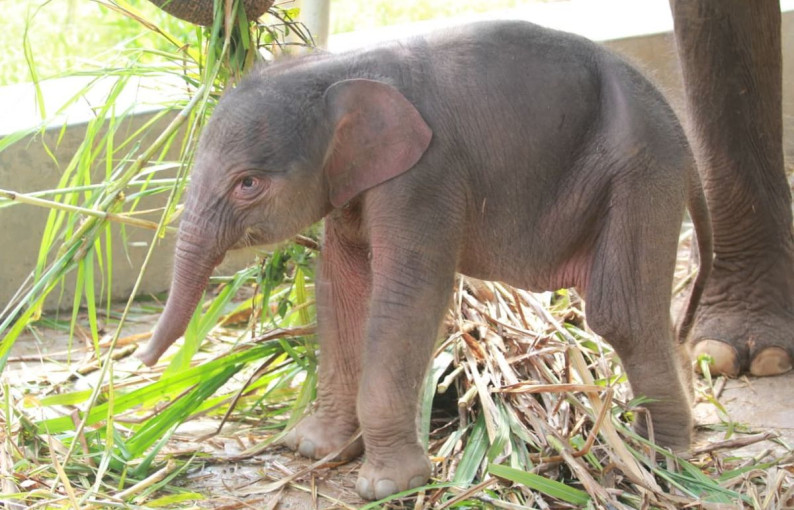
The birth of a Sumatran elephant calf weighing 123 kilograms at Lembaga Konservasi Lembah Hijau, a wildlife conservation park in Lampung, on June 5 has brought encouraging news for wildlife conservation efforts in Indonesia. The birth adds to the institution’s list of achievements after its previous success in breeding Sumatran tigers. Amid ongoing threats such as habitat loss, human-wildlife conflict, and poaching, the arrival of a new calf offers hope, demonstrating that well-managed conservation programs play a vital role in supporting the survival of endangered species.
Professor Wisnu Nurcahyo of the Faculty of Veterinary Medicine Universitas Gadjah Mada (FKH UGM) stated that the achievement is particularly significant because breeding Sumatran elephants in conservation institutions is not an easy task. In addition to their long gestation period, elephant breeding programs face various challenges related to maintaining genetic diversity and preventing inbreeding.
“I believe the birth of this elephant calf is a positive achievement for conservation sustainability. Elephants have a long gestation period, ranging from 18 to 22 months, making breeding efforts in conservation institutions particularly challenging,” he explained on Thursday (Jun. 25).
Professor Wisnu noted that inbreeding in elephants can increase the risk of health disorders, miscarriage, premature birth, and calf mortality. In contrast, breeding between unrelated individuals provides greater conservation value because it enriches the population’s genetic diversity.
“If the male and female are unrelated, the conservation value is high because it introduces new genetic material. The chances of conservation success are also greater. However, breeding between blood-related individuals is not advisable because it can lead to diseases, miscarriage, premature birth, and other complications,” he said.
According to Professor Wisnu, Lembah Hijau’s success reflects the careful monitoring and assistance provided by veterinarians and mahouts in managing elephant reproduction. The achievement is determined not only by the availability of a male and female pair but also by the ability of caretakers to identify the appropriate reproductive period, allowing mating to occur naturally.
“This indicates that veterinarians and elephant handlers have been conducting proper observations. When the female is ready to mate, and the male is receptive, mating can take place naturally,” he said.
He emphasized that ex situ conservation serves a different function from conservation conducted within natural habitats (in situ). Animals born and raised in conservation institutions have adapted to a different way of life and are therefore not recommended for release back into the wild.
“Animals raised through ex situ conservation are strongly discouraged from being released into the wild because they have become accustomed to receiving food from caretakers and may not be able to forage independently,” he explained.
Nevertheless, he noted that conservation institutions continue to play an important role in rescuing and protecting wildlife while also serving as centers for public conservation education. Through these institutions, people can learn about various aspects of wildlife, including anatomy, behavior, nutrition, and reproductive biology, through direct observation.
“For conservation education, ex situ conservation is highly beneficial because it allows the public to study animals directly and gain a better understanding of how conservation is carried out effectively,” he said.
The breeding success achieved at Lembaga Konservasi Lembah Hijau can serve as an example for other conservation institutions across Indonesia. However, such success can only be attained when managers genuinely prioritize animal welfare by providing a comfortable environment, ensuring good health care, and maintaining a reliable food supply.
“If the environment is comfortable, food is available, health is maintained, and adequate water and enrichment facilities are provided, animals will reproduce successfully,” he said.
Therefore, he reiterated that the successful breeding of endangered wildlife cannot be separated from the commitment of conservation managers to ensuring comprehensive animal welfare. According to him, animal welfare must remain the top priority if conservation goals are to be achieved sustainably.
“Managers should not focus solely on ticket revenue. Animals should not merely be exploited. Their nutrition, welfare, health, environment, and enclosures must all receive proper attention,” Professor Wisnu concluded.
Author: Cyntia Noviana
Editor: Gusti Grehenson
Post-Editor: Priyanandaningrat
Photo: Courtesy of Kemenhut