


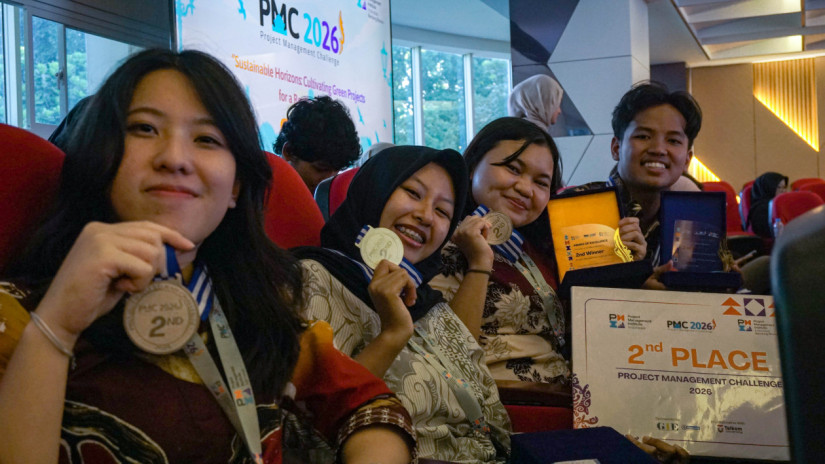
A team of Industrial Engineering students from the Faculty of Engineering, Universitas Gadjah Mada (FT UGM), secured second place by proposing an innovative solution to organic waste management through a community-based waste processing initiative and an integrated platform connecting various stakeholders involved in waste management issues in Bandung and the challenges faced by Cidadap Tourism Village. The achievement was earned at the Project Management Challenge (PMC) 2026, held on June 5–7 in Bandung, West Java.
PMC is a prestigious annual competition that brings together university students from across the Asia-Pacific region to develop project management knowledge and skills within a global context. The UGM team, named Agile-gilean, consisted of Maria Yolanda Elisabeth Turnip (Industrial Engineering, batch 2022), Mafaza A. Zidna (Industrial Engineering, batch 2022), Jauhar Najma Wigar Utungga (Industrial Engineering, batch 2024), and Michelle Carissa Purnama (Industrial Engineering, batch 2024).
The Agile-gilean team advanced to the final round after successfully passing the preliminary and semifinal stages. On the first day of the final round, participants were required to develop solutions based on real-world field cases. The team chose to address the issue of Bandung’s final waste processing site (TPA).
“We designed a solution so that waste would not be sent directly to the landfill but instead processed first through an application that facilitates coordination among existing stakeholders, allowing waste flows in Bandung to operate more efficiently,” said Michelle in a statement received on Wednesday (Jun. 24).
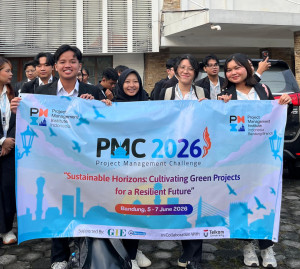
Michelle explained that the proposed solution was inspired by Bandung’s waste management challenges, as the city’s landfill facilities have reached capacity and require innovative approaches. On the second and third days, participants visited a tourism village to observe local challenges and develop a Mini Project Management Plan.
“Based on the observations, participants then had to prepare presentation slides to convince the judges of the effectiveness of their proposed solutions,” she explained.
Michelle noted that the uniqueness of the team’s proposal lay in its innovative approach to managing organic and inorganic waste through community-based waste processing groups in Bandung. Under the proposed system, recyclable and processable waste would be managed by community organizations, while only residual waste that could no longer be processed would be transported to the TPA.
Meanwhile, the solution developed for the tourism village focused on connecting various stakeholders in Cidadap Village through a single integrated framework to address multiple local challenges.
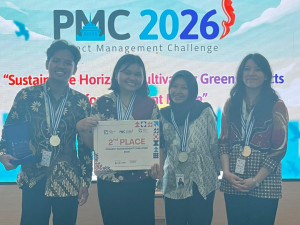
According to Michelle, one of the main challenges of the competition was developing project methodologies that were both innovative and practical.
“The challenge was finding innovative project implementation methods that remained realistic to apply and aligned with the Project Management Body of Knowledge,” she said.
At the final stage, participants were also required to complete their project within a single day.
“Fortunately, the Agile-gilean team successfully overcame these challenges, as reflected in the achievement they earned,” she said.
Through the competition, Michelle said that the Agile-gilean team gained not only recognition but also valuable experience in developing creative and solution-oriented thinking, strengthening teamwork, and improving time-management skills.
“We learned how to directly apply the knowledge and theories we acquired in the classroom to develop solutions for real problems faced by communities,” she concluded.
Reporter: Gusti Purbo Darpitojati/Faculty of Engineering UGM
Author: M. Aidil Syahputra
Editor: Gusti Grehenson
Post-Editor: Priyanandaningrat
Photo: Team Documentation