



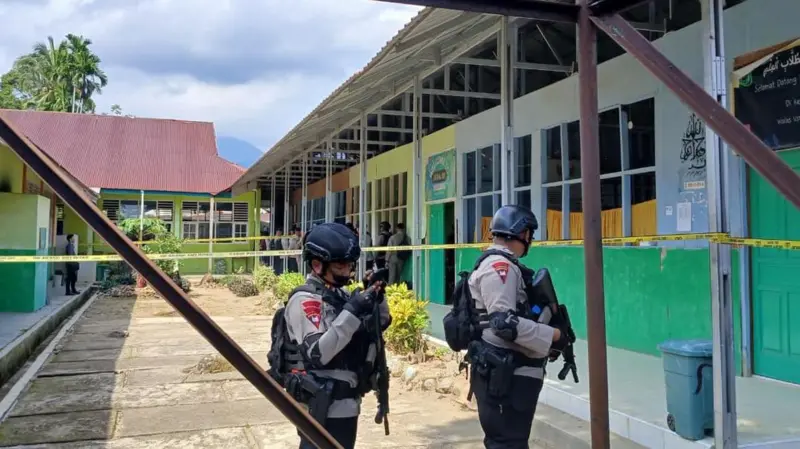
The recent bomb explosion at MAN 3 Padang has shocked the public and revived memories of a similar incident at SMAN 72 Jakarta. After securing the scene, authorities identified a student at the Islamic senior high school as the main suspect and said he was allegedly responsible for assembling three improvised explosive devices.
Following an intensive investigation, law enforcement officials identified several factors that may have contributed to the incident. One was prolonged and severe bullying. Police also said the suspect had been inspired by the SMAN 72 Jakarta case, viewing explosives as a way to respond to bullying and gain a sense of control through others’ fear. The suspect also reportedly said he was part of an international online group known as the True Crime Community.
The incident has raised broader concerns about what may be happening beneath the surface of educational institutions and families. Dr. Andreas Budi Widyanta, Chair of the UGM Social Research Center (SOREC) and a sociologist at Universitas Gadjah Mada (UGM), emphasized that children are shaped by the social environments they grow up in. Emotional pain, a lack of affection, and limited attention from those closest to them can leave lasting psychological wounds. When combined with bullying, these experiences can place an even greater burden on a child’s emotional well-being.
“When children are further shaken by bullying, sometimes by their own peers, they often internalize anger that no one else may recognize,” he said on Monday (Jul. 27).
Dr. Widyanta also highlighted another factor that deserves attention: technological development. He said the three pillars of education—family, school, and society—have gradually weakened as technology has become increasingly embedded in everyday life. Easy access to social media can expose children to inappropriate content, including violence and pornography.
“Exposure to unhealthy information during a child’s developmental years turns children into passive absorbers of harmful content and may even inspire them to imitate the violent behavior they encounter on social media,” he said.
According to Dr. Widyanta, children have the capacity for mimesis, or the tendency to imitate what they observe. In this context, this influence can come from social media content that is difficult to regulate effectively, even by government authorities such as the Ministry of Communication and Digital Affairs. The limited ability to filter harmful online content, he said, can expose children to extreme forms of violence that they may subsequently imitate.
“This misguided form of mimesis reflects the failure of educational development within the family, school, and society,” he said.
Dr. Widyanta described the two school bombing incidents as manifestations of what he sees as failed social construction. One can be understood as an inward expression of psychological distress that may result in self-harm or suicide, while the other represents outwardly directed psychological repression that can lead to violence against others.
For him, the unresolved emotional wounds carried by children should serve as a warning for the education system. Addressing school violence, therefore, requires more than strengthening physical security measures such as bomb detection. It also requires examining the underlying conditions within the education system and developing a stronger culture of dialogue with children.
“We need to examine the root of this iceberg phenomenon involving student behavior by reflecting more deeply on our education system and strengthening a culture of dialogue with our children,” Dr. Widyanta said.
Dr. Widyanta said Indonesia still lacks a strong culture of dialogue with children. Rather than encouraging children to express their emotions and perspectives, education often focuses heavily on fulfilling the state-mandated curriculum.
As a result, children may have limited opportunities to develop communication skills and moral character. While education should ideally integrate knowledge and values, he believes Indonesia’s education system still emphasizes knowledge more than character and values.
He also observed that family and school environments often operate separately rather than complementing one another. When children experience emotional difficulties and need someone to listen, teachers may regard it as a family matter. At home, however, children are not always taught to regulate emotions or encouraged to express what they feel. Instead, parents may focus more heavily on moral instruction and normative expectations.
“Since childhood, we have rarely been taught how to manage our emotions. Many parents focus only on normative values, moral lectures, and even religious arguments,” he said.
Technology, he added, presents another challenge. Some teachers still use technology primarily as a source of ready-made teaching materials, while others may delegate too much of their educational responsibility to technology.
Dr. Widyanta cautioned that when educators place greater emphasis on career advancement, income, or certification than on the broader mission of education, the consequences can extend to future generations. He also noted that some educators may lack a strong sense of vocation and therefore have limited understanding of cura personalis, an educational approach centered on holistic care and individual attention.
Applying such an approach can be particularly challenging in Indonesia, where classrooms may accommodate around 40 students.
Dr. Widyanta argued that bullying is influenced not only by school environments but also by parenting practices and family values. The family is the first social environment in which children learn to understand and respond to differences.
When families fail to foster respect for diversity, discriminatory attitudes can develop early and later manifest themselves in school environments.
He believes Indonesian society still faces challenges in fully embracing diversity, despite the country’s national motto, Bhinneka Tunggal Ika (Unity in Diversity). From this perspective, bullying should not be viewed simply as an individual behavioral problem but also as a reflection of broader social attitudes toward difference.
“I believe many of our families are still unprepared to embrace diversity. Bullying is not a simple issue; it is a reflection of a society that has not fully accepted diversity,” he said.
According to Dr. Widyanta, individuals naturally differ in their backgrounds, personalities, experiences, and perspectives. Yet these differences can become grounds for comparison, judgment, and humiliation. He said the tendency to view oneself as superior to others can reflect attitudes learned within the family.
Parents may also unintentionally pass discriminatory attitudes on to their children through stereotypes, rejection of differences, or labeling people based on their identities. Such attitudes can later become part of the social environment in which bullying occurs.
Dr. Widyanta also criticized using religious identity as a basis for judging or discriminating against others. He emphasized that religion is a personal relationship between individuals and God and should not be used to justify discrimination.
“Religion is a private matter between human beings and God. It should never be used as a tool to interfere with or discriminate against those who are different,” he said.
For this reason, he stressed that families and schools should cultivate respect for diversity from an early age and help children understand that differences are not threats but a natural part of social life.
The Cura Personalis Approach
In closing, Dr. Widyanta emphasized that education reform cannot be left to schools alone. It requires the involvement of the three pillars of education—families, schools, and communities—supported by government policies that enable a more personalized approach.
Every child has different characteristics, experiences, and needs. A standardized approach that treats every child in the same way, he argued, risks overlooking those differences.
“Restoring our education system will be extremely difficult without comprehensive solutions from all directions. The challenge is how the three pillars of education and the government can build a more cura personalis system. Education is not one-size-fits-all. Standardizing every child is a form of violence,” Dr. Widyanta concluded.
His perspective points to a broader challenge for Indonesia’s education system: preventing school violence requires not only stronger security measures but also greater attention to children’s emotional well-being, family relationships, social environments, diversity, and opportunities for meaningful dialogue.
Author: Zabrina Kumara
Editor: Gusti Grehenson
Post-Editor: Jasmine Ferdian
Photo: Magnific and Kompas.com