


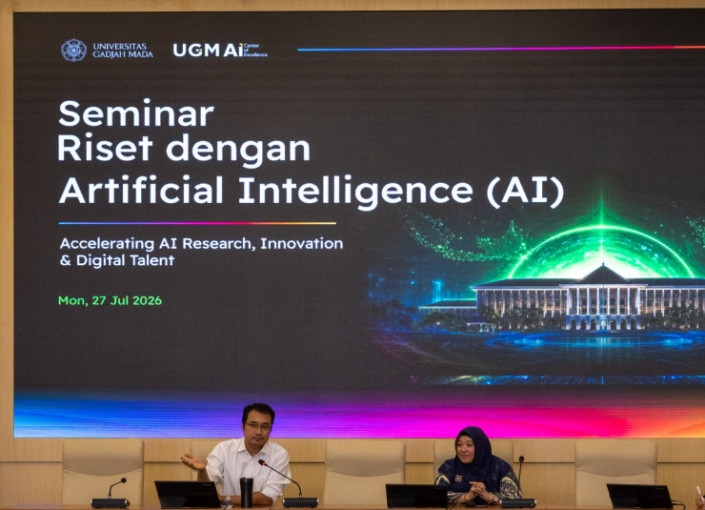
Artificial intelligence (AI) is transforming many aspects of human life, including higher education. Universities are increasingly using AI to support a wide range of academic activities, from finding references and developing research ideas to teaching, learning, and research. At Universitas Gadjah Mada (UGM), these developments are supported by efforts to build a stronger AI ecosystem through research, talent development, and industry collaboration.
Dr. Mardhani Riasetiawan, Head of the UGM Digital Transformation Bureau, said developing an AI ecosystem is one of the university’s strategic priorities to foster innovation, strengthen research capacity, and respond to the growing demands of digital transformation in higher education.
“Last year, we reached one of our major milestones with the launch of the UGM AI Center of Excellence. We also had the valuable opportunity to establish a collaboration with Indosat Ooredoo Hutchison,” Dr. Riasetiawan said during the UGM AI Seminar, “Riset dengan Artificial Intelligence (AI)” (Research with Artificial Intelligence), held at the UGM Central Building on Monday (Jul. 27).
Dr. Mardhani explained that teams from Indosat Ooredoo Hutchison and NVIDIA had conducted several site visits and on-site assessments before determining that UGM met the requirements to join the NVIDIA AI Technology Center (NVAITC) network.
The partnership is expected to strengthen UGM’s AI research capabilities by providing researchers with access to NVIDIA technologies and greater computing capacity.
“Limited computing resources have always been one of the major challenges in AI development. Through this collaboration, we hope UGM researchers will be able to utilize computing capacity on a much larger scale than before,” he said.
Beyond its industry partnerships, UGM is also developing initiatives to expand AI expertise across the university. These include the Artificial Intelligence Talent Factory (AITF), a three-year talent development program, and the UGM AI Faculty Member network, an interdisciplinary platform connecting researchers and faculty members across schools and faculties.
Dr. Mardhani emphasized that UGM’s multidisciplinary character is one of its greatest strengths in developing AI research.
“What we emphasize most in our collaboration with NVIDIA is UGM’s strength as a multidisciplinary university. The approach we are building focuses not only on technical aspects but also involves other disciplines, including the social sciences and humanities,” he said.
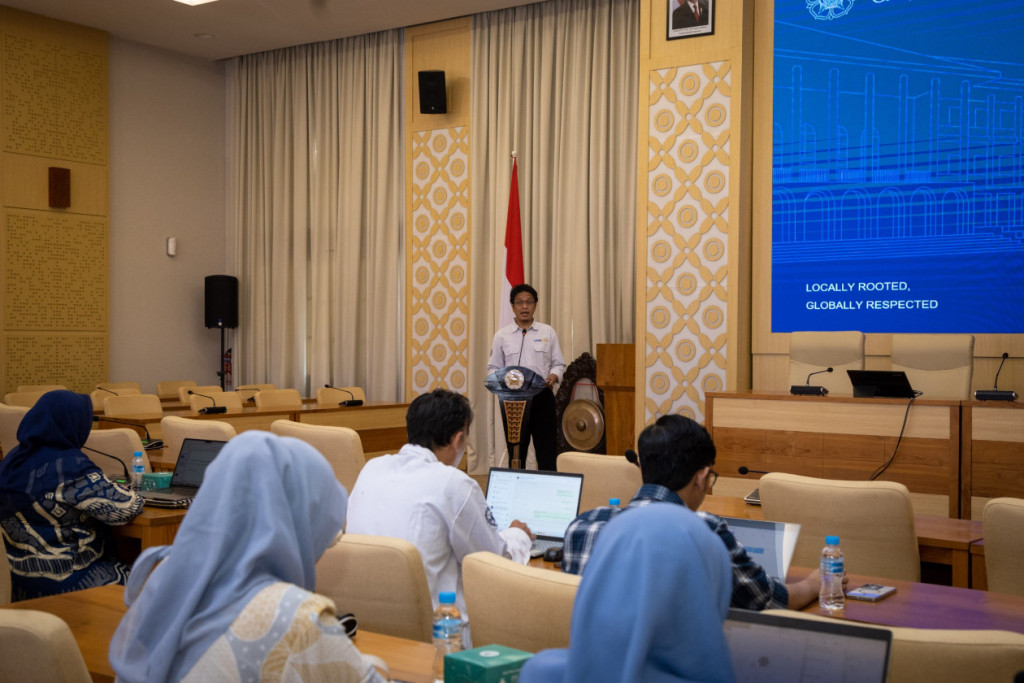
The UGM AI Faculty Member network is expected to provide a platform for researchers from different disciplines to collaborate on AI-related research. In the longer term, UGM AI is envisioned as a research center that can manage research funding, support scholarship programs, recruit master’s and doctoral students, and expand international partnerships.
“We want to build this ecosystem together because, ultimately, no one can accomplish a major achievement alone,” Dr. Mardhani said.
The seminar also showcased how AI is already being applied across different fields at UGM, demonstrating the university’s multidisciplinary approach to AI research.
Dr. Rimawati, a lecturer at the UGM Faculty of Law, explained that AI has created new opportunities for legal research, particularly in regulatory searches, court-decision analysis, and preparing analytical matrices. Tasks that previously required days or even weeks of manual work can now be completed much more efficiently.
“With AI, these research processes have become far more efficient. What used to take up to a month can now be completed in just a few hours,” Dr. Rimawati said.
She nevertheless stressed that AI remains a tool rather than a substitute for researchers. Legal analysis, interpretation of legal norms, and legal reasoning must remain the responsibility of researchers. Researchers must also check any AI-generated information against original legislation and court decisions to ensure accuracy and uphold academic integrity.
Professor Ferian Anggara of the UGM Faculty of Engineering presented a similar application. He explained that AI and machine learning have significantly improved the efficiency of research into mineral and energy resources by enabling researchers to process large volumes of data and identify resource potential more quickly and accurately.
“Our use of artificial intelligence and machine learning aims to improve the efficiency of research processes. When our work becomes more efficient, we gain at least two major benefits: saving time and reducing costs,” said Professor Ferian, a lecturer in the UGM Department of Geological Engineering.
Meanwhile, Dr. Nur Mohammad Farda of the UGM Faculty of Geography presented Tech4Disaster. This GeoAI platform integrates geospatial technology, the Internet of Things (IoT), big data, satellite imagery, drones, and AI to support the full disaster management cycle—from mitigation and preparedness to emergency response and post-disaster recovery.
The platform combines multiple spatial data sources with AI models to generate timely information for disaster management. Its applications include rapid mapping, deep-learning-based identification of damaged buildings, mapping the needs of affected communities, and a disaster information geoportal to support faster and more informed decision-making.
Tech4Disaster illustrates how AI can contribute directly to community resilience by bringing together technology, data, and expertise from multiple disciplines.
The projects presented at the UGM AI Seminar demonstrate that AI research at UGM extends well beyond its use as a tool for academic work. Researchers are applying AI to a broad range of fields, including law, energy, agriculture, health, and disaster management.
These initiatives also reflect UGM’s multidisciplinary academic environment and its potential to connect technological innovation with expertise across fields and real-world societal needs.
Through its partnerships with Indosat Ooredoo Hutchison and NVIDIA, UGM is strengthening not only its computational infrastructure but also its capacity to develop AI-based research and innovation. The university’s AI Infrastructure as a Service initiative is expected to provide a strong foundation for researchers who need greater computing capacity.
At the same time, initiatives such as the AI Center of Excellence, Artificial Intelligence Talent Factory, and UGM AI Faculty Member network are intended to strengthen the human and institutional capacity needed to sustain AI research and innovation.
Together, these efforts form part of UGM’s broader commitment to developing an AI ecosystem that is collaborative, multidisciplinary, and capable of generating meaningful benefits for society.
Author: Agito Sitepu
Editor: Gusti Grehenson
Post-Editor: Priyanandaningrat
Photo: Donnie