


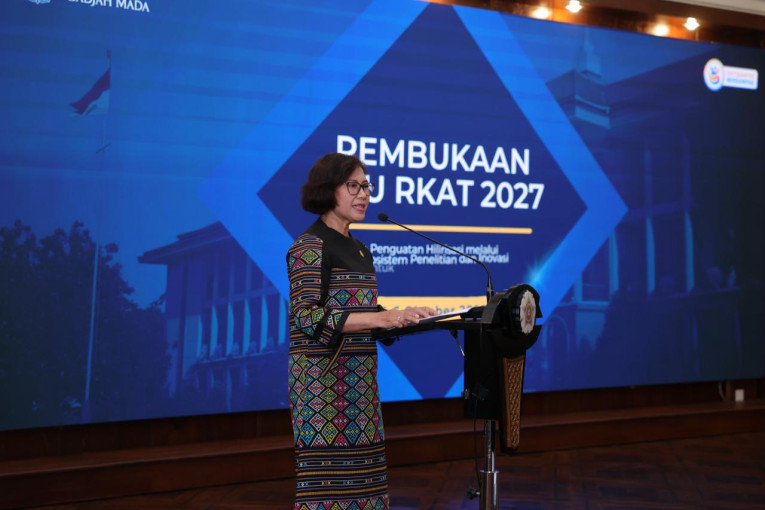
UGM is encouraging the university’s development toward downstreaming through a collaborative ecosystem to create sustainable impact. Therefore, the university’s development policies focus on broader use of the outcomes of its three pillars of higher education while delivering benefits and addressing the needs of society and industry. UGM Rector Professor Ova Emilia made the statement while opening the UGM University Work Meeting (RKU), which focused on discussing the proposed 2027 Annual Work Plan and Budget (RKAT) at the UGM Senate Hall on Monday (Oct 5).
According to Professor Ova, the spirit of creating an impactful university has now become an important part of higher education development. Therefore, downstreaming needs to be viewed as a process involving various stakeholders and built through a mutually supportive ecosystem.
“In 2027, we want to strengthen downstreaming through a collaborative ecosystem and sustainable impact,” Professor Ova said.
Downstreaming, she explained, has a broad scope. The university’s three pillars of higher education can deliver impact through knowledge creation, innovation, collaboration, and literacy, with outcomes ranging from technologies, products, and models to policies, social innovations, and talent.
In education, for example, impact is evident in graduates’ readiness to enter the professional field. Professor Ova noted that UGM graduates currently wait an average of around 2.6 months to secure employment.
In research and innovation, UGM continues to build an ecosystem that supports research outcomes from the initial stages to broader utilization. These efforts include integrated laboratory management, renewing research instruments, the UGM Science Techno Park, and strengthening the Intellectual Property Management Office (IPMO) in managing intellectual property.
Technology development is also guided by the Technology Readiness Level (TRL), ranging from TRL 1 to TRL 9, according to the maturity of the outcomes being developed. As research outcomes reach higher levels of maturity, they are expected to move toward broader utilization and eventually product industrialization.
The ecosystem is being developed to ensure downstreaming does not fall solely on individual researchers. Support for research infrastructure, intellectual property management, and supporting units is needed to help research outcomes progress beyond the development stage.
With an integrated system, researchers can receive support when their research outcomes begin to be directed toward further utilization and development. Ova considers this approach important for strengthening downstreaming at UGM.
“We should not let our researchers, for example, fight on their own, individually. So, this is the ecosystem that we need to strengthen,” she emphasized.
The drive to create impact is also applied to educational development. UGM continues to promote transdisciplinary curricula, language literacy, national and global learning experiences, inclusive education, and broader access to learning through UGM Online. Through online learning, people who have not been able to access education at UGM can still gain knowledge from modules developed by the university community. This knowledge can be used for knowledge transfer, human-based activities, problem-solving, and community-based activities.
“People who are unable to enter UGM can enjoy the modules created by all of you,” Professor Ova said.
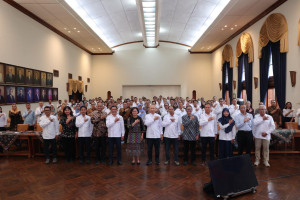
Furthermore, the direction of downstreaming and sustainable impact needs to be translated into the work plans of each faculty and work unit. The preparation of the RKAT is expected to remain aligned with the university’s strategic goals while providing each unit with room to develop programs according to its needs and potential.
Professor Ova also reminded participants that planning should not stop at repeating previous programs, but should instead establish targets and indicators that demonstrate the changes to be achieved. The two-day RKU provides a forum to discuss, align, and refine proposed programs before incorporating them into UGM’s 2027 work plan.
“I think that is what I can share, ladies and gentlemen, and hopefully these two days will run smoothly and bring out the best from all of us,” she concluded.
Deans, directors, and leaders of work units across UGM attended the 2027 RKAT RKU. The focus continues the university’s development direction established in previous years, from strengthening collaboration in 2025 to strengthening capabilities, innovation, and sustainable impact in 2026. Through the RKU, these directions will be translated into the university’s 2027 work plan and budget.
Author: Triya Andriyani
Post-editor: Zabrina Kumara
Photo: Firsto