


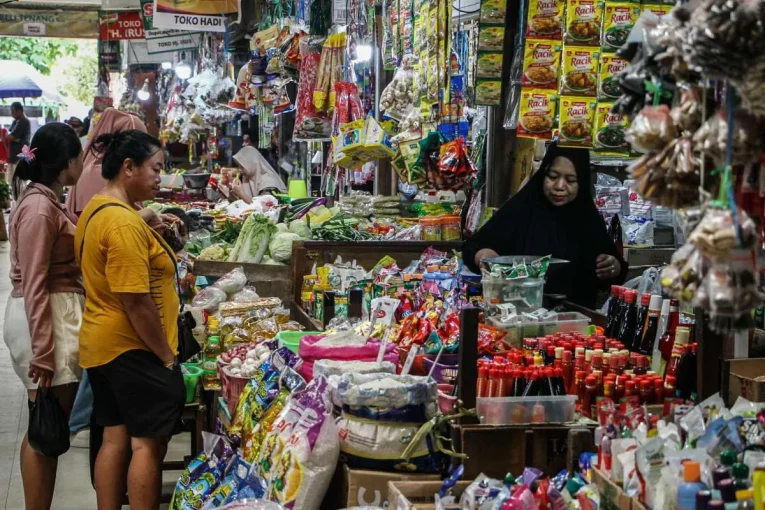
Downgrading, or shifting consumption choices toward cheaper goods and services, has recently become widely discussed. This is reflected in lifestyle changes, reduced consumption, and adjustments in asset ownership as incomes remain relatively stagnant while needs continue to rise. Recent economic uncertainty has prompted some people to change their consumption patterns, from replacing vehicles with cheaper alternatives and switching to more affordable products to reducing the frequency of dining out and recreation.
Responding to this phenomenon, a lecturer at the Faculty of Economics and Business (FEB UGM), Wisnu Setiadi Nugroho, said downgrading is a rational household response to economic uncertainty rather than merely a lifestyle choice. According to him, households to maintain essential consumption, such as food, health care, and education, by reducing more flexible or discretionary spending when incomes come under pressure or become uncertain.
“I see downgrading, also known as sachetization and downsizing, as a rational household response to economic uncertainty, not a lifestyle choice,” Wisnu said Wednesday (October 7).
He explained that in economic theory, this condition is better known as consumption smoothing, in which households seek to keep essential consumption relatively stable by sacrificing more flexible consumption. Thus, Wisnu said, people adjust their spending not because they simply want to save money, but because their room to make spending choices is increasingly limited.
In his view, the main issue is not the practice of downgrading itself, but its scale and the groups engaging in it. If it occurs only among a small portion of the population, such adjustments can still be viewed as temporary.
“If this phenomenon becomes widespread, particularly among the middle class, which accounts for a large share of national consumption, it should serve as a warning sign for the government,” he explained.
Furthermore, Wisnu identified two mutually reinforcing factors behind downgrading. First, stagnant real incomes amid rising prices for basic necessities such as food, education, and energy. He added that this condition reduces households’ real purchasing power even when their nominal incomes remain unchanged.
Second, declining economic expectations. In his view, people are currently holding back on consumption not only because their financial capacity has weakened, but also because of concerns about future economic conditions, including job security. As a result, previously routine spending patterns have become more restrained.
“These two factors are clearly reflected in the trade-down pattern, namely the shift from premium brands to economy brands, as well as the growing secondhand goods market. This pattern shows that people’s real spending budgets are indeed shrinking, rather than simply reflecting temporary efforts to save before a particular occasion,” he said.
Despite this, Wisnu noted that not all downgrading indicates a decline in welfare. He explained that consumption adjustments can occur naturally when household needs change, for example, when children become financially independent or when someone enters retirement.
Conversely, downgrading signals economic pressure when working-age households must lower the quality of their consumption because of budget constraints.
“What is unusual is when downgrading occurs among individuals or households whose composition remains intact and who are still of working age. At that point, downgrading is no longer a matter of changing preferences but is being forced by budget constraints,” he explained.
In closing, Wisnu emphasized that prolonged pressure on purchasing power could have broader effects on the economy. When people restrain consumption, trade and service activities also slow, potentially prompting businesses to delay expansion and hiring. This is particularly concerning, he added, when people rely on short-term debt or sell assets to meet daily needs.
“When households have to sell assets to cover their daily needs, that is also a sign that their financial buffers have run out. It is no longer about rearranging spending priorities, but about survival,” he concluded.
Author: Agito Sitepu
Editor: Gusti Grehenson
Post-Editor: Priyananda
Photo: Antara and Magnific