


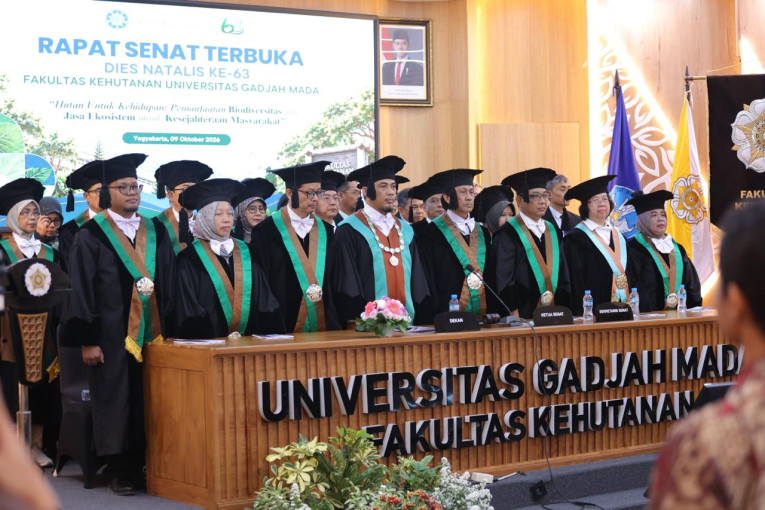
The Faculty of Forestry at Universitas Gadjah Mada (Forestry UGM) reaffirmed the role of scientific knowledge and forestry innovation in safeguarding forest sustainability while maximizing the benefits to communities. This message emerged during the faculty’s 63rd anniversary celebration, held at the UGM Faculty of Forestry Auditorium on Friday (Oct. 9) under the theme “Hutan untuk Kehidupan: Pemanfaatan Biodiversitas dan Jasa Ekosistem untuk Kesejahteraan Masyarakat” (Forests for Life: Utilizing Biodiversity and Ecosystem Services for Community Welfare).
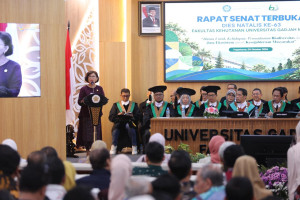
UGM Rector Professor Ova Emilia said that over its 63-year history, Forestry UGM had achieved significant milestones in forestry science and technology. These show that future forest management requires approaches that adapt to technological developments while responsive to community needs.
Forestry UGM has developed innovations such as smart forestry, human-elephant conflict monitoring, biodiversity monitoring, Rebo Drone for forest rehabilitation, Dendro Drone for tree identification, and Internet of Things (IoT)-based technology for wildlife monitoring. Also maintained its position in the 151–200 range worldwide in the forestry subject category of the QS World University Rankings by Subject 2026 for three consecutive years.
“These achievements are certainly not the work of individuals alone but the result of collective efforts by the entire academic community. Looking ahead, we hope the innovations developed by the Faculty of Forestry will go beyond academic achievements and continue to advance through collaboration with industry and partners, financial support, and access to users and markets, enabling them to generate a greater impact on society,” Professor Emilia said.
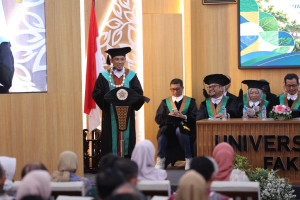
Meanwhile, Dean of Forestry UGM Dwiko Budi Permadi highlighted ongoing challenges to forest sustainability, including forest and land fires in various parts of Indonesia. These were an important part of the faculty’s progress report at the open senate meeting marking its 63rd anniversary.
Forestry UGM sent two lecturers, Mochamad Danang Anggoro and Fiqri Ardiansyah, to participate in activities at Sebangau National Park for 15 days, beginning October 2, 2026. Forest and land fires cannot be addressed through short-term responses alone but require both immediate and long-term strategies.
“Forest and land fires must be addressed calmly through strategic measures for both the short and long term. These fires result from a combination of factors, including disaster governance, ecosystem vulnerability, climate change, green leadership, and short-term human interests,” Dwiko said.
Early warning systems are essential for forest management, governance, and ecosystem resilience, particularly in peatland areas. Forestry science is responsible for ensuring that forests continue to fulfill their ecological and social functions.
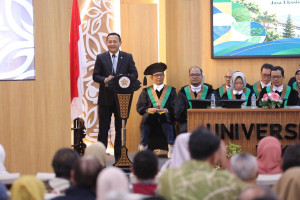
Indonesian Deputy Minister of Forestry Rohmat Marzuki urged all stakeholders to adopt a broader understanding of forests, viewing them not merely as timber-producing areas but as living spaces with ecological, economic, social, cultural, and institutional functions.
“Ladies and gentlemen, I would like to invite all of us to reconsider forests as multidimensional entities. A forest is not simply a collection of trees or an association of timber-producing trees, but a living space and an asset whose functions, influence, and governance encompass various aspects of human life and the environment,” he said.
This perspective is important because forest degradation has consequences far beyond the loss of vegetation cover. Floods, landslides, droughts, and forest and land fires can affect public health, agriculture, plantations, education, and communities’ overall well-being.
The Ministry of Forestry is promoting a transformation of the forestry economy by optimizing biodiversity and ecosystem services. Timber remains valuable but should not be the forest’s sole source of economic value.
“Timber must be produced sustainably and be traceable, while standing alongside non-timber forest products such as bamboo, energy biomass, resins, essential oils, food products, agroforestry, and carbon. In other words, we must move from a single-commodity economy toward a landscape economy that values all biodiversity and ecosystem services,” he explained.
This paradigm shift must be supported by collaboration among the government, universities, businesses, and communities. He encouraged stronger cooperation with Forestry UGM in research, innovation, and forestry governance.
“The Ministry of Forestry sincerely hopes to strengthen cooperation and collaboration with the academic community of Forestry UGM and other forestry universities so that we can work together to optimize the use of biodiversity and ecosystem services from Indonesia’s forests for the greatest possible benefit of the people,” he said.
Such collaboration has already taken shape through several initiatives, including temporary housing for communities affected by floods and landslides in Aceh Tamiang and North Aceh, as well as the rehabilitation of landslide-affected areas in Cisarua using drone technology and seedball methods.
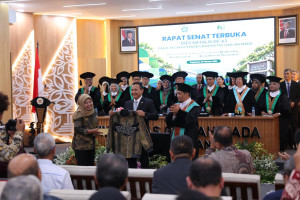
The idea of maximizing forests also drew attention from Professor San Afri Awang, Chair of the UGM Faculty of Forestry Senate. In response to the Deputy Minister of Forestry’s presentation, he stressed that forestry transformation requires more than a shift in how the economic value of forests is understood. It must also be accompanied by stronger governance, from policymaking to on-the-ground management.
This highlighted governance to ensure that biodiversity and ecosystem services do not create new problems. Forest management must take into account actual site conditions, including areas facing unrestricted access and mounting pressure on forests.
In celebrating its 63rd anniversary, Forestry UGM positioned the advancement of forestry science and innovation not only as a means of protecting forests but also as part of the effort to find ways for forests to continue benefiting communities.
The sustainable use of biodiversity and ecosystem services offers one way to reconcile ecological, economic, and social interests in Indonesia’s forest management.
Author: M. Aidil Syahputra
Editor: Gusti Grehenson
Post-editor: Jasmine Ferdian
Photos: Firsto