


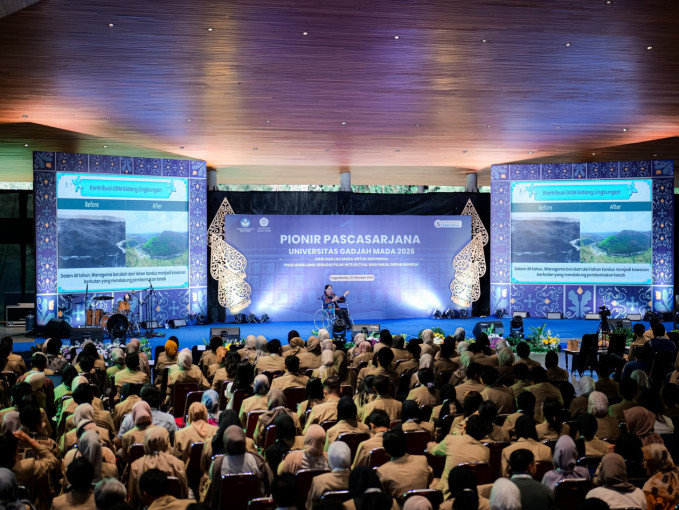
Mahfud MD, who served as Indonesia’s Coordinating Minister for Political, Legal, and Security Affairs from 2019 to 2024 and is an alumnus of UGM’s Faculty of Law (FH UGM), emphasized students’ intellectual responsibility to society and the nation. He stressed that higher education should do more than produce academically accomplished graduates; it must also shape individuals who uphold integrity, have the courage to defend the truth, and use their knowledge for the benefit of society.
Addressing 6,209 new postgraduate students at UGM, Mahfud reminded them that an academic degree is not the sole measure of a person’s success. He cited a message from former UGM Rector Professor Sardjito on the importance of producing sarjana yang sujana, graduates who are not only knowledgeable but also morally upright and concerned about others.
“UGM was established to produce sarjana yang sujana: graduates who are noble, virtuous, kind-hearted, and willing to help others; who have the courage to speak the truth and refuse to do things that are wrong and could harm others,” he said at the opening of the Student Initiative Development and Orientation Program (PIONIR) for the new postgraduate students of 2026, held at Joglo GIK on Tuesday (October 27).
He explained that academic ability can be used to do good or harm others if it lacks integrity and concern for fellow human beings. Continuing his remarks, Mahfud linked intellectual responsibility to Mohammad Hatta’s ideas about intellectuals’ moral obligations. He said university graduates must defend the truth, fight injustice, and prioritize society’s interests.
Mahfud emphasized that intellectuals should not focus solely on personal interests, positions, or profits derived from their expertise, but should also actively contribute to national development.
“Intellectuals must have the courage to defend the truth, to call right what is right and wrong what is wrong, to defend the interests of society, and to place personal interests above the interests of society,” he said.
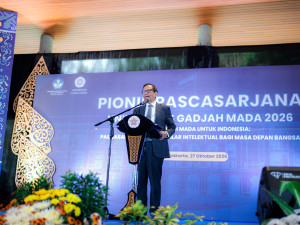
Mahfud also highlighted the importance of education that develops both intelligence and character. He explained that education should not merely sharpen people’s thinking abilities, but also shape their character and sense of moral responsibility.
In his view, science and technology must be developed in accordance with values that uphold truth, humanity, and national unity.
“Education in Indonesia must develop the intellectual and moral capacities of the nation. It must cultivate both the mind and character, not merely improve or sharpen people’s intellect,” he explained.
He cautioned that academic expertise must not justify misguided policies or serve particular interests at the public’s expense.
Concluding his address, Mahfud urged UGM’s postgraduate students to use their knowledge in service to the nation and state. He emphasized that university graduates must uphold integrity and avoid treating their diplomas as mere status symbols. Instead, their qualifications should demonstrate scholarly competence accompanied by moral responsibility.
“When you leave Universitas Gadjah Mada, become sarjana yang sujana—true scholars, not sarjana yang durjana, or scholars who do wrong. You must not become hired intellectuals who sell their expertise and use their knowledge and scholarly methods to justify what is wrong,” he advised.
He expressed hope that postgraduate students would become intellectuals with strong expertise in their respective fields, the courage to stand up for the truth, and a commitment to contributing to the advancement of Indonesian society.
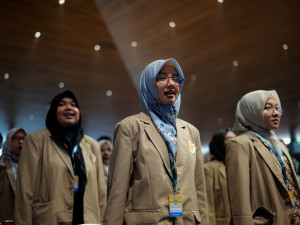
Meanwhile, UGM Vice Rector for Student Affairs, Community Service, and Alumni Dr. Arie Sudjito emphasized the importance of critical thinking among postgraduate students. He said students should use the knowledge they acquire during their studies to address problems faced by society.
“Postgraduate students are obligated to think critically. It is not enough to acquire knowledge for its own sake; knowledge must be used to address society’s problems,” he said.
Arie explained that postgraduate education should advance knowledge while building networks that benefit society. He also highlighted the challenges university graduates must navigate in learning environments and the world of work.
In this context, postgraduate education is expected to produce intellectuals capable of contributing both within and beyond the university.
According to Arie, the complexity of national challenges, including the effects of global crises, requires the involvement of various groups of intellectuals, including academics, researchers, journalists, and civil organizations.
“Once again, the task of intellectuals is not merely to develop knowledge. Fundamentally, it is to encourage public participation so that people can become part of the effort to solve the nation’s problems,” he concluded.
At the same event, UGM Vice Rector for Education and Teaching Professor Wening Udasmoro delivered a lecture on UGM, inviting new students to understand the university’s history, philosophy, values, and identity as an institution born out of the Indonesian people’s struggle.
Wening explained that UGM’s establishment was closely tied to the struggle to defend Indonesia’s independence. This history shaped UGM’s identity as an institution that upholds national unity and service to society.
She also encouraged students to apply the values UGM’s founders upheld in their daily lives, including the principle of Trisna San Sutrisna, which teaches fairness and impartiality. She urged students to resist individualism and cultivate empathy and solidarity with others.
“Our enemy is the part of ourselves that often lacks empathy, that often fails to show solidarity with others, and that often pushes others to the margins,” she explained.
Wening also outlined UGM’s five defining identities: a national university, a university of struggle, a Pancasila university, a people’s university, and a university serving as a center of culture. These five identities underpin UGM’s efforts to preserve national unity, champion society’s interests, and safeguard Indonesian culture.
She said character can be developed through consistently practiced good habits. “If we study every day, remain diligent, and continually nurture our empathy, these qualities will become part of who we are,” she said.
She added that UGM’s commitment to service, from its founding to today, is part of Indonesia’s broader national struggle. Students therefore need to understand this history and these values so UGM’s spirit of struggle continues through thoughtful contributions to society.
UGof Student Affairs Dr. Hempri Suyatna announced that the university had registered a total of 6,209 new postgraduate students. They include 794 doctoral students, 4,733 master’s students, 569 specialist students, and 113 subspecialist students.
Author: Zabrina Kumara
Editor: Gusti Grehenson
Post-Editor: Priyananda
Photo: Firsto