


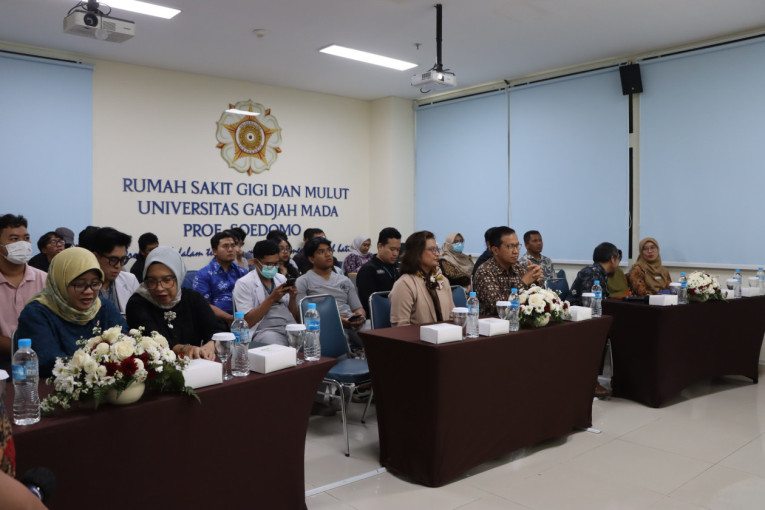
Universitas Gadjah Mada, through the UGM Faculty of Dentistry (FKG UGM), together with RSGM UGM Prof. Soedomo (Prof. Soedomo Dental and Oral Hospital), launched the FKG UGM Co-Assistant Clinical Service Subsidy Program on Thursday (October 1) at RSGM UGM Prof. Soedomo. The program is intended to support students in completing their clinical education as part of the Dental Professional Education Program while maintaining the quality of services provided to the community.
Dean of FKG UGM, Professor Suryono, said the subsidy program was an initiative he had been working toward since the beginning of his tenure as dean. The program is expected to reduce the burden on professional education students in meeting patient service requirements during their clinical education.
“Actually, this program has been one of my aspirations since I first became dean. I wanted to make sure that co-assistant students would not be burdened with paying for patients. I then conveyed this to the Director of RSGM, and thankfully, it received a positive response until the program could finally be realized,” Suryono said.
Suryono said the subsidy amounts to approximately Rp5 billion per year. Previously, co-assistant students had to cover these costs to meet patient service requirements during their professional education.

The program will also be adjusted according to the number of students undertaking professional education. Suryono said approximately 49 co-assistant students are currently admitted, and this number may increase as more graduates of the undergraduate dental program continue to professional education.
“There are currently around 49 students admitted. The number will increase according to the number of undergraduate students who enter the professional program,” he said.
According to Suryono, the need for subsidies also stems from a disparity in financial support between undergraduate and professional education. Students receiving support through the Indonesia Smart College Card (KIP) or Bidikmisi generally receive assistance at the undergraduate level, while this support does not continue when students enter professional education. This situation can challenge students from financially disadvantaged families.

Nevertheless, the clinical service subsidy is provided equally to all co-assistant students, regardless of whether they receive KIP or Bidikmisi. Thus, all students receive the same support in meeting clinical service requirements during their professional education.
Head of Education and Research at RSGM UGM Prof. Soedomo, Dr. Rini Widyaningrum, explained that the subsidy is primarily intended to cover the minimum requirements that co-assistant students need to fulfill their clinical requirements. Almost all of these minimum requirements are free of charge for the first service or treatment visit, except for the patient registration fee.
Rini explained that each co-assistant student has a control book used to record and monitor the completion of clinical requirements during professional education. The book lists the treatment stages students must complete in various departments, including conservative dentistry, prosthodontics, periodontics, pediatric dentistry, orthodontics, oral surgery, and oral medicine.
In addition to recording treatment stages, the control book also serves as a reference for the materials and equipment students need to complete their clinical competencies.
“Every student has a control book. It contains the clinical requirements, what needs to be completed, including the materials and equipment used,” Rini explained.
Rini also explained the subsidy mechanism and the payment arrangement previously borne by co-assistant students. With RSGM UGM extending a Rp10,000 subsidy per visit, patients now pay Rp15,000 instead of the standard Rp25,000 registration fee.
“Previously, the registration fee was Rp25,000. We subsidize Rp10,000, so patients pay Rp15,000,” Rini explained.
Rini said the subsidy is primarily provided for the first service or treatment visit. If treatment needs to be repeated, the subsidy does not automatically cover subsequent costs. The mechanism is expected to encourage students to provide optimal care from the outset while using materials and equipment responsibly.
“We hope this will also motivate them to provide the best possible service on the first visit,” she said.
The subsidy is provided as long as students remain within the normal period of professional education. The co-assistant program lasts approximately two years, with an additional tolerance period of around three months. Once this period ends, students will receive a warning, after which their control books may be withdrawn, and they will no longer receive the subsidy facility.

Rini emphasized that the subsidy does not reduce the standard of service provided to patients. Co-assistant services remain under the direct supervision of the physician responsible for patient care (DPJP), with the same service and sterilization standards applied to services provided by general dentists and dental specialists.
Director of RSGM UGM Prof. Soedomo, Professor Margareta Rinastiti, said the launch of the program represents an important part of the joint commitment between FKG UGM and RSGM UGM to support professional education while providing services to the community.
According to Margareta, clinical education requires students not only to master clinical skills but also to meet various requirements while providing services to patients. Through this program, institutions now share the financial responsibility.
“I believe this is an important milestone in the journey of our clinical education. For the first time, the burden is being shared by the hospital and the faculty through the co-assistant clinical service subsidy program,” Margareta said.
She added that the program results from an established collaboration between FKG UGM and RSGM UGM. Through this financial support, RSGM UGM hopes students’ clinical education can run more effectively without compromising the quality of services the community receives.
Author: M. Aidil Syahputra
Editor: Gusti Grehenson
Post-Editor: Priyananda
Photo: Jesi