


Seventeen researchers from Universitas Gadjah Mada (UGM) are included in the World’s Top 2% Scientists 2026 list. This recognition reflects UGM researchers’ contributions to scientific advancement across a wide range of disciplines. Researchers at Stanford University compile the list using data from scientific publisher Elsevier.
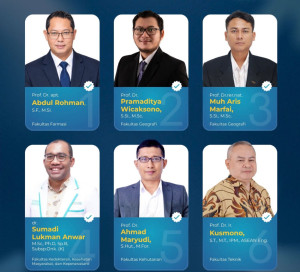
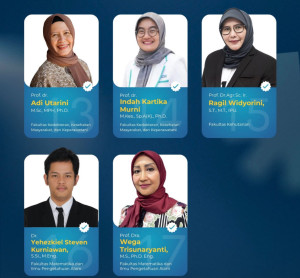
The 17 UGM researchers on the list include Professor Adi Utarini, Professor Indah Kartika Murni, and Dr. Sumadi Lukman Anwar from the Faculty of Medicine, Public Health, and Nursing (FK-KMK UGM). The Faculty of Forestry (FKT UGM) is represented by Professor Ragil Widyorini and Professor Ahmad Maryudi.
Other researchers from the Faculty of Mathematics and Natural Sciences (FMIPA UGM) are Dr. Yehezkiel Steven Kurniawan, Professor Wega Trisunaryanti, Professor Edi Suharyadi, Professor Kuwat Triyana, and Professor Jumina. The Faculty of Pharmacy (Pharmacy UGM) is represented by Dr. Eka Noviana and Professor Abdul Rohman.
Meanwhile, Dr. Muhammad Akhsin Muflikhun and Professor Kusmono are from the Faculty of Engineering (FT UGM). Professor Ika Dewi Ana represents the Faculty of Dentistry (FKG UGM), while Professor Pramaditya Wicaksono and Professor Muh Aris are from the Faculty of Geography (Geography UGM).
UGM Rector, Professor Ova Emilia, praised the achievements and innovations of the 17 researchers who earned a place on the list of the world’s most influential scientists. She said the recognition reflected the quality of their education, research, and publications over recent years.
“These achievements will continue to inspire the advancement of science and innovation in the future,” she said on Friday (Oct. 16).
The 17 researchers pursue diverse research interests, ranging from developing environmentally friendly materials and mapping coastal ecosystems to improving the quality of child health services.
Environmentally Friendly Biocomposites
Ragil Widyorini, one of the UGM researchers on the list, has long researched forest product technology, particularly developing environmentally friendly composite products using natural fibers, low-quality wood, and agricultural and forestry waste. Her research also focuses on formaldehyde-free natural adhesives to produce alternative materials with potential applications across various sectors.
One of her scientific contributions is developing biocomposites from agricultural and forestry waste, both as binderless boards and as composites made with natural binders. According to Ragil, Indonesia has abundant natural resources that could expand the application of composite technology.
“Research on composites has great potential for further development and application. Indonesia has abundant natural resources that offer broader opportunities for composite research, both for structural and non-structural applications,” she explained.
These alternative materials are expected to help address environmental challenges while increasing the added value of forestry products. One example is research on converting elephant dung into composite products as an alternative waste-management solution. Ragil has also explored using wood from thinning operations to produce laminated composites for structural applications.
Throughout her research career, Ragil has faced challenges related to limited resources, funding, and time, as well as the need to consistently produce high-quality research. To address these challenges, she has built collaborations with academics, industry, government, and communities.
“To address these challenges, I continue to build collaborations with various stakeholders, improve my competencies, and remain open to new approaches and ideas so that research can have a greater impact on society,” she said.
Coastal Ecosystem Mapping
Pramaditya Wicaksono, from Geography UGM, specializes in coastal biodiversity remote sensing, particularly mapping seagrass meadows, coral reefs, and benthic habitats. His research focuses on evaluating and developing mapping methods and models that describe coastal ecosystem conditions. His findings serve as scientific references for developing various remote-sensing mapping methods.
His contributions also support coastal and small-island management by providing data that government agencies and nongovernmental organizations can use. One example is his involvement in the Indonesian Seagrass Mapping Partnership, which comprises UGM, the National Research and Innovation Agency (BRIN), the Ministry of Marine Affairs and Fisheries, the Geospatial Information Agency (BIG), and Hasanuddin University. The partnership produced Indonesia’s first national maps of coral reefs and seagrass meadows, which the Minister of Marine Affairs and Fisheries launched in 2025.
These maps provide a basis for calculating the national area of seagrass meadows while supplying reference data for coastal management, ocean accounting, and blue carbon calculations. The project received funding from the David and Lucile Packard Foundation, with support from the Nusantara Nature Conservation Foundation (YKAN) during its final phase.
Together with national partners, Pramaditya has also helped develop an ASEAN seagrass blue carbon profile and guidelines for mapping and measuring seagrass meadows. He has also collaborated with Auriga Nusantara to develop a national map of seagrass cover percentages.
At the global level, Pramaditya serves as the global data harmonization science lead for the seagrass mapping blueprint initiative, which aims to support global seagrass mapping through data harmonization. These initiatives demonstrate how advances in mapping methods can generate the data needed to understand coastal ecosystems and support informed management decisions.
During his research career, Pramaditya has faced funding constraints, as coastal and small-island research requires substantial financial resources. He has addressed these challenges through collaborations with various national and international institutions.
“The biggest initial challenge was limited research funding, while research in coastal areas and small islands is expensive. We address this through research collaborations between institutions, both nationally and internationally,” he explained.
According to Pramaditya, another challenge has been the relatively limited attention previously given to seagrass ecosystems compared with other coastal ecosystems. However, growing interest in blue carbon and the blue economy has created new funding opportunities and encouraged further research into seagrass meadows.
Early Detection of Childhood Diseases
Indah Kartika Murni’s research focuses on improving child health services, preventing disease, and reducing maternal and child morbidity and mortality. Her work covers preventing healthcare-associated infections, the rational use of antibiotics, pediatric cardiology, and wastewater-based infectious disease surveillance.
One of her key contributions is research into delayed diagnoses of congenital heart disease. In a study of about 850 children, her team found that about 60% had delayed diagnoses. Among children with severe or critical congenital heart disease, the proportion exceeded 85%.

These findings prompted further research into pulse oximetry screening, devices that measure oxygen saturation and can help detect critical congenital heart disease in newborns. A study at four hospitals in Yogyakarta included about 1,450 infants. Follow-up examinations identified eight infants with critical congenital heart disease. The findings also strengthened the scientific evidence supporting national policies on pulse oximetry screening for newborns.
Indah explained that health research must produce evidence relevant to healthcare conditions in Indonesia, including interventions that can be implemented with limited resources.
“One of the most important contributions of my research, which we have conducted together as a team, is generating scientific evidence relevant to developing countries such as Indonesia. This evidence demonstrates how relatively simple and affordable evidence-based interventions can improve patient safety and the quality of healthcare services,” she explained.
In addition, Indah and her multidisciplinary team developed wastewater-based surveillance to monitor pathogen circulation in communities. They used the approach to detect SARS-CoV-2 during the pandemic and have since adapted it to monitor Salmonella Typhi, the bacterium that causes typhoid fever, as well as other pathogens with pandemic potential. This approach can complement conventional epidemiological data because not everyone who becomes infected seeks care at a healthcare facility.
Nevertheless, Indah considers consistently implementing research findings one of the main challenges in health research. Limited facilities and funding, heavy workloads among healthcare workers, and the need for coordination between healthcare facilities can all affect successful implementation.
“One of the biggest challenges is bridging the gap between scientific evidence and its implementation in everyday healthcare services. We may know which interventions are effective, but implementing them consistently is not always easy because of limited resources, facilities, funding, workloads, and the challenges involved in changing behavior,” she said.
To address these challenges, Indah builds collaborations with healthcare professionals, multidisciplinary researchers, national and international institutions, and policymakers. She also involves students, medical residents, and early-career researchers in developing research projects.
The inclusion of Ragil Widyorini, Pramaditya Wicaksono, and Indah Kartika Murni on the World’s Top 2% Scientists 2026 list highlights UGM researchers’ diverse contributions to scientific advancement. Ragil’s research offers alternative ways to turn waste into valuable materials, Pramaditya provides data to support coastal ecosystem management, and Indah develops scientific evidence to improve healthcare services.
Author: Zabrina Kumara
Editor: Gusti Grehenson
Post-editor: Zabrina Kumara
Photo: UGM Public Relations and Directorate of Research Documentation