


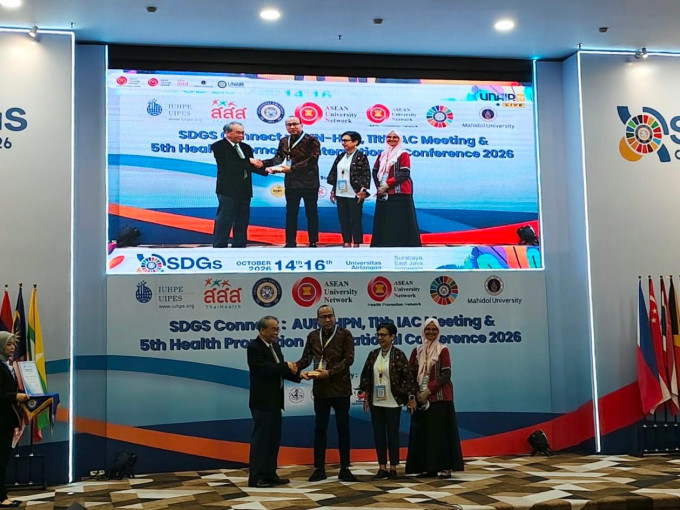
Universitas Gadjah Mada (UGM) has once again retained its Five Star Plus rating in the 2025 Healthy University Rating System (HURS), organized by the ASEAN University Network–Health Promotion Network (AUN-HPN). Presented at the 2025 HURS Awarding Ceremony on October 14, 2026, at Universitas Airlangga in Surabaya. This achievement recognizes UGM’s commitment to a campus environment that supports the health and well-being of its academic community.
UGM’s 2026 Health Promoting University (HPU) Team Chair, Professor Fatwa Sari Tetra Dewi, explained that the rating reflects the collective efforts of the entire university community.
“This achievement is certainly the result of the commitment of both university leaders and the entire UGM academic community, including students, lecturers, educational staff, faculties, schools, and work units that have implemented health and health promotion initiatives effectively in their respective environments,” Professor Fatwa said on Monday (Oct. 19).
Policy support and commitment from university and faculty leadership are among UGM’s strengths in the HURS assessment. This encourages faculties and work units to develop tailored health programs.
Nevertheless, the assessment also identified several areas that require improvement, particularly road safety, violence prevention, and a free environment from addictive substances and behaviors, including smoking, drug use, and alcohol consumption. These provide a basis for the HPU Team to strengthen health promotion programs across campus.
“The HURS system also highlights areas where improvements are needed, particularly road safety,” she explained.

In terms of road safety, UGM is working on education and coordination with relevant units, including Occupational Safety, Health, and Environment (K5L). Aim to create a safer campus environment for road users.
Meanwhile, the prevention of violence, bullying, and harassment continues to be promoted through education to foster an environment that respects diversity and is inclusive of people with disabilities. Health promotion initiatives need an environment that enables members of the academic community to adopt healthy behaviors in their daily lives.
“We hope to make the campus environment safer and further improve road safety,” she said.
Through its 2026 HPU program, UGM is also strengthening health promotion and disease prevention initiatives to support the physical health of its academic community. One initiative involves educating campus canteen food providers about healthy eating through modules and guidelines.
Safe spaces for physical activity, along with strengthened early detection of noncommunicable diseases through Integrated Development Posts (Posbindu) and regular health screenings for lecturers and educational staff, are important. These are expected to build healthy lifestyle habits while improving access to well-being-supportive environments.
“Our main focus is to raise awareness, encourage healthy habits, and create an environment that makes it easier for people to engage in activities that support a healthy lifestyle,” she said.

In mental health, UGM is developing support initiatives through the Lintang chatbot for mental health screening, mental well-being awareness campaigns, and the strengthening of peer support networks within faculties. Members of the academic community who need further assistance can access these services through the referral system.
These services need to be strengthened to reduce stigma so that campus community members feel more comfortable. Mental health programs are also part of the HPU approach to creating a campus environment that supports the well-being of the university community.
“Peer support initiatives are already working quite well in many faculties, and we will continue to strengthen them,” she said.
HPU initiatives across UGM involve university-level policies and initiatives developed by individual faculties, schools, and work units. The UGM HPU Team has nine working groups, while each faculty has designated personnel responsible for developing programs that address its specific needs. Regular coordination, the exchange of good practices, and collaboration between faculties are integral to expanding these programs.
One example is the implementation of physical activity programs and Posbindu services involving several faculties within the health sciences cluster, including group exercise sessions organized on a rotating monthly basis.
“We do not require every faculty to implement the same programs because each faculty is best placed to understand its own programs and needs,” Fatwa explained.
To assess the impact more accurately, the UGM HPU Team is also strengthening the collection of health and behavioral data from the academic community. This includes surveys with a more representative range of respondents, including students, lecturers, and educational staff from various units.
The findings will inform evaluations of existing initiatives and the development of programs that better address the needs of the campus community. Health screening data may also support these evaluations, provided its use has a legitimate basis, confidentiality is maintained, and analyses are conducted using aggregated data.
“We hope for high participation across the academic community so that we can better understand the issues and assess the impact of our programs,” she said.

Promoting healthier lifestyles faces challenges, including established habits and environments that do not always support healthy choices. The availability and affordability of healthy food, safe places for physical activity, and access to mental health services remain key issues that require continued attention.
In a university environment with diverse needs across its academic community, programs must be reviewed and adjusted regularly to ensure implemented policies remain grounded in reality. Feedback from students, lecturers, and educational staff is essential to improving both programs and the campus environment.
“We need input from the entire academic community to improve our policies, programs, and environment so that they can support healthier behavioral changes and make healthy living part of our campus culture,” she said.
Looking ahead, the UGM HPU Team aims to make healthy living an increasingly important need and an established culture across the university community. Expected to be reflected in the effective use of health services and improvements in health indicators that can be monitored regularly. One expected indicator is a reduction in sick leave among students and educational staff, though progress toward this goal will need to be evaluated using data.
UGM also seeks to expand the HPU program’s contribution so that it can serve as a reference and partner for other higher education institutions at both the national and regional levels.
“We hope that HPU activities at UGM will not stop at UGM but will also grow and develop at other universities,” she concluded.
Author: Triya Andriyani
Post-editor: Jasmine Ferdian
Photo: Donnie