


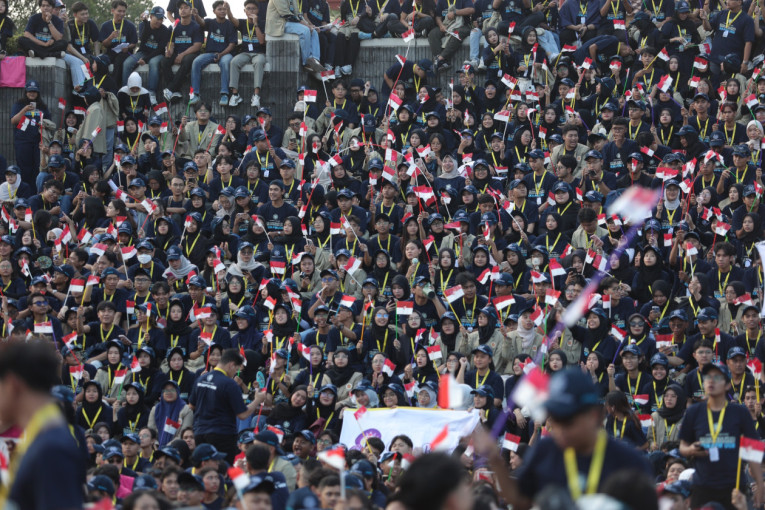
Universitas Gadjah Mada (UGM) has officially deployed 8,178 students for the 2026 Period II Community Service Program (KKN-PPM). The deployment ceremony, held at Pancasila Field on Friday (June 19), marked the beginning of the students’ 50-day community service assignments in various regions across Indonesia, running from June 20 to August 8, 2026.
The KKN-PPM participants will be assigned to 298 units located across 274 sub-districts, 132 regencies/cities, and 32 provinces throughout Indonesia. During the program, students will be guided by 324 Field Supervisors and Regional Coordinators and supported by 199 partners from the central government, local governments, businesses, industries, community organizations, and UGM’s alumni network.
UGM Rector Professor Ova Emilia stated that KKN-PPM serves as both a learning platform and a space for students to make meaningful contributions to society.
“This event is not merely a send-off ceremony, but a gathering point for our shared spirit and commitment to building the nation through community empowerment. For approximately 50 days, students will live with communities, work alongside communities, and learn directly from communities,” she said.
Professor Ova Emilia also reminded students to maintain their health and safety, and the university’s reputation, throughout their service at their respective locations.
“I am confident that you will implement programs capable of addressing community challenges and creating positive change, particularly in advancing food sovereignty and sustainable environmental management,” she said.
At the same event, Indonesia’s Deputy Minister of Industry, Faisol Riza, S.S., M.A., who attended the deployment ceremony, commended UGM’s consistency in maintaining strong connections between the university and society through KKN. According to him, students play a strategic role in supporting the government’s current village industrialization agenda.
“Villages possess enormous potential, whether in natural resources, human resources, or social networks. However, these potentials must be woven into productive economic strength through industry. I hope UGM KKN-PPM students can contribute ideas, innovation, and tangible actions to develop Small and Medium Industry (IKM) centers across various regions,” he said.
Meanwhile, UGM Vice Rector for Student Affairs, Community Service, and Alumni, Dr. Arie Sudjito, S.Sos., M.Si., emphasized that KKN-PPM is a concrete manifestation of the Tri Dharma of Higher Education and a learning opportunity for students to understand social realities firsthand.
“KKN-PPM is not merely an academic requirement but an authentic opportunity to learn from communities. Students are expected to develop social empathy, work with communities to create solutions, and contribute to food security, human resource development, local economic strengthening, and sustainable environmental management,” he said.
This year, UGM’s KKN-PPM carries the theme, “Pemberdayaan Masyarakat dalam Mewujudkan Ketahanan Pangan dan Menghadapi Perubahan Iklim melalui KKN-PPM UGM.” (Community Empowerment in Achieving Food Security and Addressing Climate Change through UGM KKN-PPM.) The theme is reflected in a wide range of community empowerment initiatives, including strengthening food security, developing MSMEs, environmental management, community-based tourism development, stunting prevention, and the application of appropriate technology and digitalization.
This spirit of service is reflected in the various KKN-PPM teams assigned to frontier, outermost, and underdeveloped (3T) regions, including Papua. One of them is the Raja Ampat Begisah KKN-PPM Team, which will serve in the villages of Samati and Waim, Raja Ampat Regency, Southwest Papua. Rizki Abdillah, the unit coordinator from UGM’s Faculty of Psychology (Psychology UGM), explained that his team has designed several flagship programs based on the local potential of coastal communities.
“We will assist fishing communities through simple financial record-keeping training, fisheries marketing development, and the continuation of fish-processing initiatives into value-added products such as fish nuggets, which were first introduced by previous KKN-PPM teams,” he said.
In addition, the team is developing innovations in mangrove utilization by producing mangrove tea as a community-based creative economic product. In the environmental sector, they are collaborating with international and national environmental organizations to collect water samples and assess the quality of water used by local residents.
“We want to ensure the quality of the water consumed by the community because some water sources still appear cloudy even after being boiled before use,” Rizki explained.
Although the team initially faced funding challenges after not receiving a competitive grant, the Raja Ampat Begisah team successfully secured support from several partners, enabling them to continue their service program in the region.
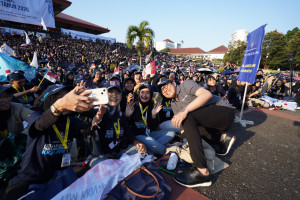
Meanwhile, the Biak Elok KKN-PPM Team, which will serve in Saribra Village, Bromsi Island, Aimando District, Biak Numfor Regency, Papua, is carrying out community empowerment programs focused on strengthening local economies, participatory tourism, and green infrastructure.
Team leader Sarasvati Baktiantoro from the Cultural Anthropology Study Program at UGM’s Faculty of Cultural Sciences (FIB UGM) said that their assignment location is a new area that has never previously hosted a UGM KKN-PPM team.
“We will focus on community empowerment through strengthening MSMEs, community-based tourism, and enhancing the capacity of coastal communities, most of whom work as fishers,” she said.
The Biak Elok team has been preparing for its deployment since September of last year, including building funding partnerships with various organizations and companies. According to Sarasvati, serving in the island communities of Papua is a valuable opportunity to share knowledge while learning directly from local residents.
“We want to bring the knowledge we have gained during our studies to benefit the community. At the same time, we also want to learn from the lived experiences and local wisdom of the people there,” she said.
Through the deployment of the 2026 Period II KKN-PPM program, UGM hopes that students will become agents of change, integrating knowledge, innovation, and collaboration to address community development challenges. More importantly, the KKN-PPM program is expected to further strengthen UGM’s role as a people-centered university that grows alongside Indonesian society.
“To all students, depart safely and return safely. Take care of yourselves, take care of your friends, and nurture your relationships with the communities you serve. Learn together with the people, because there is a wealth of knowledge that cannot always be found in the classroom,” Dr. Arie Sudjito said.
Author: Jelita Agustine
Editor: Gusti Grehenson
Post-Editor: Zabrina Kumara
Photos: Firsto and Donnie