


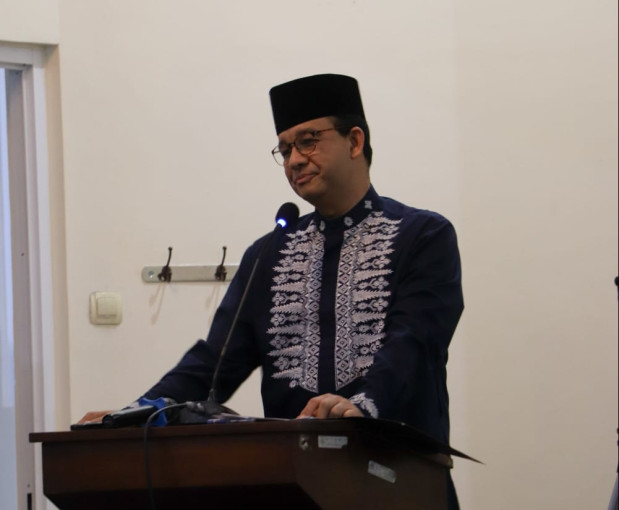
In an era of information abundance, the greatest challenge for modern society is no longer limited access to texts but the shallowness in interpreting reality. This discussion emerged during a tarawih sermon delivered by former Jakarta governor Anies Rasyid Baswedan at Masjid Al Hayat, Faculty of Biology, Universitas Gadjah Mada (Biology UGM).
Anies emphasized that Indonesia’s main problem today is not a lack of information but a crisis of clarity in how people process it. He presented an analysis that divides illiteracy into two categories. The first consists of those who are illiterate, as they cannot read texts. The second includes those who read written words fluently but fail to read reality.
“As a result, many leaders fail to formulate policies. They even fail to hear the cries of the people,” he said on Wednesday evening (Mar. 4).
Anies stressed that Islam inspires humanity to build civilization by first understanding.
“Humans are asked to become khalifah, but that message begins with an invitation to observe and read with clarity,” he explained.
He further encouraged the congregation to broaden the meaning of Iqra beyond textual literacy. In his view, Iqra should be positioned as an instrument for sharpening empathy and moral awareness when observing circumstances.
Within the university context, this responsibility becomes even greater. According to him, students are given the opportunity to think critically as they test ideas and express their views clearly and courageously.
“Campus should be the home for questions, not a factory of compliance. Campuses must become space for experimentation, not warehouse storing past knowledge. Therefore, the people within must not merely memorize. If learning is limited to memorization, then the spirit of Iqra has not yet come alive,” he said.
Anies explained that the Iqra command for young people represents a major opportunity to transcend their time. He encouraged students to practice Iqra by capturing social phenomena so they can produce ideas relevant to global change. For him, the critical capacity of young people is the key to innovation.
“Young people look toward the future, bringing new perspectives and questions,” he emphasized.
In a broader context, the former Rector of Paramadina University (2007–2015) illustrated that Iqra is not merely about reading letters but about understanding social realities, especially those experienced by ordinary people.
“Do not read poverty, backwardness, and inequality from the space of a press conference. Instead, read them from family kitchens, from queues for medical treatment, and from the anxiety of parents waiting for opportunities for their children to attend school,” he stressed.
Author: Aldi Firmansyah
Editor: Gusti Grehenson
Post-editor: Jasmine Ferdian
Photo: Documentation of the Muslim Biology Students Congregation