


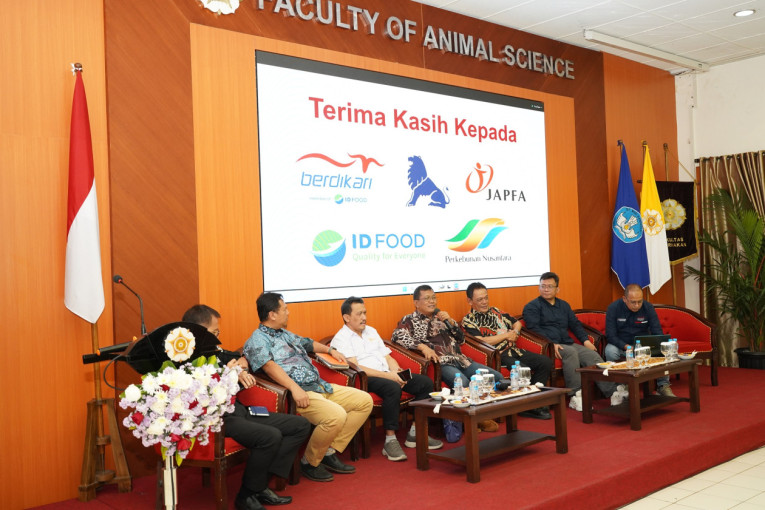
The rising demand for chicken meat and eggs, partly driven by the government’s Free Nutritious Meal (MBG) program, has positioned both commodities among the contributors to regional inflation. Responding to this development, the Faculty of Animal Science, Universitas Gadjah Mada (Animal Science UGM), held a Poultry Livestock Forum on Saturday (Nov. 22) at the drh. R. Soepardjo Auditorium under the theme “Transforming the National Poultry Sector: Optimizing the IDR 20 Trillion Budget to Achieve Food Self-Sufficiency.”
Director General of Livestock and Animal Health at the Indonesian Ministry of Agriculture, Dr. Agung Suganda, served as the keynote speaker and presented national policy directions for modernising and integrating Indonesia’s poultry sector through budget management.
He emphasized the importance of ensuring a consistent national supply, strengthening the animal health system, and establishing integrated poultry ecosystems across various regions.
Dr. Suganda reported that national poultry production in 2024 recorded a surplus.
“Egg production reached 6.2 million tons, while demand was 6.03 million tons, leaving a surplus of 0.17 million tons. For chicken meat, production amounted to 4.03 million tons against a demand of 3.72 million tons, resulting in a surplus of 0.31 million tons,” he explained.

He further stated that the MBG program requires an annual supply of 0.7 million tons of eggs and 1.1 million tons of chicken meat.
To support this demand, the government has prepared an integrated poultry downstreaming program to be implemented by state-owned enterprises with an investment of IDR 20 trillion, complemented by livestock-based People’s Business Credit (KUR) worth IDR 50 trillion with a low interest rate of 3%.
The government aims to develop 323 poultry industry facilities in 29 provinces outside Java.
These facilities will include feed mills, modern poultry houses, slaughterhouses, cold storage units, processing plants, and vaccine production facilities.
“We hope that every island will eventually be self-sufficient in protein production, enabling Indonesia to achieve self-reliance in egg and chicken meat supply,” Dr. Suganda said.
After presentation, the forum continued with a panel discussion featuring six leaders from major poultry organizations and industries: the President Director of ID Food, the President Director of Berdikari, the Chairperson of the Indonesian Poultry Breeding Companies Association, the Chairperson of the Indonesian Feed Producers Association, the Chairperson of the Garda National Poultry Farmers Organization, and the Chairperson of the National Poultry Farmers Association.
The discussion explored strategic issues, including collaboration among state-owned enterprises, private companies, and farmers; the development of poultry production centers; industry challenges; equitable partnership models; and opportunities to leverage digitalization to improve efficiency in the poultry sector.
Dean of Animal Science UGM, Professor Budi Guntoro, stated that the forum was attended by 125 participants, including farmers, academics, government officials, and industry players.
He noted that the event served as a strategic platform to identify opportunities and challenges in integrating chicken farming, supported by substantial government funding.
“We also hope the forum will generate constructive recommendations for policies, investments, and farmer institutional strengthening, while at the same time encouraging collaboration among academics, government, industry, and farmers,” Dean Guntoro said.
Author: Hanifah
Editor: Triya Andriyani
Post-editor: Lintang Andwyna
Photographs: Animal Science UGM