


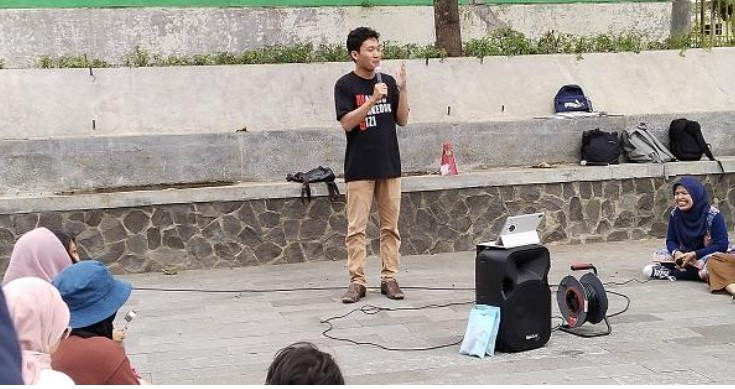
The trend of young people participating in protest actions over national conditions is increasing. Most of them from Generation Z voice sharp criticism of socio-economic issues, inequality, corruption, and nepotism.
One example is the Chair of the Student Executive Board (BEM) of Universitas Gadjah Mada (UGM), Tiyo Ardianto, who criticized the Makan Bergizi Gratis (MBG/Free Nutritious Meals) program for allegedly violating the constitution by diverting funds from the education budget, which amounts to more than Rp200 trillion.
A lecturer at the UGM Faculty of Psychology (Psychology UGM), Dr. Wenty Marina Minza, considers the growing critical attitude among young people to be natural. Major societal changes are often initiated by younger generations, particularly during their productive years, when rapid cognitive, moral, and social development occurs.
“These conditions make them more sensitive to surrounding issues while beginning to question authority, justice, and ethics,” she explained on Thursday (Feb. 26).
Wenty further explained that this phenomenon is influenced by power relations. Socially, the status quo often provides comfort for older generations but not necessarily for the young. Cultural reproduction processes become a primary driver of change, especially those that reject the values and norms of older generations.
“Therefore, various protests are part of young people’s efforts to resist systems built by previous generations,” she said.
Wenty observed that youth protests are largely driven by “crisis” conditions across social, economic, cultural, and political domains that directly affect young people’s lives. Currently, many issues in Indonesia have clear direct or indirect impacts on youth, such as the use of state budgets for programs whose implementation and outcomes remain questionable. At the same time, government responses are often perceived as insensitive to public conditions, including unclear handling of disaster emergencies and other issues.
She added that one of the most influential issues for young people concerns opportunities for a decent livelihood. This includes not only access to the labor market but also education, whose direction and quality are often questioned. Even access to the labor market has become increasingly difficult for youth. Beyond that, young people still face significant pressure to complete normative life transitions, such as securing employment and marriage “on time”.
“How can young people navigate these normative transitions under such conditions?” she asked.
Easy access to information, especially through social media, has increased public awareness of ongoing issues. According to Wenty, “collective protests” expressed by youth on social media can motivate others to join protest actions. Social media has become a platform for political activism among young people.
“Besides being physically safer than street demonstrations, social media also makes it easier for young people to express their opinions,” she explained.
Wenty stated that political activism can have positive or negative impacts depending on how young people adapt to its processes and consequences. For youth, political activism is not only about protesting a system or policy but also a space for learning, forming friendships, and building networks. It can also serve as a medium for voicing concerns. However, she noted that political activism carries risks for mental health.
“Political activism involves risks, including pressure from various parties, whether from those being protested or from fellow social media users,” she said.
In closing, Wenty explained that disappointing socio-political conditions can affect psychological well-being. Possible symptoms include feelings of distrust, sadness, helplessness, shame, and others. Political disappointment may also lead to avoidance behaviors.
“Individuals may avoid political matters to prevent further disappointment, or conversely become angry and actively oppose the source of that disappointment,” she concluded.
Author: Fatihah Salwa Rasyid
Editor: Gusti Grehenson
Post-editor: Rajendra Arya
Photo: Tribunjogja