


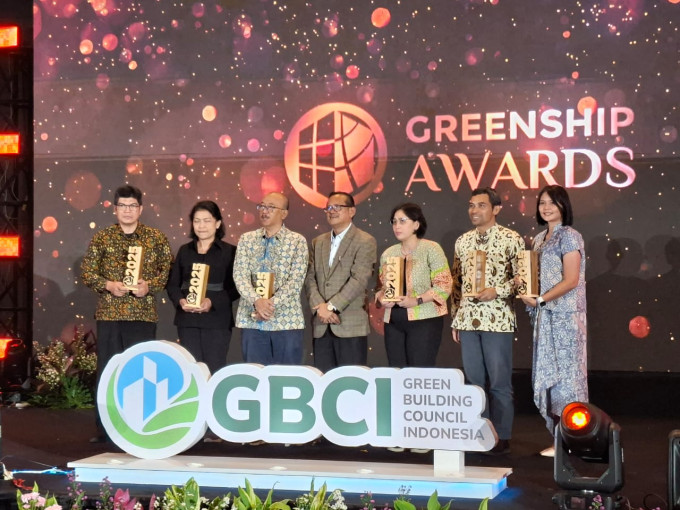
The CLT Nusantara Pavilion, an eco-friendly wooden house developed by a research team led by Professor Ali Awaludin of the Faculty of Engineering, Universitas Gadjah Mada (FT UGM), in collaboration with industry partners, has officially been selected as one of three recipients of the Best Greenship Innovation Award at the 2025 Greenship Awards. The awards were organized by the Green Building Council Indonesia (GBCI) and held on Friday (Dec. 5).
The recognition was granted based on the building’s environmentally friendly design concept, which is considered a potential model for future low-emission, wood-based construction.
The award demonstrates Indonesia’s potential to develop timber-based construction models that have previously been more widely adopted in developed countries. The wooden house also symbolizes UGM’s commitment to promoting sustainability practices within the university environment.
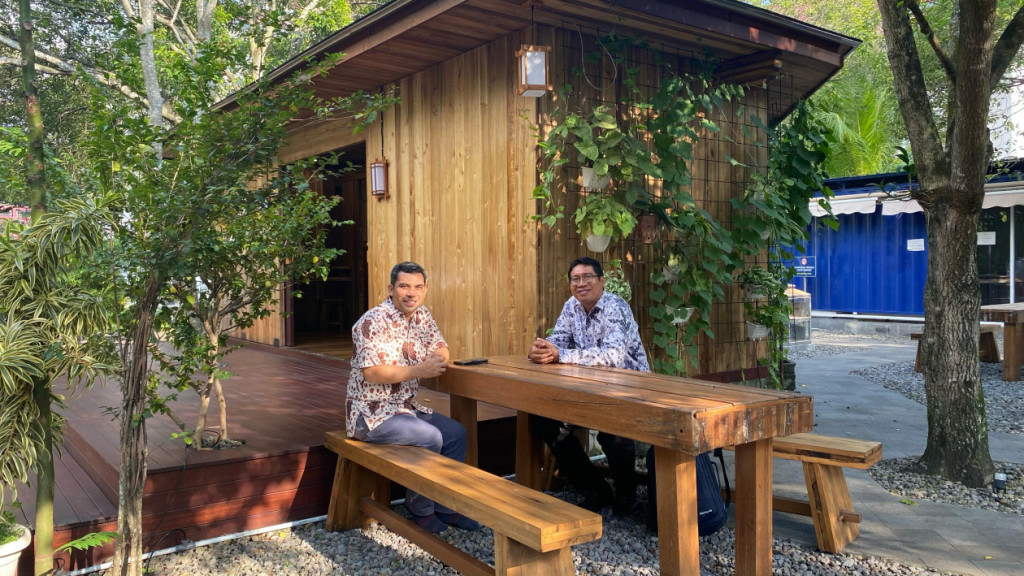
The prototype eco-friendly wooden building, known as the CLT Nusantara Pavilion, stands at the Manufacturing Park of FT UGM and has been visited by partners from five continents. The pavilion serves as a tangible example of the integration of timber technology, solar energy, and smart technology within a single structure.
Since its inauguration by the Dean of FT UGM, Professor Selo, on August 23, 2024, the CLT Pavilion has attracted significant attention from researchers, academics, and international guests.
“This pavilion does not only function as a meeting space or showcase room, but also as a laboratory for various sustainable construction innovations,” Professor Awaludin told reporters on Monday (Dec. 8) at UGM.
Professor Awaludin outlined several innovative aspects of the pavilion, including the use of local materials such as acacia wood, solar panels as an energy source, a smart lighting system, and an IoT-based smart garden that supports zero-emission principles.
The head of the Kedaireka research team explained that acacia wood was chosen as the primary material because it is a fast-growing, strong, and fungus-resistant tree species.
He added that the Cross-Laminated Timber (CLT) technology applied in the pavilion has been adapted through reverse engineering to suit Indonesia’s climate and material conditions. The CLT technology is also used as a locally developed jointing component for the relatively slender acacia wood structures.
The collaborative research conducted by UGM, ITB, and Polman Bandung began with experiments using adhesive tape and acacia wood, which later evolved into a national-scale project.
Nevertheless, the award recipient emphasized that the primary aim of the CLT Pavilion is not mass housing but rather its use as an educational building or public space, such as elementary and junior high schools and learning facilities.
“We designed this concept mainly as a learning area, so that younger generations can directly observe how ecological materials are applied in construction and see firsthand the practical implementation of the theories they study,” he said.
He also noted that the project aligns with Indonesia’s zero-emission target for 2026, which can be achieved through planned reforestation efforts.
From a technical perspective, Professor Awaludin explained that this recycled material-based innovation offers advantages such as shock-resistant structural performance, carbon storage capacity, and efficient maintenance.
He added that wooden buildings can, in fact, last longer when properly maintained.
“It is sufficient to ensure that the wood remains dry and does not become damp. Maintenance is simple, just polish it if it looks dull and reapply the coating twice a year,” he explained.
For Professor Awaludin, the CLT Nusantara Pavilion serves as a collaborative platform for academics, government, and industry to promote the adoption of green construction. He hopes that UGM will soon implement this innovation more broadly to inspire other universities in Indonesia.
He cited several universities, such as the University of British Columbia (UBC) in Vancouver and Nanyang Technological University (NTU) in Singapore, which have already constructed multi-storey timber buildings.
The success of the CLT Nusantara Pavilion in winning the Best Greenship Innovation Award signals that the path toward a greener construction future in Indonesia is increasingly open.
“UGM and Indonesia have the potential to become role models in initiating sustainable building concepts,” he concluded.
Author: Ika Agustine
Editor: Gusti Grehenson
Post-editor: Rajendra Arya
Photographs: FT UGM