


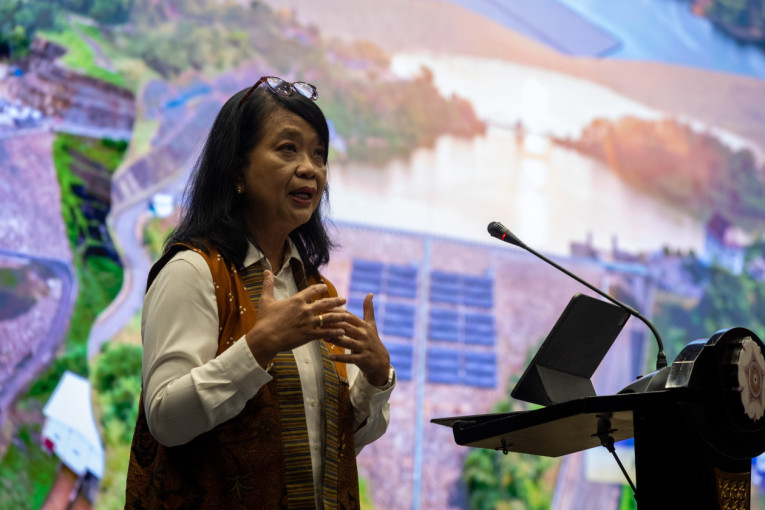
The Energy Center Student Community (Kamase) of the Unversitas Gadjah Mada’s Faculty of Engineering (FT UGM) held the IDENERGI National Seminar and Talk Show, titled “RECHARGE: Recharge Today, Power Tomorrow,” at the Smart and Green Learning Center (SGLC), FT UGM, on Monday (Nov. 23). Held to commemorate the 25th anniversary (fifth lustrum) of Kamase UGM, the forum brought together policymakers, academics, industry practitioners, and students to strengthen collaboration in advancing sustainable infrastructure development and achieving the 2060 Net Zero Emissions (NZE) target.
As the keynote speaker, Deputy Minister of Public Works of the Republic of Indonesia Diana Kusumastuti highlighted the urgency of accelerating the energy transition amid the threats of the global climate crisis and rapid urbanization.
She explained that urban areas, which account for only three percent of the world’s land area, consume 75 percent of global energy and generate 70 percent of greenhouse gas emissions. Meanwhile, the building construction sector accounts for 37 percent of global carbon dioxide emissions.
“Climate change requires us to strengthen resilience and transform the way we build and manage energy. The transition to renewable energy is not merely an environmental issue; it is also part of efforts to strengthen energy security and maintain economic competitiveness,” Diana said.
Diana explained that the Ministry of Public Works is accelerating infrastructure decarbonization through four main measures: optimizing infrastructure assets, such as using dams for hydropower plants and floating solar power plants; developing waste-to-energy facilities; implementing Green Buildings (BGH) and Smart Buildings (BGC); and strengthening cross-sector collaboration.
She noted that transforming buildings into green and smart facilities not only reduces operational carbon emissions through energy efficiency and the use of the Internet of Things (IoT), but also addresses embodied carbon, from the selection of low-carbon materials to the construction process.
“The energy of the future begins with the infrastructure we build today. Achieving this requires collaboration among all stakeholders, from the government through regulations and green incentives, businesses through investment, universities through research, and students as drivers of innovation,” she emphasized.
Representing the UGM Rector, Vice Rector for Planning, Assets, and Information Systems Dr. Arief Setiawan Budi Nugroho expressed appreciation for Kamase UGM’s 25 years of sustained efforts to provide a platform for student innovation in conservation and renewable energy.
He reaffirmed UGM’s commitment to supporting the energy transition through its Tri-dharma of higher education, while also implementing the green campus concept through energy efficiency, environmental management, and environmentally friendly transportation.

“‘Recharge Today, Power Tomorrow’ is a highly relevant theme because what we learn and do today will become the driving force behind building the future. Students are not merely future users of technology; they are also prospective researchers, innovators, and leaders who will shape the direction of Indonesia’s development. Do not stop at discussion—turn ideas into tangible contributions to society,” Arief said.
Meanwhile, Dean of FT UGM, Professor Sarjiya, emphasized that energy conservation and efficiency in buildings are among the most practical energy transition measures in everyday life and offer relatively quick returns on investment compared with constructing new power plants.
He explained that efficiency measures can begin at the design stage through passive design concepts, without necessarily relying on expensive technologies.

Sarjiya also praised the self-sustaining Kamase UGM ecosystem, which has maintained strong networks across generations and established a foundation and independent business entities with the support of its alumni.
“The UGM Faculty of Engineering is ready to collaborate with and support the Ministry of Public Works in mainstreaming research and implementing building energy efficiency as part of the solution to national energy security,” he concluded.
In addition to the keynote presentation by the Deputy Minister of Public Works, the IDENERGI program featured a scientific address by Muhammad Ery Wijaya, Co-Founder and CEO of Lestari Advisors, as well as a panel discussion with energy industry practitioners from Medco E&P Indonesia, Atom8ai Pte Ltd, and PwC Indonesia.
Dr. Rachmawan Budiarto, a lecturer at the Department of Nuclear Engineering and Engineering Physics, FT UGM, moderated the discussion. The event concluded with a symbolic activity marking Kamase UGM’s continued commitment to sustainability and the presentation of awards to the winners of the HORIZON energy competition.
Author: Triya Andriyani
Post-Editor: Priyananda
Photo: Donnie