



Consumer loyalty is a crucial factor in the successful marketing of Micro, Small, and Medium-sized Enterprises (MSMEs) products. Therefore, business actors must implement quality standards in their products to meet market demands. This is especially critical for food and beverage products, where processing and quality control play vital roles in protecting public health and ensuring the sustainability of the national food industry.
Dr. Arifin Dwi Saputro, a lecturer at the Department of Food and Post-Harvest Engineering, Department of Agricultural and Biosystems Engineering, Faculty of Agricultural Technology at Universitas Gadjah Mada (FTP UGM), emphasized that to comply with food safety regulations, business actors must adhere to government-established rules.
These include sanitation requirements throughout the food chain, covering production, storage, distribution, and circulation, as well as the implementation of good food manufacturing practices.
“Food safety assurance involves producers, retailers, and the government. However, the party most responsible for food quality and safety is the producer,” he stated during the UMKM Class Series #24 talk show on Safe and Halal Food Processing, held at the Merapi Audio Visual Room, PDIN Building, Terban, Yogyakarta, on Thursday, Jun. 26, 2025.
He further explained that to ensure food products are high-quality, safe, and suitable for consumption, producers must meet the minimum requirements of Good Manufacturing Practices (GMP).
“Of course, it’s not just about proper food handling during production, but also includes waste management and sanitation. Written procedures are essential for every production process because GMP is the foundation for implementing HACCP (Hazard Analysis & Critical Control Point) and ISO 22000,” he added.
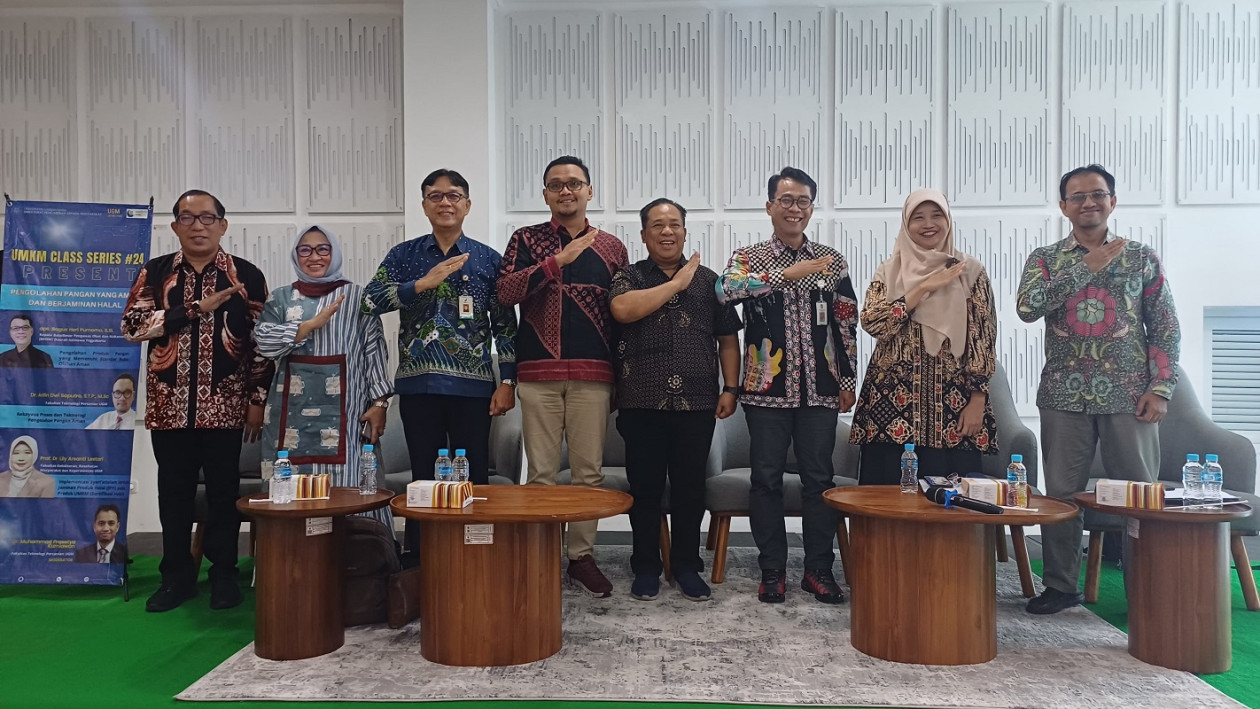
Meanwhile, Professor Lily Arsanti Lestari, a researcher from UGM’s Halal Inspection Agency, noted that in recent decades, awareness and demand for halal-certified products have grown exponentially, surpassing the geographic boundaries of Muslim-majority countries.
This trend is not only driven by the increasing global Muslim population but also by non-Muslim consumers who associate halal certification with food safety, hygiene, quality, and ethical production.
“It’s fascinating because the global halal market has become a significant economic force, projected to reach trillions of US dollars in the coming years,” said Professor Lestari.
Head of the Yogyakarta City Office for Industry, Cooperatives, and MSMEs, Tri Karyadi Riyanto Raharjo, expressed his appreciation for the entrepreneurship training provided to MSME actors, mainly as it was attended largely by women.
“Government agencies support efforts to improve community welfare. We hope the slogan ‘moving up a class’ is not merely a catchphrase, but translates into real action, and this UMKM series is one example of that,” he stated.
Dr. Djarot Heru Santosa, Secretary of UGM’s Directorate of Community Service, reaffirmed UGM’s commitment to supporting MSMEs in various ways, including through the organization of the UMKM series. He expressed hope that such programs will continue regularly.
“This time, the theme is particularly insightful and beneficial for MSME actors, especially regarding food processing and halal assurance,” he concluded.
Author: Agung Nugroho
Post-editor: Lintang Andwyna
Photographs: Freepik and DPKM UGM