


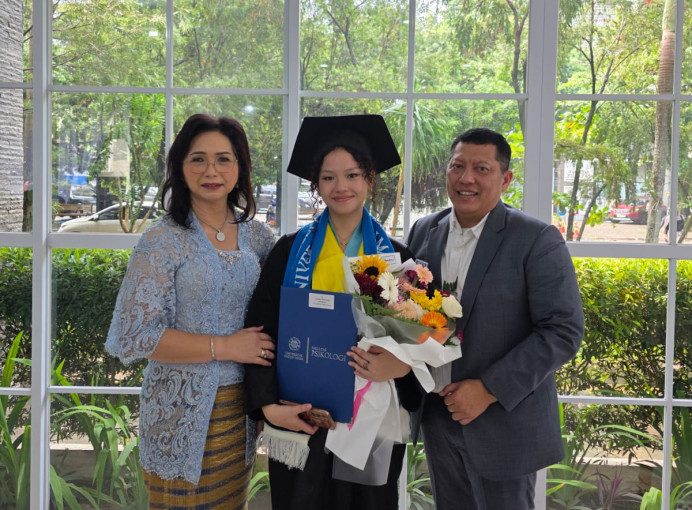
Amid the growing trend of live commerce that encourages impulsive shopping behavior, Nadya Marvella Santarini instead chose the phenomenon as the focus of her research to complete her studies in the Undergraduate Psychology Program at the Faculty of Psychology (Psychology UGM). Her interest in consumer behavior in the digital era led her to become the graduate with the shortest study period at this undergraduate commencement.
Nadya completed her education in 3 years, 4 months, and 1 day and officially graduated on Wednesday (May 21). Meanwhile, the average study period for the 1,644 undergraduate graduates in this commencement period was 3 years and 11 months.
In her undergraduate thesis titled The Role of Social Influence in Compulsive Buying on Live Commerce, Nadya examined how social influence shapes compulsive buying tendencies among live commerce users. Live commerce is a sales strategy that combines live streaming with online shopping features. Meanwhile, compulsive buying refers to uncontrolled shopping habits carried out as a coping mechanism for stress, anxiety, or negative emotions.
She employed a quantitative approach using a survey of more than 250 respondents and three instruments: the Bergen Shopping Addiction Scale (BSAS), Consumer Susceptibility to Interpersonal Influence (CSII), and Brief Self-Control Scale (BSCS). The research data were then analyzed using moderation analysis and multiple linear regression.
Nadya explained that her research stemmed from the rising trend of shopping via live broadcasts on digital platforms, which are heavily influenced by social interactions among hosts and fellow consumers. According to her, live commerce creates unique social pressures that can influence purchasing decisions.
“I examined whether the influence of other people, whether fellow consumers or hosts in live commerce, affects consumers’ tendency to engage in compulsive buying and whether self-control can moderate that effect,” Nadya said on Friday (May 22).
The findings showed that social influence contributes to compulsive buying behavior. Meanwhile, self-control was not proven to strengthen or weaken the relationship, although it still had a direct effect on compulsive buying behavior.
“What I found interesting from my research is that self-control can still serve as a negative predictor of compulsive buying behavior directly,” she explained.
Behind her success in completing her studies earlier than most, Nadya admitted that the thesis-writing process was far from easy. She described revisions as the biggest challenge, often causing students to lose motivation to continue working on their thesis. According to her, many students become mentally exhausted after repeated revisions and eventually lose the confidence to continue consultations with their supervisors.
“Many of my friends also got stuck because after revisions, they already felt exhausted, their self-esteem dropped, their confidence decreased, and eventually they became reluctant to continue,” she said.
Nevertheless, Nadya chose to change her perspective on revisions and supervision sessions. Instead of viewing revisions as obstacles, she turned them into motivation for self-improvement. She also tried to maintain active communication with her supervisors to establish a clear timeline for completing her thesis.
“I changed my perspective and reframed those obstacles into something that could help me. I see lecturers as guides who help me grow,” she said.

According to Nadya, having deadlines and timelines is an important factor in completing a thesis on time. She believes one reason students struggle with thesis writing is that there is often no binding timeline to keep them progressing consistently.
“One of the reasons why thesis writing feels difficult is that it always feels like it can wait until tomorrow. So having deadlines and timelines is really important to keep us moving,” she remarked.
During her studies, Nadya was also actively involved in various internship programs that enriched her experience and perspective as a psychology student. One of her most memorable experiences was interning at SLA Fredios, an advanced autism school in Seturan, Yogyakarta. There, she assisted students aged 12 to 54 in learning to live more independently through simple daily activities such as sweeping, playing music, and participating in group exercise sessions.
The experience deepened Nadya’s understanding of the challenges faced by people with autism and the importance of social support and accessibility for them. She admitted to feeling inspired by the dedication of the teachers who continued to accompany the students despite various limitations.
“I truly admire the people there because even though their work is extremely challenging, exhausting, underpaid, and sometimes dangerous, they stay because of their compassion,” she said.
In addition, Nadya also completed an internship at the Ministry of Marine Affairs and Fisheries under the Directorate General of Marine and Fisheries Resources Surveillance (PSDKP). During the program, she studied the psychological conditions of ship crews and listened directly to their concerns while working at sea for extended periods.
“There, I discovered the hidden challenges faced by ship crews. Even though they appear physically and mentally strong, they also experience fear, anxiety, and sadness that often go unnoticed,” she said.
Not only active in academics and professional experiences, but Nadya has also prepared for the next step in her educational journey. While writing her thesis, she applied to various master’s programs to motivate herself to continue growing. Her efforts paid off after she was accepted into the Master of Educational Psychology program at Victoria University of Wellington.
For Nadya, campus life offered opportunities to meet people from diverse cultural, ethnic, and academic backgrounds. The experience taught her to become a more open-minded, empathetic, and considerate person who values different perspectives.
“I used to feel comfortable only with people who were similar to me. But meeting people from many different backgrounds truly changed my perspective and made me more considerate, empathetic, and open-minded,” she said.
At the end of the interview, Nadya encouraged students not to focus solely on their field of study but also to explore new experiences throughout their university years. She also emphasized the importance of maintaining mental health and allowing time for rest amid academic demands.
“Rest is more important than you might think. Our brains work much better and more clearly after resting. So when you feel stressed by revisions or responsibilities, try to give yourself time to calm down. It’s not stopping, but restarting,” she concluded.
Author: Zabrina Kumara
Editor: Gusti Grehenson
Post-editor: Zabrina Kumara
Photo: Nadya Documentation