


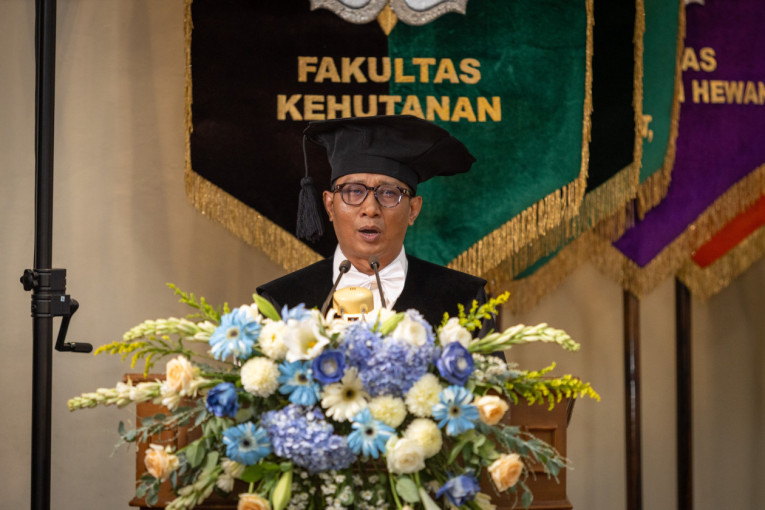
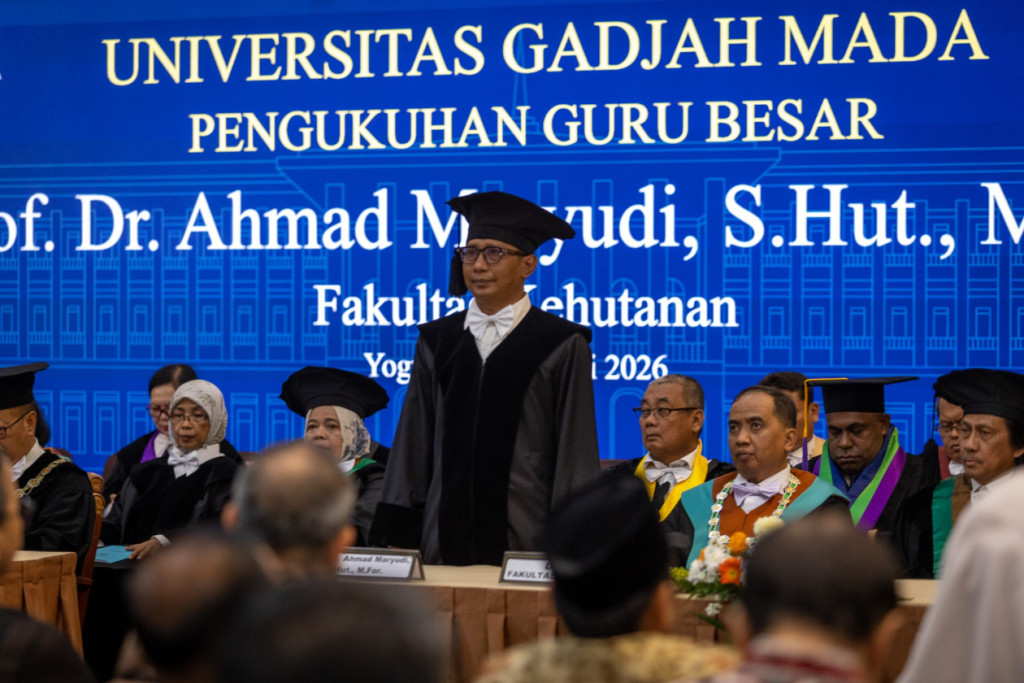
UGM Faculty of Forestry lecturer Professor Ahmad Maryudi was inaugurated as a Professor of Forest Policy at Universitas Gadjah Mada during a ceremony at the UGM Senate Hall on Thursday (July 16). In his inaugural speech, “Kebijakan Pengelolaan Hutan dalam Pusaran Politik Kepentingan” (Forest Management Policy in the Vortex of Political Interests), he argued that forest policy must be understood not only through scientific evidence but also through the political forces that shape it.
According to Chair of the UGM Professorial Board Professor Baiquni, Professor Maryudi is the university’s 543rd active professor and one of 19 active professors at the Faculty of Forestry, which has produced 33 professors in total.
Professor Maryudi opened his address by noting that forest policy is a relatively young discipline, having emerged around 50 years ago. At first, the field focused on formulating solutions and strategies for forestry problems — an early school of thought he described as forest science for policymaking.
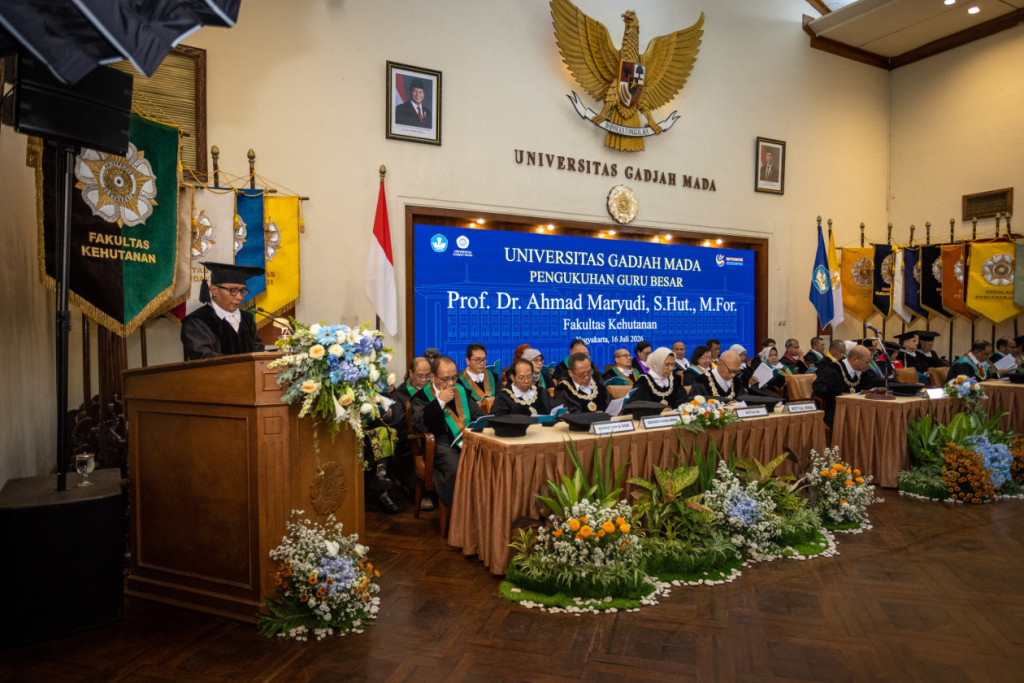
“Policy formulation relied primarily on pure forestry science, which was preoccupied with providing technocratic solutions without any grounding in policy science,” he said.
Ideally, Professor Maryudi noted, policymaking should be rooted in rigorous research — evidence-based policy that reflects the principle of good science for good policy. Yet his experience has shown that public policy does not always follow academic reasoning. In many cases, policies contradict scientific evidence and fail to deliver evidence-based outcomes.
The limits of the “science for policy” approach, he explained, gave rise to a new paradigm known as the “science of policy.” This perspective challenges the traditional technocratic mindset by focusing not only on hitting policy targets but also on understanding why policies fail and learning from those failures.
“This school of thought began to emerge in the 1990s and is built on understanding how politics operates within the policymaking process,” he explained.
The new paradigm, Professor Maryudi added, draws on interdisciplinary perspectives from the social sciences, political science, public policy, law, and even international relations. Over the past two decades, research on the socio-political dimensions of forestry has expanded significantly, establishing forest policy as a distinct subdiscipline — a convergence of forestry science and policy studies into a new field of forest policy scholarship.
Turning to the concept of forests, Professor Maryudi explained that foresters generally define them by ecological and silvicultural traits, such as vegetation associations within a particular landscape. Some stakeholders, however, narrow that definition to commercially valuable tree species alone, treating forests as mere “timber plantations.” For many Indigenous communities in Indonesia, by contrast, forests are seen as a mother that sustains life.
“It is equally possible for others to view forests simply as natural resources for generating enormous profits,” he remarked.
Amid growing global concern over climate change and its humanitarian consequences, Professor Maryudi said forests have increasingly become a source of collective hope. Beyond serving as ecological support systems, they are now also valued as recreational spaces where urban communities can escape the pressures of modern life. These varied perspectives, he argued, show that forest management policy never exists in a politically neutral space.
Forest policy in Indonesia, he continued, still leans heavily on a single interpretation of state control over forests. This approach tends to oversimplify the country’s diverse historical, social, and cultural contexts. He observed that while many policy instruments emphasize conservation, their overall coherence remains weak.
“Pressures from resource exploitation, unsustainable harvesting practices, ecological degradation, and tenure conflicts continue to outweigh efforts to build sustainable forest governance,” he said.
Drawing on the work of Max Krott (2005), Professor Maryudi argued that policymaking is fundamentally a process of social negotiation aimed at balancing competing interests, so the character of forest policy is shaped by the interplay among actors pursuing their own agendas. That, he stressed, is why science and policymaking must be integrated far more closely. One of academia’s greatest shortcomings, he said, is its failure to grasp the political logic of policymakers.
“Scientific knowledge must be championed, translated, and advocated so that decision-makers can understand and apply it,” he said.
Professor Maryudi closed with an emotional reflection, saying that standing at the university’s highest intellectual podium was the result of a long personal journey. He credited his achievement to unwavering faith and to the sacrifices of his mother, who did not finish elementary school, and his father, whose education ended at junior high.
His path, he said, shows that education is determined not by one’s background but by the courage to pursue aspirations beyond perceived limits.
“This professorship belongs to them. It is the quiet triumph of two people who never imagined standing in the highest academic space, or even dreamed that their child would one day attend university,” he said.
Author: Hanifah
Editor: Gusti Grehenson
Post-editor: Zabrina Kumara
Photo: Donnie