


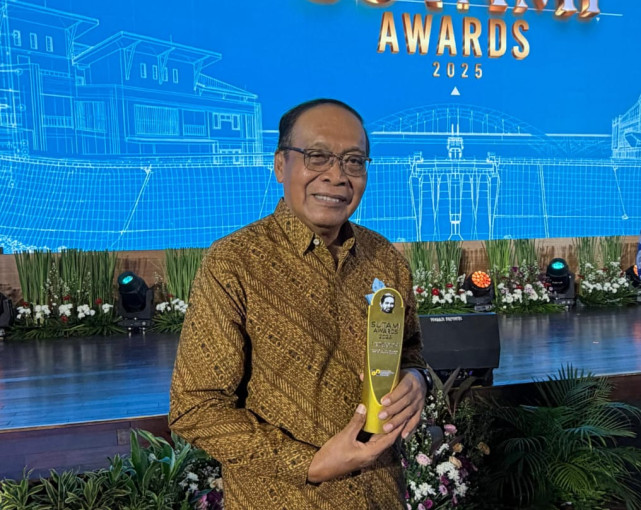
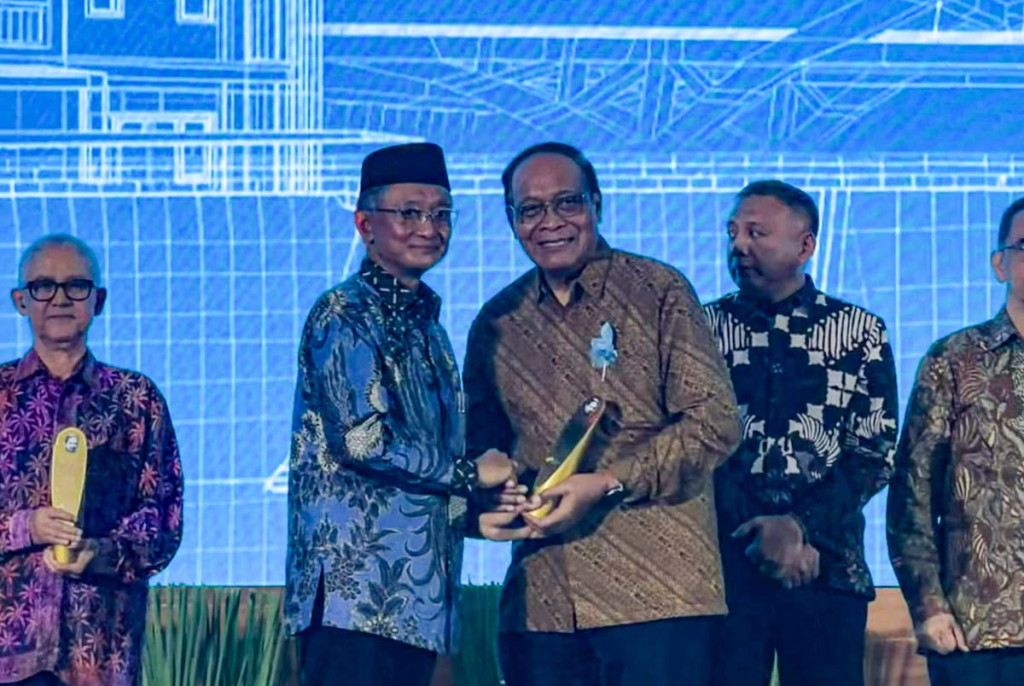
Universitas Gadjah Mada (UGM)’s expert in wetland management and development, Professor Budi Santosa Wignyosukarto, has received the 2025 Sutami Awards from the Ministry of Public Works at the 2025 Sutami Awards Appreciation Night held on Monday (Dec. 1) at the Ministry of Public Works Auditorium in Jakarta.
Professor Wignyosukarto is a lecturer from the Department of Civil and Environmental Engineering, UGM Faculty of Engineering (FT UGM), and the UGM Graduate School (SPs UGM).
He was named the winner in the academician category for his dedication as a wetland expert in the revitalisation of the former Mega Rice Project area.
The senior UGM academic’s expertise spans technical aspects, modelling, conservation, and environmental risk mitigation, making him one of the most frequently consulted experts in wetland rehabilitation and revitalisation programmes, including the former Mega Rice Project.
“I am certainly very pleased to receive the Sutami Award. It is a recognition of my long-standing contribution to wetland development. At a time when I have stepped back from academic activities, being invited to receive an award I never imagined is truly meaningful,” he said in an interview on Friday (Dec. 19).
Professor Wignyosukarto’s interest in the field began in 1974, when he was still a student, and he became involved in wetland development activities alongside his lecturers, Professors Hardjoso and Soenarjo.
At the time, he participated in field surveys for the Tidal Lowland Rice Development Project (P4S) across several regions in Kalimantan, including South, Central, West, and East Kalimantan.
“Back then, I observed river water level fluctuations during tidal cycles, assessed water and soil quality, and designed channels capable of draining rainwater,” he recalled.
This academic foundation led him to pursue further studies at IHE Delft, the Netherlands (1979–1980), in Land and Water Development, and later at INPG Grenoble, France (1982–1985), where he specialised in mathematical modelling of flow and water quality at the Sogreah hydraulic research institute.
His dissertation, entitled “A Study on the Dilution of Soil Leaching Products in Tidal Irrigation Networks,” has become an important reference for simulating the management of acidity and salinity in wetland areas.
When asked about the greatest challenges he faced as an academic, Professor Wignyosukarto explained that wetland development and management are highly complex endeavours.
This complexity arises from the interaction of multiple variables, including land resources such as peat, sand, and mineral soils; water resources encompassing river water, rainfall, and seawater intrusion; and human resources shaped by social, economic, and political factors.
According to him, the most significant challenges emerge when political decisions underpinning development policies are not grounded in adequate scientific knowledge and research.
In the early 1970s, when wetland studies were still developing, numerous problems were encountered, particularly design constraints in peatlands and wetlands with acid sulphate potential.
From these learning processes, various approaches and designs emerged that placed greater emphasis on the natural characteristics of wetland ecosystems.
One political decision that sparked considerable opposition at the time was the One Million Hectare Peatland Development Project (PLG) launched in 1996.
The project was based on the assumption that wetlands were synonymous with peatlands, whereas peat is only one component of wetland systems, alongside mineral soils formed from alluvial and marine deposits, as well as sand.
Based on this assumption, the PLG developed a macro-drainage network to channel river water into wetland areas for irrigation while simultaneously discharging wetland water into the delta.
This large-scale system encountered numerous problems because it attempted to resolve the complexity of wetland issues through a single, uniform approach.
In the early 2020s, Professor Wignyosukarto was also actively involved in efforts to revitalise the former Mega Rice Project area by introducing Smart Water Management in the Dadahup area of Central Kalimantan.
The 20,000-hectare area is managed using a polder system and equipped with water gates and telemetry devices to monitor water levels, pH, salinity, and rainfall online.
“We from the UGM Hydraulics Laboratory helped install telemetry equipment with sensors for water level elevation, water pH, salinity, and rainfall. These tools can be monitored online, supporting the operation of water gates and the monitoring of water quality in the area,” Professor Wignyosukarto explained.
In addition, Professor Wignyosukarto remains actively involved in supporting various wetland and environmental management initiatives, including collaboration with the South Sumatra Natural Resources Conservation Agency (BKSDA) on forest fire control studies at Padang Sugihan Wildlife Reserve, as well as with the Sulawesi III River Basin Authority on the planning of the Salugan Irrigation Area in Lampasio, Tolitoli Regency.
He hopes that academic research can help guide and, when necessary, correct policies that deviate from sound scientific principles. Many environmental challenges are shaped by social, economic, and political complexities that often stray from established academic frameworks.
“To address environmental problems, the involvement of academics is essential to advocate for knowledge that can guide improvements in life on this planet,” Professor Wignyosukarto concluded.
Author: Lintang Andwyna
Editor: Gusti Grehenson
Post-editor: Rajendra Arya
Photographs: Professor Budi Santosa Wignyosukarto